By Anan Shehadeh
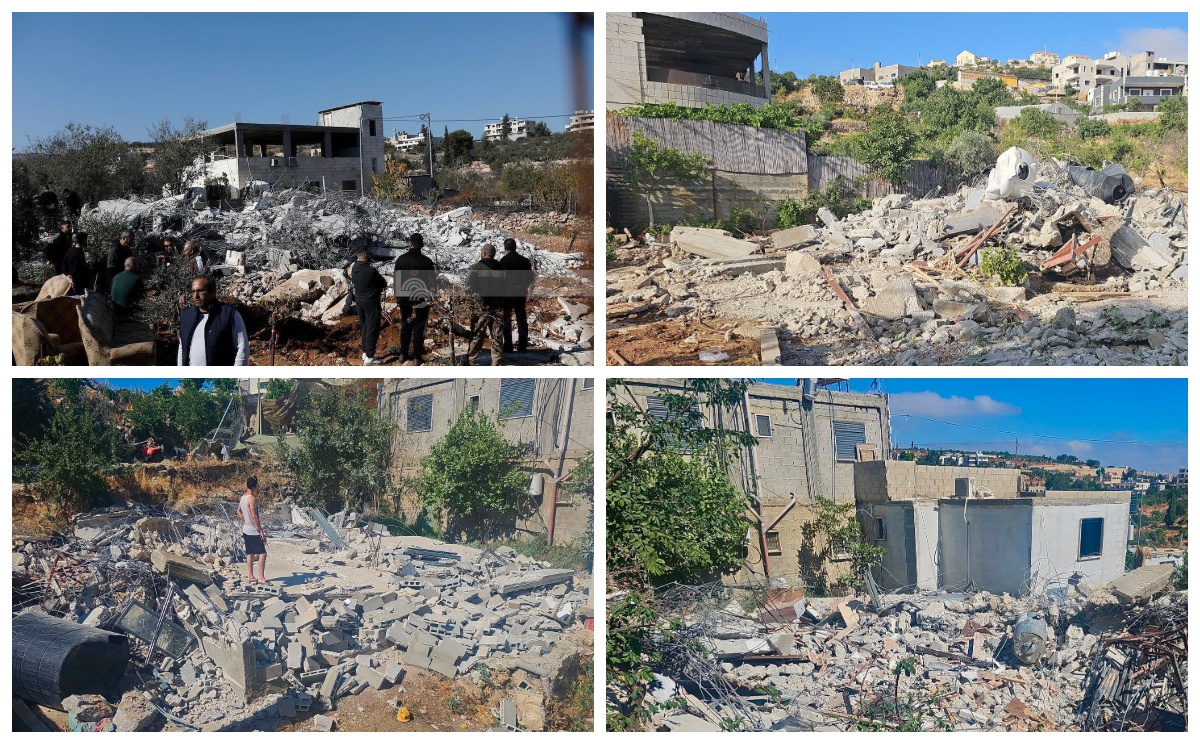
BETHLEHEM, July 17, 2026 (WAFA) – When Mohammad Adnan Sbeih, also known as Abu Amous, began building a home for his family, he believed years of sacrifice would finally provide the stability he had worked so hard to achieve. Instead, four years of continuous labor, decades of savings, and mounting debt were erased within hours when Israeli forces demolished the two-story house in September 2025.
Standing before the ruins of what was once his family's dream home in the town of Al-Khader, south of Bethlehem, Abu Amous looked across the debris and raised his hands in prayer, hoping for compensation after an unimaginable loss.
"With the demolition of the house, everything was gone," he said. "The house, with two floors of 270 square meters each, cost around 1.3 million shekels. I sold all of my wife's gold, spent everything I had saved over 20 years, used my son's savings, and even sold my old apartment to my brother. It is incredibly painful to watch your dream collapse before your eyes."
Despite losing the house, Abu Amous remains burdened with approximately 45,000 shekels in construction-related debt. Unable to remain without shelter, he was forced to repurchase the apartment he had previously sold, despite lacking the financial means to do so, further deepening his debt.
His experience is one of dozens in Al-Khader and hundreds across the occupied Palestinian territory, where home demolitions have left families without homes while imposing significant financial and emotional hardships.
Al-Khader has faced years of escalating Israeli measures, including home demolitions, stop-work orders, and demolition notices. At the same time, thousands of residents have been unable to access more than 20,000 dunums of agricultural land isolated behind Israel's separation barrier.
Israeli settlements established on land belonging to Al-Khader—including Efrat, Daniel, Elazar, and Sde Boaz, alongside several settlement outposts—have further reshaped the landscape surrounding the town.
Mahmoud Abdullah, a member of Al-Khader Municipality and head of its agricultural activities, described the town's situation as "disastrous," saying Israeli policies have intensified significantly since October 7, 2023.
According to Abdullah, movement restrictions have become increasingly severe, with entrances blocked by earth mounds, limiting residents' ability to move freely or reach their farmland.
He said authorities have also expanded demolition policies and construction restrictions in areas considered the town's last remaining urban extensions, while some residents have reportedly been forced to evacuate their homes under armed threats.
The impact has extended far beyond housing. Abdullah said approximately 5,000 dunums of farmland have been completely closed off, while access to remaining agricultural areas has become heavily restricted.
He added that eight iron gates have been installed along agricultural roads, access routes crossing Route 60 have been sealed, several natural springs have been damaged, and four water wells have been filled in.
The consequences have been reflected in agricultural production. Al-Khader has roughly 7,000 dunums planted with trees and had traditionally produced around 6,000 tons of grapes annually. Since October 2023, annual production has fallen to approximately 2,400 tons.
The decline has forced some farmers to purchase grapes and vine leaves from local markets despite previously being among the area's leading producers.
Among them is 82-year-old farmer Naeem Marzouq, who can no longer reach the agricultural land he cultivated for decades behind the separation barrier.
Marzouq said he once supplied produce to markets in Bethlehem, Ramallah, and Jerusalem. Today, however, he says he is prevented from entering his land and faces threats and attacks by Israeli settlers whenever he attempts to approach it, forcing him to turn back before setting foot on his fields.
For a farmer who spent decades relying on his harvest, buying grapes and vine leaves from the market has become a painful symbol of how dramatically life has changed.
Hassan Breijieh, an expert on Israel's separation barrier and settlement affairs, said developments in Al-Khader reflect a systematic policy aimed at reducing the Palestinian presence while expanding Israeli settlement activity.
He warned that several areas of the town face increasing risks of displacement, noting that Israeli authorities recently issued demolition and stop-work notices for 32 homes in Ard Al-Deir.
According to Breijieh, Route 60, which runs west of the town, threatens approximately 175 Palestinian families with displacement under allegations of unlicensed construction. He warned that implementing these plans would amount to forced displacement linked to settlement expansion.
Citing data from the Wall and Settlement Resistance Commission, Breijieh said there are around 350 Israeli settlement outposts across the occupied West Bank, including 39 in Bethlehem governorate. He argued that these outposts are strategically established to connect existing settlements, serve as launching points for attacks on nearby Palestinian communities, and facilitate the expansion of new settlements.
He added that since October 7, 2023, Israeli authorities have seized approximately 70,000 dunums of land across the occupied West Bank, including around 500 dunums in Bethlehem governorate, according to official figures.
For families like Abu Amous's, however, the broader statistics remain deeply personal. Behind every demolition order and every inaccessible field lies years of work, savings, and hopes that can disappear in a single day.
M.N