By Mohammad Dahman
GAZA, July 18, 2026 (WAFA) — Before the war, disposable cigarette lighters were among the cheapest everyday items in Gaza. Three could be bought for a single shekel (equal to $0.38), and once the fuel ran out, they were tossed away without a second thought.
Today, amid war, displacement, and a prolonged blockade, a single lighter can cost between 90 and 100 shekels. What was once disposable has become an essential household asset, giving rise to an entirely new trade: repairing and restoring broken lighters.
The transformation reflects how months of shortages have reshaped daily life across the Gaza Strip. As border crossings remain largely closed by Israeli occupation authorities and goods remain scarce, the struggle for survival has expanded far beyond food, water, and fuel. Even the simplest tool needed to ignite a cooking fire has become difficult to obtain.
With electricity unavailable to most displaced families and cooking gas in critically short supply, hundreds of thousands of people now rely on firewood and makeshift clay ovens to prepare meals and boil water. Without a functioning lighter, those basic tasks become nearly impossible.
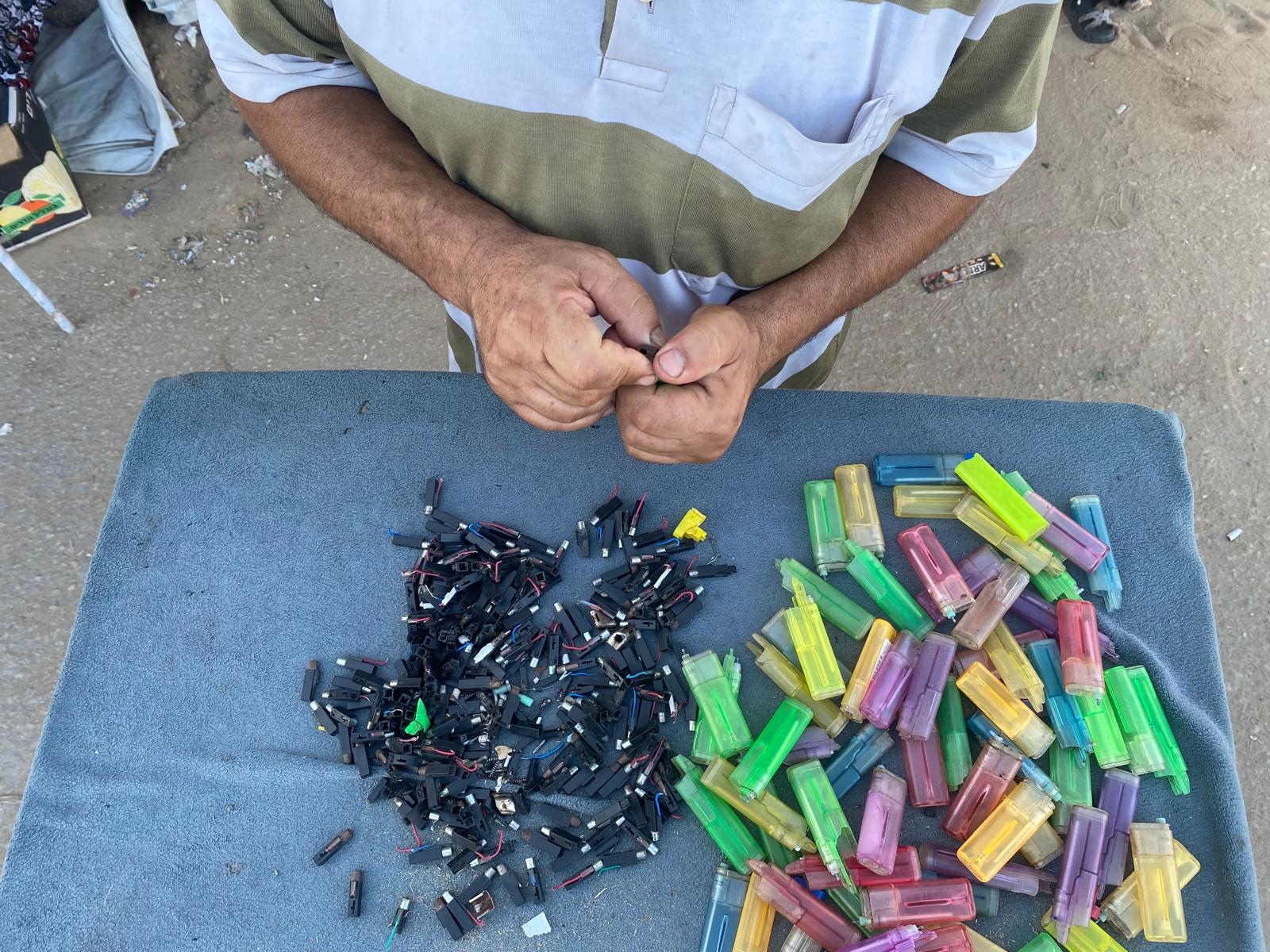
Inside a modest tent west of Khan Younis, 53-year-old displaced resident Abdul Rahman Abu Lebda, originally from Rafah, spends his days repairing broken lighters — a profession that did not exist in Gaza before the war.
He carefully dismantles damaged lighters, inspecting valves, flints, spark wheels, springs, and other tiny components. Broken parts are replaced with pieces salvaged from used lighters before each device is reassembled and tested.
Finding spare parts has become almost as difficult as the repairs themselves. Abu Labda buys used lighters for between 10 and 20 shekels simply to harvest usable components, while new ones now sell for nearly ten times that amount.
Another challenge is fuel. Gas specifically designed for refilling lighters is no longer available in Gaza, forcing him to refill them with cooking gas instead. Although it keeps the lighters working, he says it was never intended for that purpose and reduces their efficiency and lifespan.
Refilling a lighter costs five shekels (about $1.8), while replacing the ignition flint costs seven (equal to $2.4). Other repair costs vary depending on the damage, but they remain far cheaper than purchasing a replacement.
Demand for his services continues to grow as families repair the same lighter repeatedly rather than attempt to replace it.
For many displaced residents, a lighter has become as indispensable as the fire it creates.
Mohammed Abu Jamea, 62, whose home east of Khan Younis was destroyed and who now lives in a tent in Al-Mawasi, says obtaining a lighter can consume hours of his day.
Sometimes, he says, he walks from tent to tent for more than two hours searching for someone willing to lend one. Once a fire is lit, his family tries to keep it burning for as long as possible to cook meals, heat water, and prepare milk for children.
For Ibtisam Al-Agha, 39, a widow raising one son and three daughters after her husband was killed during the war, the lighter has become the most valuable tool in the clay oven she built to bake bread for fellow displaced families.
She saved money to buy one for nearly 90 shekels after growing uncomfortable waking neighbors before dawn to borrow theirs.
When other displaced residents learned she owned a lighter, they began borrowing it as well. Constant use caused it to break repeatedly, forcing her to pay for repairs each time rather than replace it.
Many families now visit her oven simply to light a piece of cardboard or wood before carrying the flame back to their own tents to cook.
Fatima Khalil, 36, a displaced mother of four from northern Gaza, says her family now protects its lighter more carefully than almost any other possession.
"There are days when the lighter feels more important than food," she says. "Without it, we cannot cook or heat water. If it breaks, we repair it. If that fails, we search from tent to tent because everyone is facing the same shortage."
The story of Gaza's disappearing lighters captures the wider transformation brought about by war. Reuse and repair, once associated mainly with furniture or household goods, now extend to one of the smallest objects in daily life.
A tool that was once discarded without hesitation has become a scarce commodity, shared among neighbors, repaired over and over again, and treated as an essential means of survival in a place where even the simplest necessities have become difficult to secure.
M.N