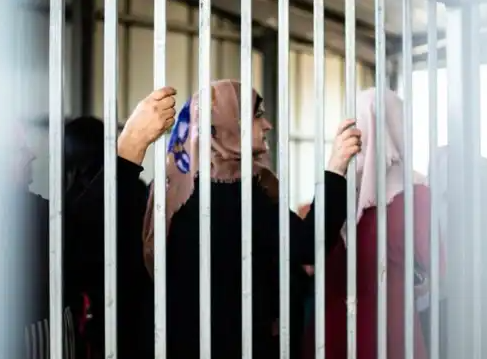
RAMALLAH, August 7, 2026 (WAFA) – The Palestinian Prisoner's Society (PPS) said on Friday that Israeli National Security Minister Itamar Ben-Gvir's decision to renew the ban on family visits to Palestinian detainees in Israeli prisons was not unexpected, but rather an extension of a systematic policy aimed at enforcing the complete isolation of detainees and turning prisons into closed environments where torture, starvation, slow killing, and concealment from the outside world can continue without oversight or accountability.
The Society said the policy provides the prison system with greater cover to continue committing the most serious violations against Palestinian detainees.
The PPS added that the renewed ban on family visits came shortly after the Israeli Supreme Court ruled that the continued prevention of visits by the International Committee of the Red Cross (ICRC) to Palestinian detainees was unlawful.
It said the ruling had no tangible impact on detainees’ conditions, as Israeli occupation authorities continued to entrench the policy of denial and isolation by preventing the ICRC from visiting Palestinian detainees and renewing the ban on family visits.
This, it said, is further confirmation that Israel’s various institutions operate under a unified policy aimed at creating an environment that ensures the continuation of crimes committed against Palestinian detainees, perpetuating their complete isolation from the outside world, preventing any effective oversight of their conditions, and giving the prison system greater scope to continue committing its crimes without accountability.
The Society stressed that the renewal of the order does not constitute an isolated measure, but rather represents another link in a broader system of retaliatory and punitive policies that the occupation has intensified since the start of the genocide, to completely isolate Palestinian detainees and give the prison authorities free rein to commit further crimes and violations that have reached unprecedented levels in the history of the Palestinian prisoners' movement.
The Society said that, since then, Israeli prisons have become an integrated system for the systematic use of torture, starvation, humiliation, deliberate medical neglect, sexual violence, enforced disappearance, and slow killing, and have become one of the main arenas for the daily and systematic perpetration of the crime of genocide against Palestinian detainees.
The PPS added that it recently held a series of meetings with ICRC teams in the occupied West Bank, during which it discussed the catastrophic consequences of disrupting the committee’s role since the start of the genocide, as well as observations submitted by relevant institutions regarding the serious decline in its ability to carry out its humanitarian mandate.
The Society said this comes amid systematic measures by the occupation authorities aimed at undermining the role of international institutions, foremost among them the International Committee of the Red Cross, and preventing them from accessing Palestinian detainees, thereby ensuring the continuation of crimes committed against them in the absence of any field monitoring or independent documentation.
The Society said that, during its recent meetings with the ICRC, it called on the committee to issue a clear and official position that would bring to the international community’s attention the fact that Israeli occupation authorities continue to prevent it from visiting Palestinian detainees despite the Israeli Supreme Court’s ruling.
It also called on the committee to openly disclose the obstacles and measures imposed by the occupation that hinder its ability to carry out its humanitarian mandate, and to clearly state that families of detainees continue to be denied their right to visit their relatives, constituting a grave and systematic violation of international humanitarian law, the Geneva Conventions, and all other legal provisions guaranteeing the protection of detainees.
The Society noted that, under the pretext of the continued state of emergency, Israeli occupation authorities have, since the beginning of the genocide, issued a wide range of exceptional orders and measures targeting detainees, foremost among them the ban on family visits.
It added that the Israeli Knesset has also enacted a series of laws and draft laws that have provided legislative cover for the legitimization of torture, starvation, isolation, and the denial of detainees’ fundamental rights.
The Society said these measures have transformed prisons into spaces beyond oversight and accountability, where grave violations are systematically committed, as part of an integrated policy aimed at entrenching the ongoing genocide against Palestinian detainees and concealing its repercussions from the international community.
The Society renewed its call on the International Committee of the Red Cross to fulfill its humanitarian role as guaranteed under the Geneva Conventions and to take public and effective steps commensurate with the scale of the violations committed against Palestinian detainees, rather than relying solely on closed-door diplomatic efforts that have proven insufficient to halt or curb these violations.
It also called on the Committee to issue a clear and explicit position before the international community regarding the continued denial by Israeli occupation authorities of its access to Palestinian detainees, and to disclose all obstacles hindering the exercise of its humanitarian mandate.
The Society stressed that silence or reliance solely on undisclosed measures is no longer commensurate with the scale of the worsening humanitarian catastrophe inside Israeli prisons.
The Society further affirmed that the international community’s continued failure to address these crimes and take meaningful deterrent measures effectively has emboldened the occupation to pursue its policies of isolation, torture, starvation, and slow killing, while further entrenching a culture of impunity.
It stressed that depriving detainees of contact with their families and preventing the International Committee of the Red Cross from accessing them are no longer merely violations of their fundamental rights, but have become part of the mechanism through which the ongoing crime of genocide against Palestinian detainees continues.
The Society emphasized that this situation requires urgent international intervention to compel the occupation to end the policy of isolation, immediately resume visits, ensure the protection of detainees, and hold those responsible for the crimes committed against them accountable before international justice mechanisms.
T.R.