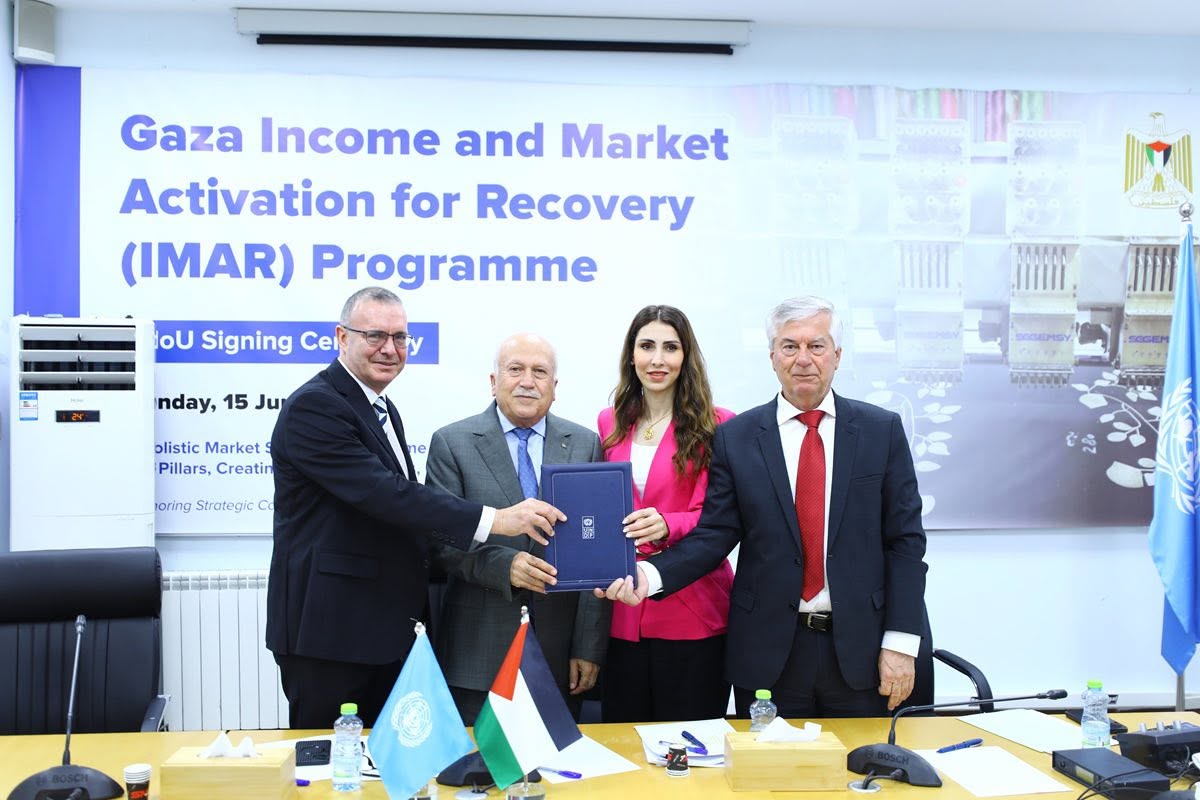
RAMALLAH, June 15, 2026 (WAFA) - The United Nations Development Programme/ Programme of Assistance to the Palestinian People (UNDP/PAPP), together with the Ministry of National Economy, the Ministry of Industry, and the Ministry of Labor, signed on Monday a Memorandum of Understanding launching the Gaza Income and Market Activation for Recovery (IMAR) programme.
The MoU marks an important milestone in advancing a Palestinian-led and Palestinian-owned framework for economic recovery in Gaza, aimed at restoring livelihoods, reactivating markets and industries, and strengthening the resilience of the Palestinian economy through coordinated national action.
Aligned with the Palestinian Government’s recovery priorities and the Gaza Recovery, Reconstruction and Development Plan, IMAR provides an integrated platform to support enterprise recovery, market activation, employment generation, workforce development, industrial revitalization, agriculture, and innovative financing.
"Today’s signing reflects our shared commitment to a Palestinian-led recovery that restores opportunity alongside infrastructure. “IMAR” is designed to move beyond short-term relief by supporting the reactivation of markets, productive enterprises, and decent jobs while strengthening the resilience of Palestinian institutions and the private sector,” said Jaco Cilliers, UNDP Special Representative of the Administrator.
“Recovery is most effective when it is nationally owned, partnership-driven, and anchored in the capacities and aspirations of the Palestinian people,” he added.
Minister of National Economy, Mohammad Al-Amour, emphasized the practical impact of the initiative: "This programme is a vital step toward reactivating markets, revitalizing economic enterprises, and restoring the capacity of the private sector. By building a gradual path toward recovery and attracting investment, 'IMAR' aims to support up to 20,000 micro, small, and medium-sized enterprises and generate up to 100,000 job opportunities.”
“Beyond economic metrics, our objectives include strengthening social stability, reinforcing resilience, and restoring confidence in our future,” he added.
Minister of Industry, Arafat Asfour, noted the strategic significance of the partnership: "The signing of this Memorandum between the Ministry of Industry, the Ministry of National Economy, the Ministry of Labour, and the UNDP marks a crucial transition from the emergency humanitarian response phase in Gaza toward sustainable economic recovery and the rebuilding of our productive capacity."
Minister of Labor, Enas Dahadha Attari, stated: “At a time when unemployment remains one of the most pressing challenges facing our people, IMAR represents a strategic investment in restoring livelihoods, revitalizing markets, and generating decent jobs. Furthermore, since the outbreak of the war, the Ministry of Labor has not ceased its efforts to create employment opportunities within a developmental vision, working closely with all partners and sectors across government institutions, the private sector, and civil society organizations.”
“Through this programme, we are strengthening national efforts to build economic resilience, support enterprise recovery, and create inclusive pathways to employment and dignity for Palestinians,” she added.
Building on UNDP’s longstanding work in economic resilience and early recovery, the programme represents a shift from short-term income support toward market activation and private sector-led recovery. Through a phased approach, IMAR aims to support the recovery of up to 20,000 micro, small, and medium-sized enterprises (MSMEs) and contribute to the creation of up to 100,000 jobs, while strengthening value chains, expanding access to finance and digital payment solutions, and mobilizing investment for sustainable and inclusive economic growth.
The Memorandum of Understanding reaffirms the shared commitment of UNDP and its national partners to advancing recovery efforts that are nationally owned, institutionally anchored, and partnership-driven, while empowering Palestinian institutions, supporting the private sector, and creating pathways toward a more resilient and inclusive economy.
K.F.