


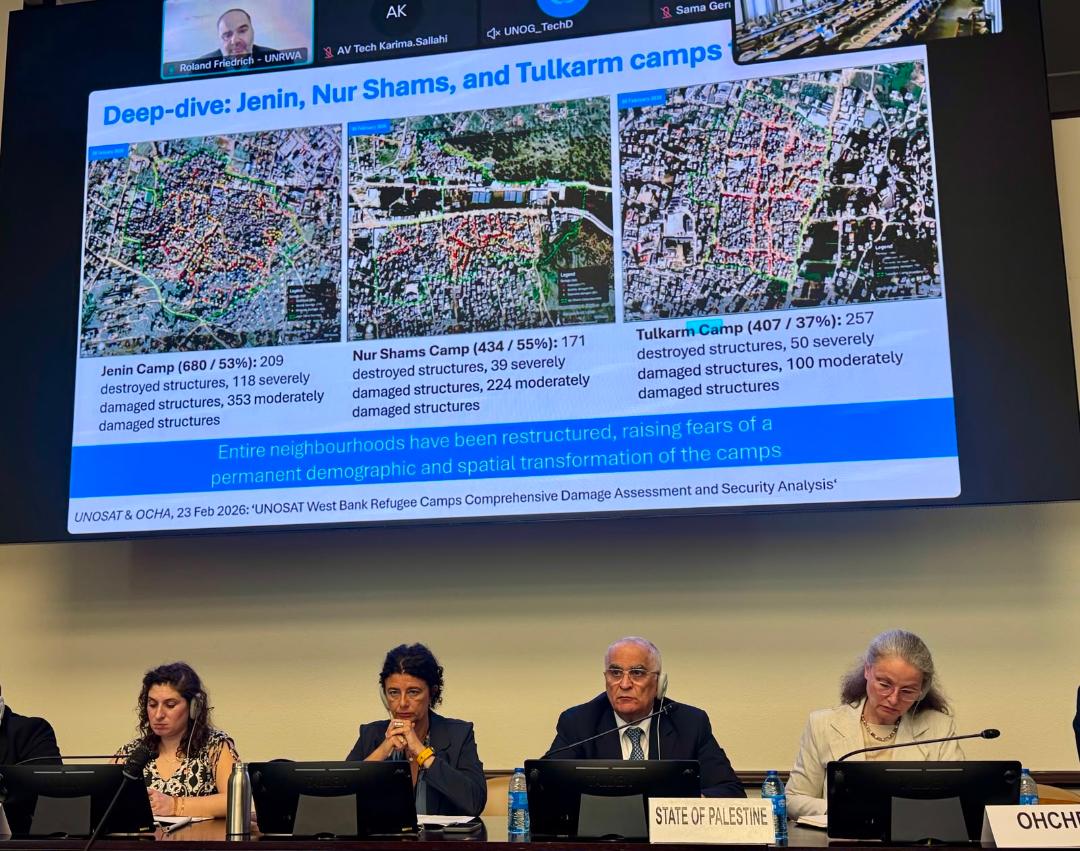
GENEVA, June 12, 2026 (WAFA)– Palestine’s Permanent Mission to the UN on Friday sounded the alarm over the largest wave of forced displacement of Palestinians in the occupied West Bank.
The Mission made the warning during a briefing held by the Mission in cooperation with the Norwegian Refugee Council for diplomatic missions accredited to the UN in Geneva. The event was attended by representatives of the United Nations Agency for Palestinian refugees (UNRWA), the Office of the United Nations High Commissioner for Human Rights, and a Palestinian delegation from refugee camps in the northern West Bank.
During his intervention, Palestine's Permanent Representative in Geneva, Ambassador Ibrahim Khraishi, warned of the unprecedented deterioration of conditions in the occupied West Bank amid the upsurge of colonist attacks, colonial settlement expansion, and the ongoing military offensive on the refugee camps of Jenin, Tulkarm and Nur Shams, which has triggered the largest wave of forced displacement in the West Bank since 1967, alongside widespread destruction of infrastructure, homes and civilian facilities.
He stressed that the West Bank was witnessing a dangerous escalation at the political, economic and humanitarian levels due to Israel’s unbridled annexation and settler-colonialism policies, arrests, extrajudicial killings, colonist violence, and the continued withholding of Palestinian clearance revenues.
He emphasised that punitive measures adopted by some countries against Israeli figures do not match the scale of the ongoing violations, calling on the international community to take practical steps to protect the Palestinian people, implement UN resolutions, ensure accountability and justice, and achieve the two-state solution based on the June 4, 1967 borders.
The Norwegian Refugee Council (NRC) delivered a presentation on the obstacles imposed by Israeli occupation authorities on humanitarian operations, including legislation and measures that hinder the issuance of permits and restrict the delivery of humanitarian assistance.
The NRC stressed that such practices are inconsistent with international humanitarian law, and called on states to increase funding for humanitarian efforts and to take action against violations of international law.
Meanwhile, UNRWA representatives outlined the latest developments in the northern West Bank, pointing to escalating destruction and the forced displacement of more than 45,000 Palestinians, attacks on infrastructure and medical facilities, and Israeli measures aimed at demolishing the Agency’s premises in occupied Jerusalem.
The Office of the High Commissioner for Human Rights (OHCHR) presented findings from its reports documenting Israeli violations in the northern West Bank, including attacks on civilians, destruction of civilian infrastructure, deliberate killings, and restrictions on freedom of movement.
The OHCHR underscored the responsibility of the occupying power and UN member states to uphold international law, protect the population living under occupation, safeguard their right to return to their towns and villages, support the reconstruction of refugee camps, and ensure access to education, healthcare and the conditions necessary for a dignified life.
The briefing concluded with testimonies from Palestinian refugees who described attacks committed by Israeli colonists, the destruction of their homes, and forced displacement. They said they were experiencing displacement, loss of shelter and separation from family members for the third time, amid continuing Israeli violations and growing humanitarian risks in the West Bank.
At the conclusion of the event, numerous representatives of states and diplomatic missions expressed deep concern over the continued deterioration of conditions in the West Bank, as well as recent Israeli legislation and measures intended, as they described, to undermine humanitarian work, expand colonial settlement activity and further entrench policies of forced displacement.
They reaffirmed their commitment to international law and international humanitarian law, reiterating their steadfast support for the Palestinian people's inalienable right to self-determination and the establishment of an independent Palestinian state.
K.F.


