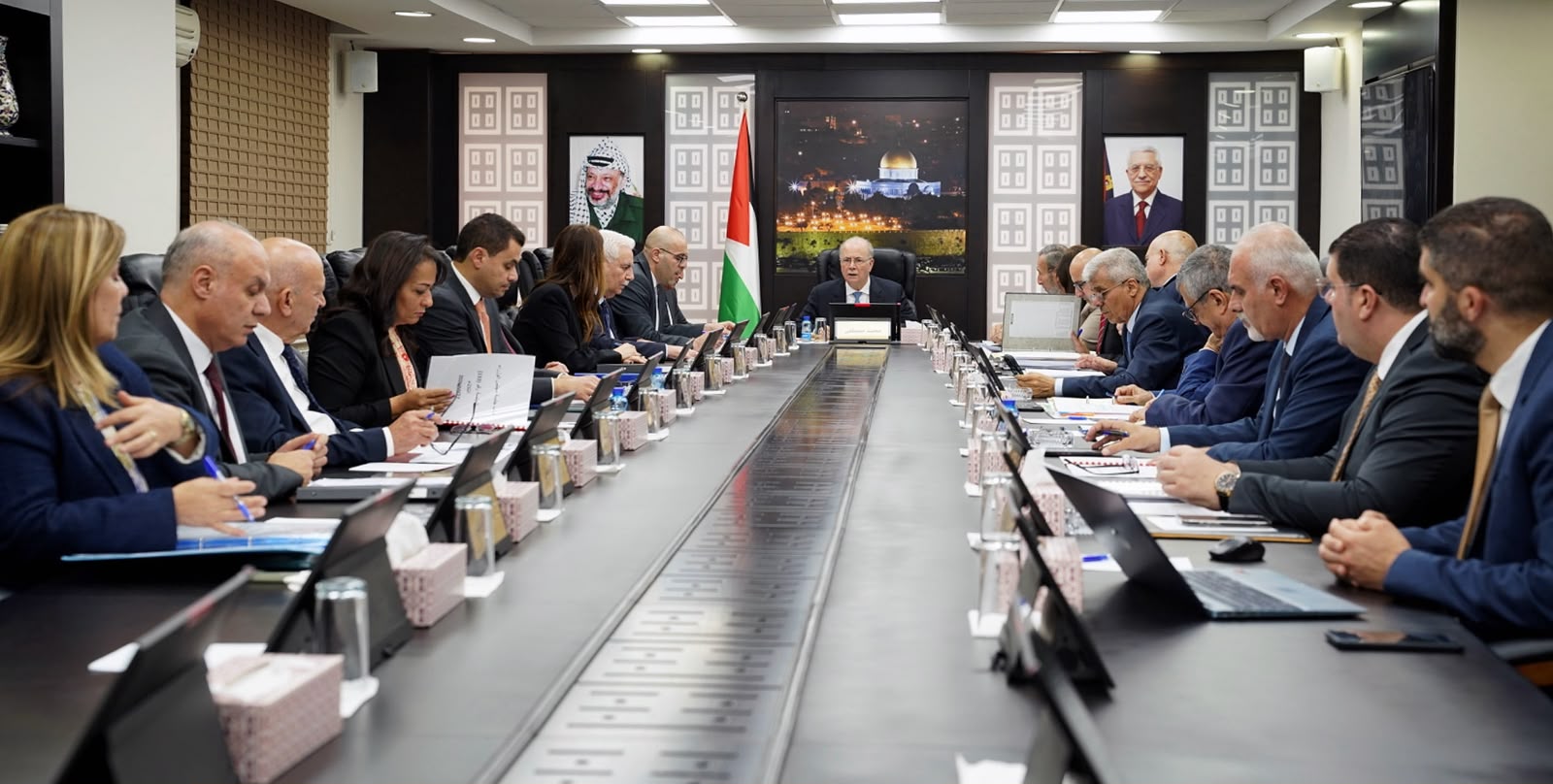
RAMALLAH, November 3, 2026 (WAFA) – Prime Minister Mohammad Mustafa on Tuesday renewed his directives to all government institutions to intensify their efforts and field interventions and strengthen coordinated action in emergency response efforts, in order to alleviate the suffering of our people, particularly in areas under attack.
During its weekly session in Ramallah, the Cabinet warned of escalating Israeli restrictions on the operations of international humanitarian organizations in the Gaza Strip, further exacerbating the suffering of Palestinian citizens and undermining these organizations’ ability to deliver humanitarian and relief assistance.
Marking the International Day to End Impunity for Crimes against Journalists, observed on November 2, the Cabinet reiterated its call for accountability for perpetrators of war crimes and for ensuring that they do not enjoy impunity, including for crimes and violations committed against journalists. Following a briefing by the Minister of Culture, the Cabinet noted that 260 Palestinian journalists, both men and women, have been martyred since the beginning of Israel’s genocidal war, while hundreds more have been injured or detained. In addition, 63% of media institutions in the Gaza Strip have been destroyed, with total losses sustained by media institutions reaching USD 131 million.
According to a statement issued by the Government Communication Center (GCC), the Cabinet also warned of the serious implications of UN report findings highlighting continued concerns over the risk of ethnic cleansing in the Gaza Strip. This comes amid the Israeli occupation’s declared plans to expand its control and occupation to cover approximately 70% of the Strip, while Palestinians face extremely harsh humanitarian conditions. Most of the population in Gaza is preparing to endure its fourth consecutive winter in dilapidated tents, as living conditions and the humanitarian situation continue to worsen.
Meanwhile, attacks by Israeli occupation forces and terrorist gangs of colonial settlers across the West Bank continue to escalate, with 683 attacks against Palestinians and their property recorded over the past week.
The Cabinet also adopted the recommendations of the Permanent Ministerial Committee on Jerusalem at its fifth meeting, held on 28 October 2026, to help strengthen the resilience of Palestinian citizens of Jerusalem. It further received a briefing from the Minister of National Economy on efforts to ensure the stability of essential commodity supplies and price stability, particularly in light of the understandings reached between the Ministry and food-sector trade unions.
The Cabinet also directed that the oncology department at Darwish Nazzal Governmental Hospital in Qalqilya be brought into operation as soon as possible, to serve patients across the northern West Bank governorates.
In another development, the Cabinet approved the organizational structure of the Ministry of Education and Higher Education to enhance institutional efficiency. It also discussed, at first reading, the Alternative Care Strategy in Palestine (2027–2029), which establishes specific standards for addressing cases requiring alternative care, particularly in shelters and care centres. The strategy aims to support families and prevent separation, prioritize kinship care, and reduce reliance on institutional residential care.
The Cabinet approved two funding agreements in support of the Palestinian Judicial Institute: the Institute’s Technical and Financial Cooperation Project, in partnership with the Italian Agency for Development Cooperation, and a grant project provided by UN Women.
It also approved the Mutual Recognition Agreement between the Palestinian Standards Institution (PSI) and Indonesia’s Halal Product Assurance Organizing Agency (BPJPH) concerning halal certificates, with the aim of promoting Palestinian exports to international markets.
K.T