By Sami Abu Salem
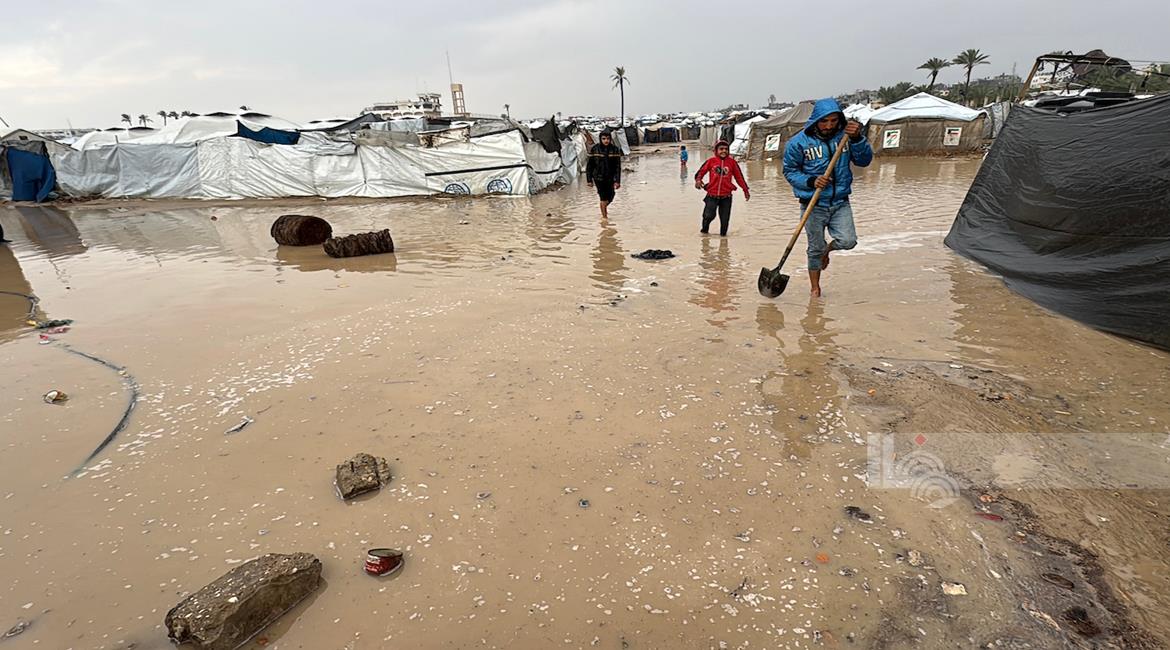
GAZA, December 11, 2025 (WAFA) - Mazen Abu Darabi woke up in the middle of the night to the sound of rushing water. In his tattered tent in Al-Maghazi refugee camp, the flood had already begun seeping in from beneath, while rain poured from above, soaking his meager belongings.
Frantically, Abu Darabi roused his seven children and wife, salvaging what they could before the deluge ruined more of their possessions. “The rain came from above, the flood from below,” he told WAFA. “Much of the children’s clothing, our belongings, and even food got wet.”
Across Gaza, tens of thousands of displaced families spent the night exposed to the elements, as torrential rains and flooding battered the already devastated territory. Since the Israeli offensive that began in October 2023, around two million Palestinians have been displaced, forced to live in tents or temporary shelters ranging from rented homes to chicken farms and agricultural greenhouses. Local sources estimate that roughly 300,000 families reside in tents.
Despite knowing of an approaching storm, Abu Darabi had no choice but to remain in his tent, his last refuge. Barefoot, he tried to block new streams of water from entering, while his children waded through the mud, seeking shelter under a makeshift lean-to. His wife gathered soaked clothing, and his 17-year-old daughter, Malak, collected what remained of their schoolbooks.
“Part of our food was swept away, mattresses, blankets, and the children’s clothes soaked,” Abu Darabi said. “I don’t know how we will survive the winter.” Once a farmer, he now finds himself in a heap of mud and despair after the destruction of homes and farms in Beit Lahiya by the Israeli occupation.
A UN report released in October last year stated that 83% of homes in Gaza have been destroyed. Abu Darabi’s tent, pitched beside a garbage dump since October, marks his latest displacement. For many, the challenge of enduring harsh winters is compounded by the deterioration of tents after two years of use and severe restrictions on importing relief supplies imposed by the occupation.
Central Gaza—including Deir al-Balah, the refugee camps of Al-Nuseirat, Al-Bureij, Al-Maghazi, and nearby villages—remains overcrowded with displaced families in fragile shelters. In the southern city of Rafah, entirely destroyed, and Khan Younis, where most homes were demolished, residents have clustered in the Al-Mawasi agricultural area, much of which has been washed away by floods.
Floodwaters have engulfed displacement camps in Al-Bassa and Al-Baraka in Deir al-Balah, in Al-Nuseirat camp, and in Al-Mawasi west of Khan Younis, according to eyewitnesses.
Hussein Youssef, 23, along with his family of five, searched desperately for an ax to divert the water from their tent, only to find neighbors equally busy protecting their shelters. “We had a large home. I was imprisoned at a checkpoint, released after two years, only to find my father dead, our home destroyed, and our family in a tent,” Youssef said, recalling his displacement from Jabalia to Deir al-Balah.
Despite a ceasefire in place since October 11, 2025, which established a “yellow line” preventing entry into certain areas, the occupation continues to destroy homes beyond the line. The rain now threatens not only tent-dwelling families but also tens of thousands in partially damaged or collapsing homes.
In the Al-Nasr neighborhood of Gaza City, the Baghadadi family fled their home as rain-soaked soil undermined its foundations, causing it to collapse shortly after.
Even under ceasefire, Gaza’s 2.3 million residents face dire humanitarian conditions, with limited access to safe housing, food, and security. The United Nations reports that more than two million Palestinians are now cramped into less than half of the Gaza Strip, with most lacking sufficient shelter materials to protect them from rain and wind.
For Abu Darabi, Youssef, and countless others, survival is measured not in comfort or stability but in the desperate efforts to keep water out, food intact, and children safe—a daily battle against nature and occupation alike.
--
M.N