By Safaa Al-Bureim
GAZA, February 8, 2026 (WAFA) — After nearly a year and a half of closure, the Israeli occupation army partially reopened the Rafah crossing on February 1, allowing limited movement through Gaza’s only gateway to the rest of world. For tens of thousands who had been stranded outside the Strip, the announcement carried the promise of return after forced absence and long months of waiting at the edge of the unknown.
Yet for those who finally made it back, the joy of reopening the crossing did little to soften the cruelty of the journey, or to erase memories of humiliation and suffering at the hands of Israeli soldiers.
Following an exhausting return trip, Sabah Saleh, 65, sits inside her son’s tent in the Mawasi area of Khan Younis in southern Gaza. Fatigued and frail, she carries the weight of immense loss: her husband and three sons were killed when their home in the town of Abasan was bombed.
“I left Gaza with my daughter-in-law for medical treatment in Egypt in April 2024, after our house was destroyed,” Saleh said. “My husband Faisal, 65, and three of my sons — Mohammad, 40, Omar, 38, and Saqr, 30 — were killed [during the war].”
Her voice grows heavier as she recalls how a short medical trip turned into prolonged exile. “I never imagined that journey would become such a long absence. Shortly after I left, the crossing was completely closed following Israeli takeover, and we remained trapped outside Gaza even after my treatment ended.”
According to data from the Palestinian Ministry of Health, around 72,000 Palestinians have been killed since Oct. 7, 2023, and more than 171,000 wounded. Saleh’s story is one among thousands that reflect the scale of human suffering endured by displaced families and those stranded abroad. Between the joy of return and the pain of memory, returnees now face a reality that bears little resemblance to the life they once knew — haunted by questions of the missing, destroyed homes, and an uncertain future.
“I only wanted to come back to Gaza,” Saleh said softly. “To live with my son Ahmad, the only one who survived, my grandchildren, and whoever is left of my loved ones.”
When she heard that the crossing would reopen, she felt hope surge again. But the road home, she said, was anything but easy. Saleh was part of the second group allowed to enter Gaza on Feb. 3. The journey was long and draining, filled with endless hours of waiting before the ordeal on the Israeli side began.
“We were subjected to intense and humiliating searches,” she said. “Israeli soldiers tied our hands, blindfolded us, and left us for hours in the freezing cold.”
The suffering did not end there. “They confiscated the medicines I needed to continue my treatment, and even the small toys I bought for my grandchildren,” she added bitterly. “They would not let me bring them into Gaza. They did not even allow me to carry a small joy with me.”
Health authorities in Gaza say around 20,000 patients and wounded individuals are still waiting for permission to travel abroad for treatment.
Inside the same tent, Saleh’s son Ahmad, 35, sits with his three children. Like many families, they were forced into displacement after their homes were destroyed during the war, which also claimed the lives of dozens of relatives.
“I was overjoyed when my mother returned,” Ahmad said. “Her presence gives us some comfort, even though we are living in a tent after my father and brothers were killed and our homes destroyed.”
For him, her return brought back a measure of warmth to a shattered family, despite the harshness of daily life.
“I miss the smallest details of the life that was taken from me,” Saleh said, her voice blending longing with sorrow. “The smell of my home, the sound of my grandchildren running around me — all the little things I once thought were ordinary.”
She described her decision to return as difficult but final. “Coming back and staying here is a form of steadfastness,” she said. “It is a clear message rejecting all Israeli attempts at displacement, aimed at uprooting Palestinians from their land.”
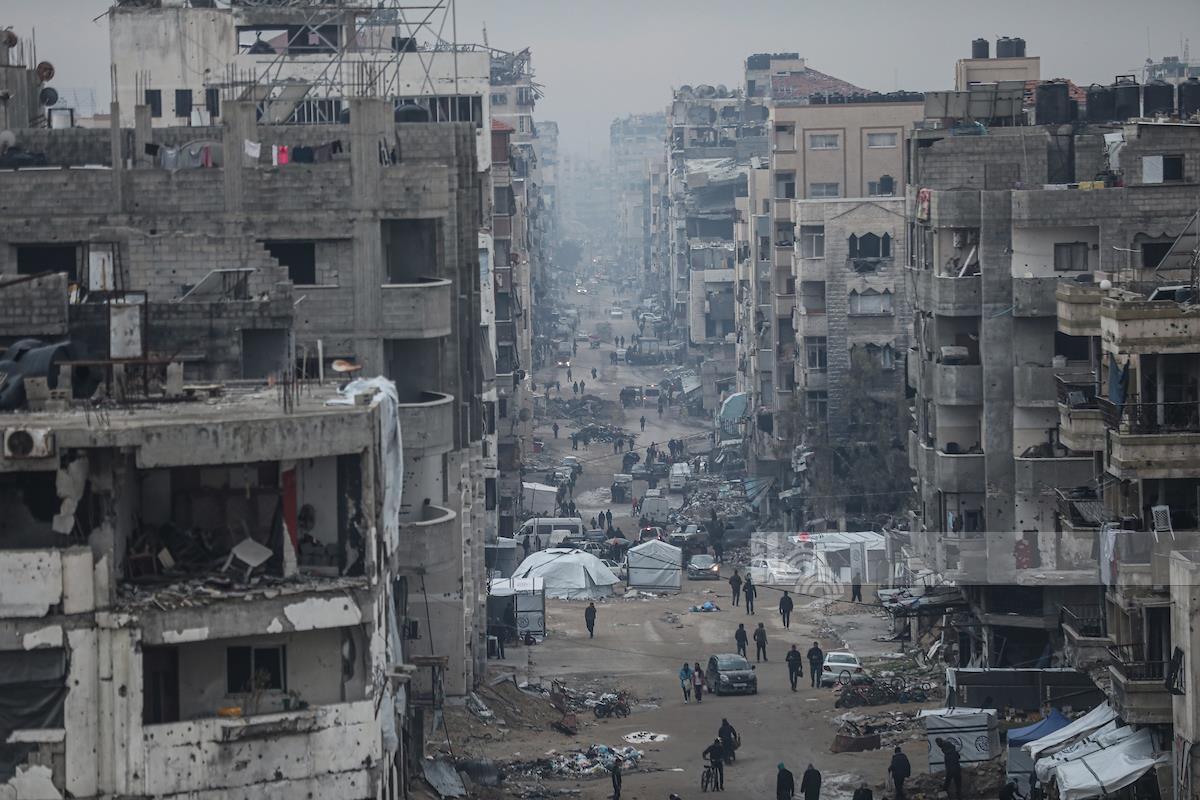
Still, any momentary relief quickly collided with a grim reality. The Gaza she left behind, she said, no longer exists. “My heart ached when I saw Gaza, once full of beautiful homes, turned into a city of tents, without enough water, without treatment, without the most basic necessities of life.”
According to official reports by Palestinian bodies and statistics from the Palestinian Central Bureau of Statistics, around 100,000 Palestinians were forcibly or involuntarily displaced from Gaza between the start of the war in October 2023 and the end of 2025 due to widespread destruction and forced displacement.
For Abeer, 37, Saleh’s only daughter, emotions remain conflicted. “My happiness at my mother’s return is great,” she said through tears, “but the pain is greater. I wish my father and brothers were with us today.”
Saleh’s experience is not an exception, but one of hundreds of stories carried by those crossing through Rafah, where reunion is mixed with grief, and the hope of return is overshadowed by memories of searches, waiting, and deprivation.
In the first days after the Rafah crossing reopened, Israeli authorities allowed only a very limited number of people to cross. On the first day, around 12 people were permitted to enter Egypt, including patients and their companions. In the following days, movement remained severely restricted compared to the needs of thousands of stranded citizens. On one day, for example, about 25 Palestinians entered Gaza while 46 others were allowed to leave, underscoring the continued constraints imposed on movement.
Despite the reopening, the crossing has continued to operate at minimal capacity under strict inspection measures, leaving the flow of people far below what is needed to meet the demands of patients, students, and families trapped by the prolonged closure.
M.N