By Ula Mukadi
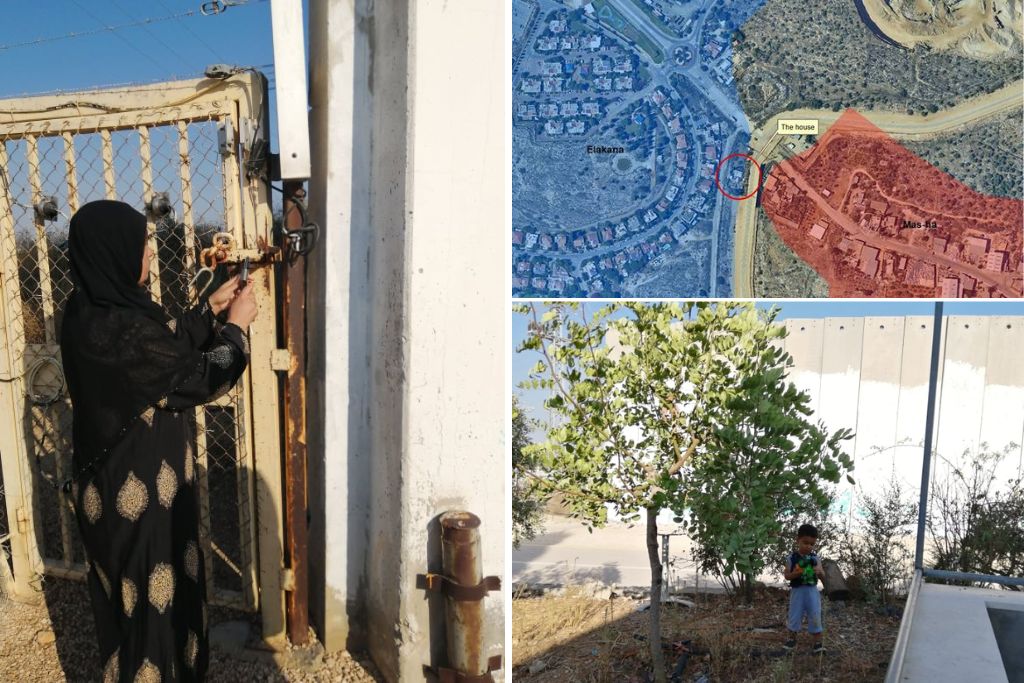
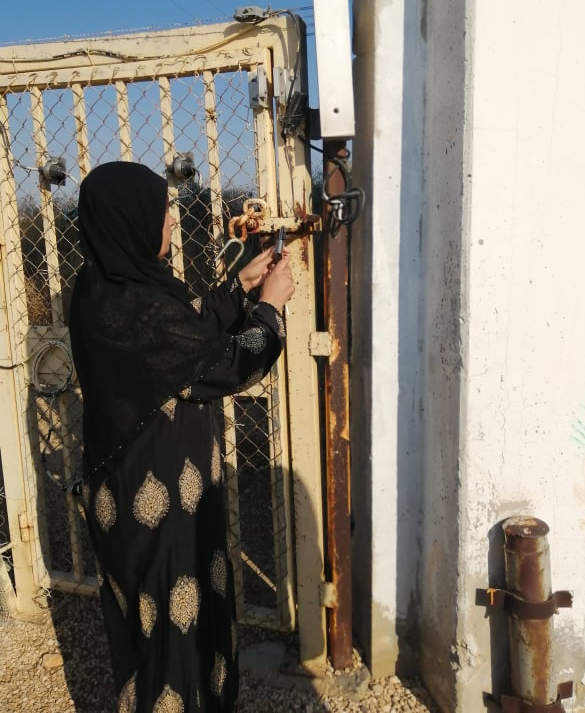
SALFIT, February 28, 2026 (WAFA) – At the western edge of the village of Mes'ha, in the occupied West Bank province of Salfit, the day begins with the slow creak of an iron gate. Munira Al-Amer, 61, pushes it open carefully, almost apologetically, as though afraid of disturbing the silence imposed on her home.
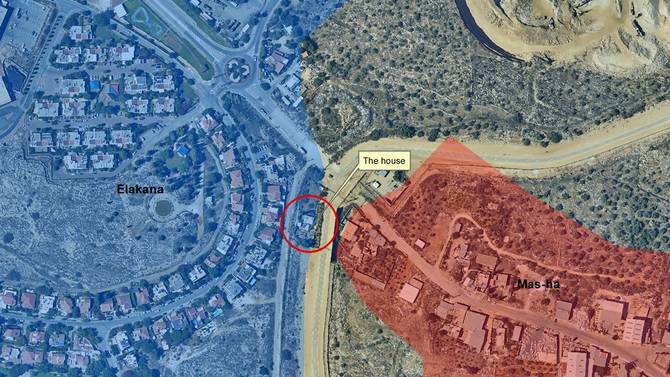
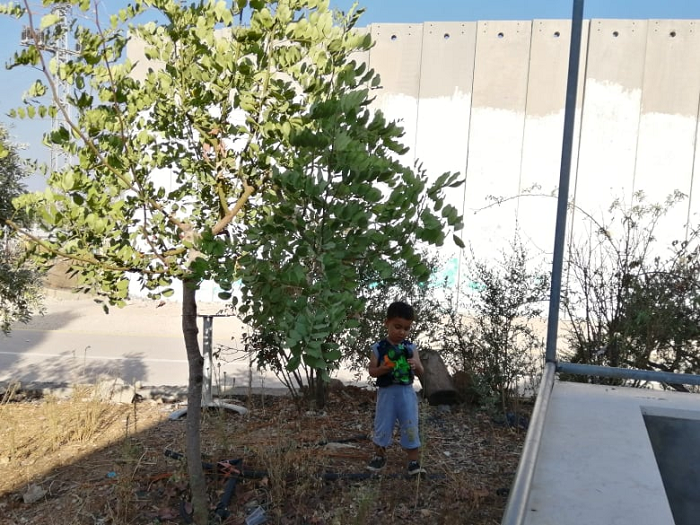
Her house stands alone behind Israel's separation wall — an eight-meter-high concrete barrier topped with cameras and barbed wire. Just a few dozen steps separate it from the last Palestinian house in Mes'ha, from schools, clinics, and everyday services. Yet in reality, it is worlds apart.
According to the Palestinian Central Bureau of Statistics, Mes'ha is home to around 2,822 residents. But Munira's house is the only Palestinian home in Salfit governorate isolated behind the wall. Surrounding it are settlement units belonging to Elkana, established in 1978 on lands belonging to the village.
What began on approximately 50 dunums as a semi-military outpost — one of the earliest settlement footholds in Salfit — expanded over the decades, taking over thousands of dunams and eventually encircling the Al-Amer family home entirely.
An economy of permits and time slots
Within this tightening ring of concrete, steel, and surveillance, Munira has built an economy of her own, one governed by time slots, permits, and restrictions.
Each morning, Munira leaves her home knowing that the journey ahead is long and uncertain. She travels to citrus groves and olive fields in Azzun, in the Qalqilya governorate — an area that itself was once heavily restricted — where she has worked for decades to provide for her family.
“The land was our only source of income,” she says. “We worked long hours and returned before dark because of military requirements. I have no choice. Either I work, or I suffocate here alone inside this siege.”
A family divided by a gate
Munira and her late husband, Hani Al-Amer, raised six children in this house. When they first built it, life felt ordinary. “My husband would go to work. I would sit with my children. When they played outside in the yard, I felt they were safe,” she recalls. “Today, the settlement surrounds us from every direction.”
In 2004, the family was informed that their home would be placed on the “Israeli side” of the separation wall. They were given a choice: leave, or remain under strict military restrictions. The area was later sealed with two iron gates — one controlled by Israeli authorities, the other by the family, though locks can be changed at any time.
One memory remains etched in Munira's mind. “The gate was shut on us. Half the family was outside, half inside. We were split between two sides of the wall in minutes.”
Her home ceased to be simply a place of shelter. It became a monitored zone. Leaving a door open for a few minutes can trigger a call from a settlement guard demanding it be closed immediately, or else face penalties.
Visitors are now effectively banned. Entry and exit require official permits. In recent months, additional barbed wire and new gates have further tightened the restrictions. Life here is counted not in days, but in obstacles overcome.
After loss, a reshaped role
On May 25, 2021, Hani Al-Amer died of a sudden heart attack after years of enduring mounting pressure and isolation. With his death, Munira assumed full responsibility for the household.
In rural Palestinian society, women are often viewed as secondary economic supporters. But under these conditions, roles were forcibly reshaped. Munira became the primary provider.
She works in the fields and supplements her income by producing and selling homemade agricultural goods: dried molokhia leaves, cooked tomatoes, stuffed grape leaves, and maftoul. “This is our family home,” she says. “I want my family to find goodness in it.”
Her small-scale production offers a degree of self-sufficiency — fragile, but vital. Yet the physical toll is evident. Years of labor have left her with chronic back pain, muscle fatigue, high blood pressure, and diabetes. Still, she rises each morning and heads to work, carrying what she describes as “a glimmer of hope and the will to remain.”
The “state” of one family home
Locals have come to refer to the house as “The State of Hani Al-Amer” — a reflection of the extraordinary level of control imposed on a single-family home.
International humanitarian law, including the Fourth Geneva Convention, guarantees protection for civilians under occupation, including freedom of movement, access to food and healthcare, and humane treatment. Article 27 affirms that protected persons must be treated with respect for their dignity and personal security, and prohibits collective punishment.
In 2004, the International Court of Justice issued an advisory opinion declaring that the construction of the separation wall inside occupied Palestinian territory violates international law, calling for its dismantling and compensation for those harmed.
Hilmi Al-Araj, director of the Hurriyat Center, argues that restrictions such as those imposed on the Al-Amer family violate fundamental principles of international humanitarian law. He says freedom of movement is a protected right and that policies aimed at economic suffocation and forced displacement may amount to grave breaches.
UN Security Council Resolution 2334 also reaffirmed the illegality of Israeli settlements and called for a halt to settlement activity.
Despite these legal frameworks, Munira’s daily reality remains defined by permits, unpredictability, and isolation.
The economy of the wall
Na'im Harb, head of the National Forces in Salfit, describes the family’s situation as a model of systematic economic strangulation.
“How can we speak of a dignified life without safe housing, food, clothing, and freedom of movement?” he asks. “Munira lives under an economy we can call the economy of the wall and the iron gates — an economy controlled by the machinery of repression through restricted movement and imposed isolation.”
For Munira, however, the struggle is less abstract. It is measured in early mornings, in aching muscles, in the careful turning of a key. Between a towering wall and the expanding footprint of a settlement, she has carved out something stubborn and defiant: continuity.
Each time the iron gate opens, slowly and cautiously, it signals not surrender, but survival.
M.N