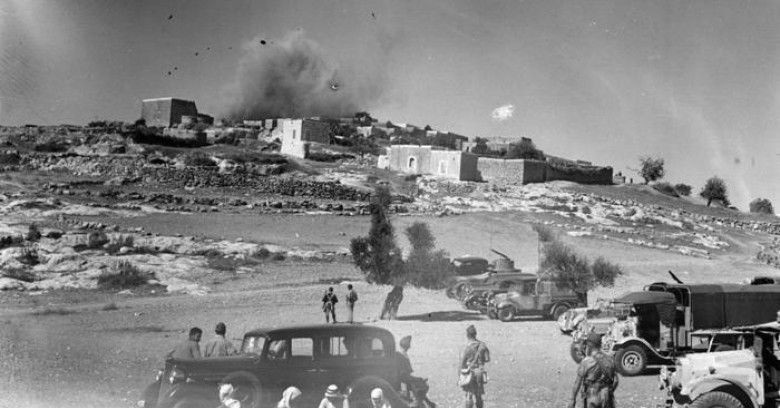
CHICAGO, April 5,2010 (WAFA)-“This Palestinian Life”, a 28-minute documentary, surveys rural resistance in occupied Palestine: in the northern Gaza town of Beit Hanoun, in the Jordan Valley, and in the south Hebron hills, shown yesterday, Electronic Intifada Site said.
“The film was made by Egyptian-German journalist Philip Rizk, who lived in Palestine from 2004 to 2007, talking with those struggling under the daily violence and oppression of Israel's occupation, and recording their stories. The project was political, a sort of ad hoc social history of agrarian resistance. Rizk narrates his wish to 'Capture the stories of villagers because these examples of 'steadfastness... are the most rarely told.' This film begins to fix that problem.
'Steadfastness,' a survival strategy oriented towards communal self-preservation in the face of ideologically-motivated territorial expansion. It is a sensible strategy of resistance when one's opponent is intent on ethnic cleansing to create a homogenous, territorially contiguous homeland, and when that opponent is steadily isolating the native fauna -- in this case, farmers, shepherds and villagers -- in quarantine clusters.
But the type of villagers Rizk has recorded are the ones capable of creating a more mediatic spectacle, the kind that could capture the sort of attention that could change the symbolic structure of the conflict, and restructure it in a way that empowers Palestinian resistance.
Sociologists have little idea what catalyzes a transition from steadfatness to more open confrontation like that in Bilin, Nilin, or Budrus, but it's worth wondering. It's unfortunate that Rizk didn't ask the villagers what they thought of the more active struggles.
Simply telling the stories of Israeli home destruction in the hills, or explaining how Israeli settlers in the occupied West Bank and East Jerusalem can build as they wish while the native Palestinians need permits to build higher than 60 centimeters corrodes the occupation narrative.
More effective still is showing the destruction of ancient olive trees by the Israeli military, or the shattered lemon boughs and upset earth scored deep by tank-treads, all of it composing a bracing curative for Israeli propaganda.
In addition to telling a neglected part of the Palestinian story, Rizk also cleverly interweaves broader sociological and economic points into the anecdotal fabric of the film. One shot is of verdant stands of trees in the occupied West Bank.
Another is of arid scrub or rock. Why? Because Israelis can dig wells willy-nilly, while Palestinians may not dig wells of any appreciable depth. Shots of the neat trees and buildings of Israeli settlements edging up against the rock desert at their borders evocatively captures this dynamic.
It is not Occidental technological wonders versus primitive pastoralism but advancement enabled by enforced resource deprivation: the Israeli theft of Palestinian water, which strengthens Israeli agriculture while preventing Palestinian agricultural development.
Even more stirring are the shots of Israeli tanks and military bulldozers destroying farmland in Gaza. Some of this land was razed to create the Israeli 'buffer zone,' a newfangled Israeli imposition, which essentially means that Israel destroys as much vegetation as possible in tremendous swathes, 300 meters or so wide, on the Gaza side of the boundary with Israel. Israeli soldiers shoot farmers who enter that zone, often up to two kilometers inside the boundary.
Destroying land means destroying lives. To hear a Palestinian woman describe an Israeli rocket blowing up a chicken coop or a rabbit hatch to bits, or to see the footage of a Palestinian man in desperate anguish as he wails over the goats he has raised lying crushed to death under Israeli army bulldozers is to slice clean to the conflict's core.
Another issue: the shots of sheep and goats moving over dried-out dirt, then slate grey rock seldom last long. Instead of lingering, Rizk rushes over them, perhaps worried that they won't hold the viewer's eye. But that sort of naturalism is perfect for expository voice-overs. Livelihoods, ecological cycles, husbandry and land and agriculture are axial to the conflict for the poor village folk Rizk makes his protagonists. They are their lives. Why move so hurriedly past them? He also moves too quickly over viciously uprooted trees, a metaphor for the conflict and the Israeli attempt to excise Palestinian cultural roots and cultural identity from the ground in which they sit.
Two points follow. One is that resistance in Palestine has not yet suffused the political landscape. Thousands of dead and injured during the second Palestinian intifada linger in the collective memory.