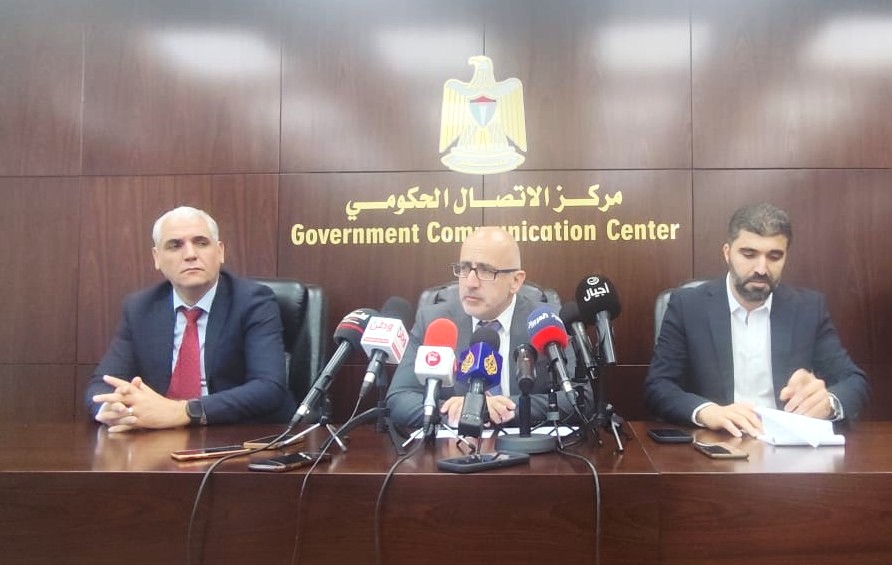
RAMALLAH, July 29, 2026 (WAFA) – Minister of Finance and Planning Estephan Salameh said on Wednesday that Israeli threats to sever banking relations with Palestinians constitute a crossing of all red lines, warning that such a move would affect citizens’ ability to access basic services and forms part of a systematic Israeli policy aimed at destroying the Palestinian economy and preventing the establishment of a viable Palestinian state.
Speaking at a press conference held at the Prime Minister’s Office in Ramallah, Salameh announced a package of measures to address the financial and fuel crises, saying that signs of improvement in the fuel crisis are expected to emerge next week, while the government will continue paying 50% of public employees’ salaries through the end of the year.
"We have reached the end of the road with the Israeli side financially and economically," he said. "When the Israeli side speaks today about steps to sever banking relations with Palestinians, taking such action would cross all red lines, as it would prevent the provision of basic services to Palestinian areas, including water, electricity, and fuel, and make life more difficult for Palestinian citizens."
He added that these measures are part of a systematic policy that has persisted since the beginning of the occupation but has intensified under the current Israeli government, which is narrowing all avenues available to Palestinians amid the ongoing genocidal war on the Gaza Strip and the escalation of colonist violence in the West Bank.
Salameh said the occupation continues to impose restrictions on economic and financial activity, as well as on the movement of individuals, while obstructing operations at crossings, particularly the King Hussein Bridge, in addition to imposing restrictions on electricity, water, and food supplies. He stressed that the objective of these measures is to undermine Palestinian national existence and prevent the establishment of a viable Palestinian state.
He said the current financial crisis stems from Israel’s continued withholding of Palestinian clearance revenues, noting that the government has completed its fifteenth month without receiving these funds and is entering the sixteenth month amid their continued withholding.
"Every month, we have loan payments and financial obligations. After meeting these obligations, we are left with only around 100 million shekels, while our actual monthly needs amount to approximately 1.5 billion shekels. For 15 months, we have been working to keep state institutions functioning and continue providing citizens with the minimum level of basic services," he said.
Salameh explained that the government will continue paying 50% of salaries until the end of the year, noting that securing this percentage requires around 650 million shekels per month.
"We fully understand the extent of the suffering experienced by Palestinian employees, but this is the limit we can provide under the current circumstances," he said.
He said the government relies on four main sources to finance salary payments: borrowing, foreign aid, domestic revenues, and sound financial management.
Salameh said the government is working to increase foreign assistance, but that it remains below actual needs. He added that borrowing from banks has reached its maximum limit, praising the cooperation of the Palestinian banking sector in supporting the government throughout the crisis and affirming that efforts to find solutions with banks will continue.
Salameh stressed that the government will not impose new taxes on citizens but will continue strengthening domestic revenues by requiring taxpayers to settle outstanding tax obligations. He said combating tax evasion and smuggling has become a matter of Palestinian national security and is being addressed in accordance with the law and through the relevant authorities.
Salameh emphasized that addressing the liquidity crisis requires expanding the use of electronic payment methods and gradually reducing reliance on cash and the Israeli shekel, stressing that this issue has become a matter of Palestinian national security.
"The Israeli side does not want to deal with us and does not want to receive the surplus shekels available in the Palestinian market. We have large quantities of shekels in banks, and the solution is to gradually stop using cash and move toward electronic payments," he said.
He explained that cash circulating in the Palestinian market is distributed as follows: 53% in shekels, 33% in US dollars, and 12% in Jordanian dinars. He noted that the Palestinian market has the infrastructure needed for this transition, with around 1.8 million bank cards currently in circulation.
He added that if Israel continues obstructing the use of the shekel, the Palestinian side will move toward increasing reliance on other currencies, noting that the Palestine Monetary Authority is monitoring the issue daily in coordination with the government and international partners.
Salameh said banks have begun taking steps to expand electronic payments and adopt the Jordanian dinar as a legally recognized currency alongside modern payment methods, as part of measures aimed at protecting the Palestinian economy from the repercussions of any Israeli decision to sever banking relations.
Regarding the fuel crisis, Salameh said it is among the crises facing Palestinian citizens as a result of Israeli measures, stressing that the government has worked since its onset to address its causes, particularly the liquidity crisis.
"We faced a cash problem, as fuel stations rely heavily on cash transactions, while restrictions remain in place on depositing cash into banks. Consequently, the Ministry of Finance has been working around the clock to address this issue," he said.
He said the main obstacle at present is the limited fuel storage capacity, explaining that expanding storage facilities would have prevented the current crisis.
"Station owners confirm that their storage capacities are sufficient for around two weeks, which is a positive development, but the real challenge lies in ensuring a continuous supply in the required quantities," he added.
Salameh pointed to additional transportation-related challenges, saying ministry data indicate that the Israeli army requisitioned around 250 of the 450 fuel tankers that had been transporting fuel to the Palestinian market for its own use, reducing the number of tankers available to serve the Palestinian market and subjecting fuel deliveries to complex security procedures.
The minister revealed that fuel smuggling operations exist in the Palestinian market, saying the ministry is working to assess their scope and address them in accordance with the law, while noting that there is currently no accurate estimate of their volume.
He said the government has managed to address a significant part of the liquidity crisis, while current efforts are focused on increasing supply quantities and ensuring the arrival of fuel tankers through crossings. He added that relevant authorities, in coordination with the Civil Affairs Commission, are working to release held tankers and secure the entry of fuel, including during holidays.
"We supply around three million liters of fuel daily, and current indicators show that conditions are expected to begin improving at the start of next week, marking the beginning of the end of queues at fuel stations," he said.
He renewed his call for citizens to use electronic payment methods and increase reliance on other currencies, saying that such measures would reduce dependence on the Israeli shekel and help address the liquidity crisis.
Regarding the establishment of the National Fuel Company, Salameh explained that it is a government-owned entity established under an amendment to the Petroleum Authority Law, with the aim of addressing governance shortcomings and separating regulatory and oversight responsibilities from operational functions.
"Today, the Petroleum Authority sets policies, regulates, and supervises, while simultaneously carrying out operational tasks related to purchasing, sales, and transportation. This constitutes a governance issue, and therefore there was a need to separate these functions," he said.
He added that the initiative to establish the company is not new, as it is based on a Cabinet decision issued in 2018, and that the draft amendment to the Petroleum Authority Law includes a provision authorizing its establishment.
Salameh stressed that the National Fuel Company will not be the first government-owned company of its kind, noting that other state-owned companies already exist, including the Electricity Transmission Company and the National Water Company. He said the establishment of the company will not affect fuel stations or the services provided to citizens, but rather aims to strengthen governance, oversight, and efficiency in managing the sector.
He said that earlier on Wednesday he met with representatives of the fuel station owners’ union and the head of the Chamber of Commerce, providing them with a copy of the draft law amendment as part of ongoing consultations on the establishment of the company.
Salameh said the current financial crisis has affected all sectors, stressing that the government continues to set priorities based on the most urgent national needs.
He said the health sector and salaries remain top priorities, as salaries are essential to ensuring the continuity of education, security, and public services, while the health sector is directly linked to citizens’ lives. He noted that from the beginning of the year until the end of June, the government allocated 300 million shekels to hospitals and medicines, and plans to allocate an additional 350 million shekels by the end of the year, bringing total spending on the health sector to 750 million shekels.
He said the government is engaging with its international partners to secure additional support for the health sector, particularly for hospitals and medicines, adding that it allocated around 160 million shekels to the sector during the past month alone.
Salameh said that Palestinian clearance revenues withheld by Israel are approaching $6 billion, stressing that these funds are the exclusive right of the Palestinian people.
"Yesterday, the Israeli Supreme Court issued a decision, while Israel is moving toward eliminating clearance revenues. Our withheld funds held by the Israeli Ministry of Finance, which are approaching $6 billion, are purely Palestinian funds," he said.
He added that the government continues, in coordination with international partners, to pursue efforts to secure the release of these funds, but that the initiatives proposed thus far have yet to yield practical solutions.
The minister expected pressure to intensify in the coming weeks, stressing that the government’s responsibility is to continue providing basic services and strengthening citizens’ resilience while maintaining transparency with the Palestinian people regarding the realities on the ground.
"We are here today thanks to the steadfastness of our people and the resilience of civil and military public sector employees," he said.
Salameh held the international community responsible for the continuation of the crisis, saying that the current level of international support falls short of what is required given the exceptional circumstances facing the Palestinian people.
T.R.