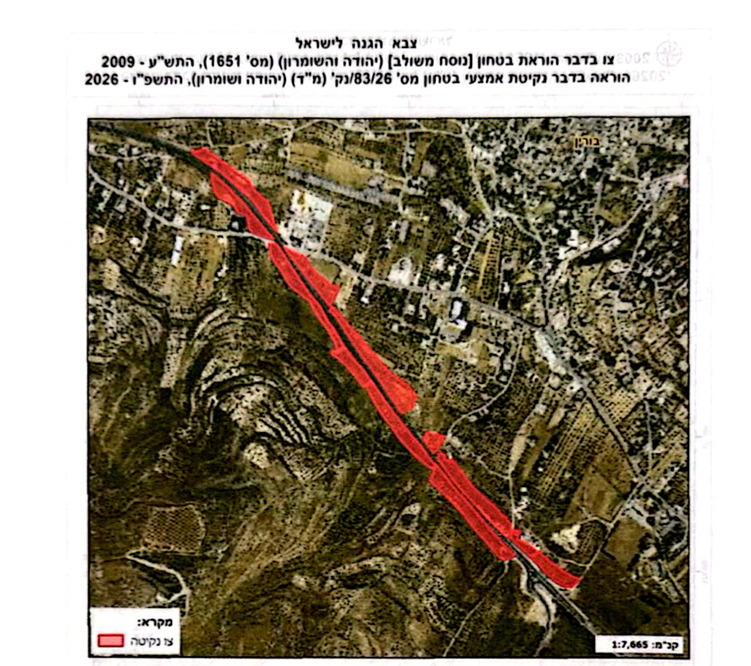
RAMALLAH, July 25, 2026 (WAFA) — The Wall and Settlement Resistance Commission revealed on Saturday that Israeli occupation authorities have issued three orders to take “security measures” aimed at removing vegetation and uprooting olive trees from Palestinian-owned lands in the villages of Salem, Burin and Madama, in the Nablus governorate.
According to the Commission, the orders target an estimated 68.7 dunums of land, including a strip stretching 5,567 metres across lands belonging to Burin and Madama.
In a statement, the Commission said an examination of the orders showed that two of them, Orders 79/26 and 80/26, target approximately the same location in Salem, while differing significantly in the deadlines provided for implementation and filing objections. Order 83/26, meanwhile, targets a lengthy corridor extending between lands belonging to Burin and Madama.
The Commission stressed that the main danger posed by the orders is not limited to the size of the areas or the number of trees targeted. Rather, it lies in the fact that the orders were issued after Israeli occupation forces had already carried out the removals on the ground, effectively transforming them from decisions issued prior to implementation into subsequent procedural cover for actions that had already taken place.
It explained that, although the orders formally grant Palestinian landowners periods to submit objections, issuing them after olive trees have already been uprooted—and allowing implementation in some cases immediately after the order is signed or within only three hours—effectively strips the right to object of its substantive meaning.
The Commission said this turns the objection process into a largely formal procedure that cannot prevent the damage or safeguard landowners’ property rights. In this way, it said, Israeli military orders are being used to retroactively legitimise a reality imposed on the ground, rather than to guarantee landowners a genuine opportunity to challenge measures before their lands and property are harmed.
The Commission further warned that Orders 79/26, 80/26 and 83/26, issued under the stated justification of taking “security measures”, reveal what it described as a highly dangerous pattern in the use of Israeli military legislation.
According to the Commission, field information indicates that the orders were issued after Israeli forces had already begun removing trees or had completed the removal operations. This, it said, changes the nature of the orders from measures authorising future action into instruments providing procedural cover after the fact for a reality imposed through force.
The Commission noted that the orders contain provisions allowing landowners to file objections, but argued that these provisions fail to provide meaningful protection when the damage has already occurred.
It pointed specifically to the immediate implementation allowed under Order 79, the deadline of no more than three hours under Order 83, and the explicit provision allowing objections even after the works have been completed.
It stressed that an objection cannot constitute an effective legal remedy when it is allowed only after the damage has already been inflicted, particularly when the measures involve the uprooting of olive trees and the permanent alteration of the character of Palestinian land.
M.N