


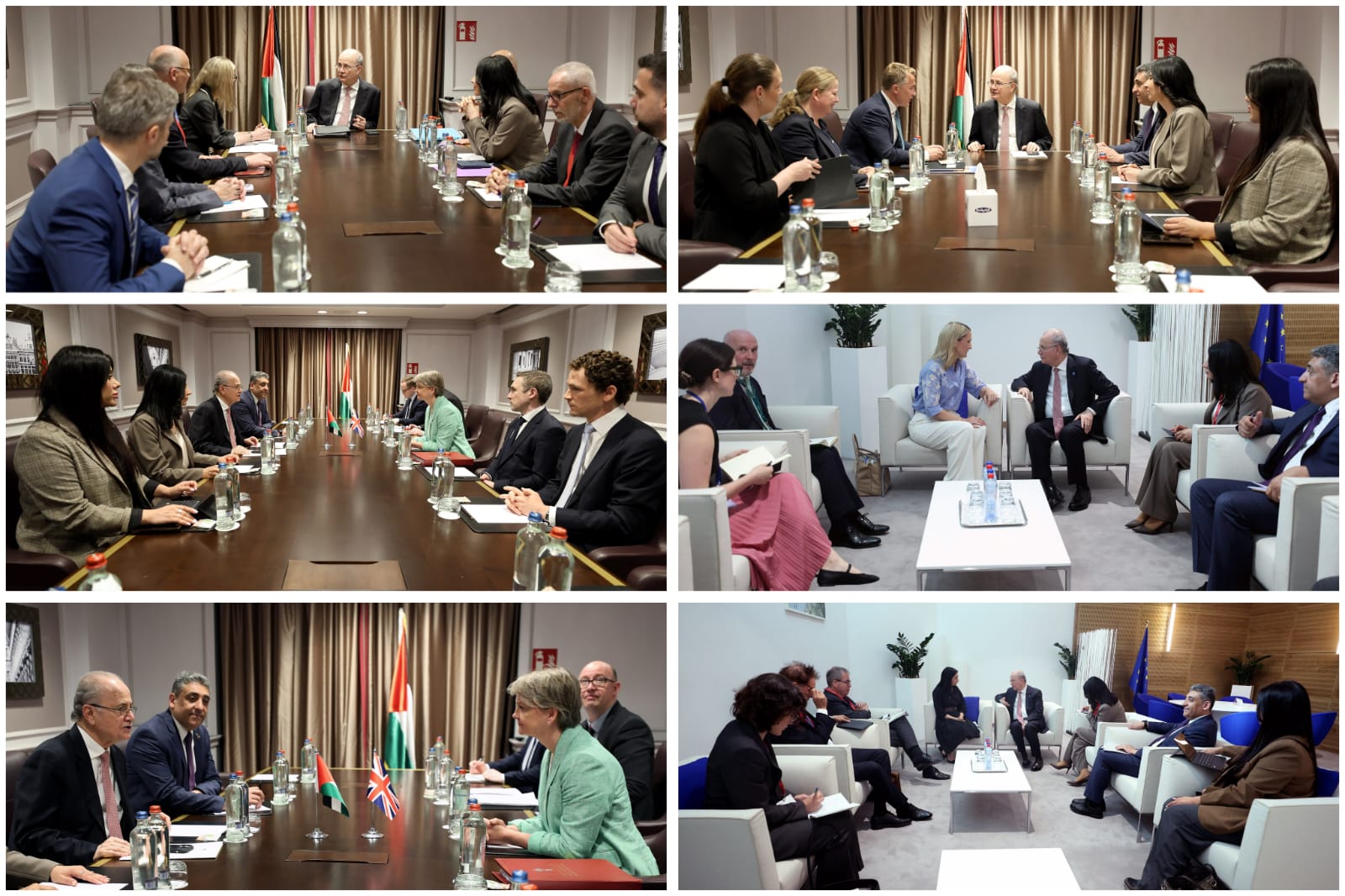
BRUSSELS, July 13, 2026 (WAFA) – Prime Minister Mohammad Mustafa met on Monday with several European and international officials on the sidelines of the second ministerial meeting of the Palestine Donor Group in Brussels.
The meetings were held in the presence of Minister of Finance and Planning Estephan Salameh, Palestine’s Ambassador to Belgium, Luxembourg and the European Union Amal Jadou Shakaa, and Undersecretary of the Ministry of Foreign Affairs for Political Affairs Omar Awadallah.
The meetings included Norwegian State Secretary for Foreign Affairs Andreas Motzfeldt Kravik, British Secretary of State for Foreign, Commonwealth and Development Affairs Yvette Cooper, Irish Minister for Foreign Affairs and Trade Helen McEntee, German Federal Minister for Economic Cooperation and Development Reem Alabali-Radovan, and Managing Director of Operations at the World Bank Anna Bjerde.
During the meetings, Mustafa reviewed the latest developments on the ground and the deteriorating humanitarian and social conditions resulting from the Israeli occupation’s continued measures in the occupied West Bank, including restrictions on freedom of movement, daily raids, colonist violence and terrorism, land seizures for colonial expansion, and the continued unlawful withholding of Palestinian clearance revenues.
He also highlighted the dire situation in the Gaza Strip, including the worsening humanitarian crisis and severe shortages of supplies, medicines, and materials required for reconstruction and recovery efforts.
The Prime Minister stressed that the reality on the ground in the Gaza Strip demonstrates that UNRWA remains a fundamental pillar of the humanitarian response, alongside the institutions of the State of Palestine, non-governmental organizations, and international institutions. He said these entities collectively provide essential services to the population of the Gaza Strip and that there is currently no practical alternative to their role.
Mustafa also addressed the financial situation and the unprecedented crisis facing the government as a result of Israel’s continued withholding of Palestinian clearance revenues, which has severely constrained the government’s ability to fulfill its obligations toward the Palestinian people. He called for intensified international pressure on Israel to release the withheld revenues and prevent the collapse of Palestinian institutions.
The Prime Minister said the government is working at full capacity to maintain the continuity of state institutions and public services despite the severe fiscal deficit. He added that the government has taken exceptional measures to prevent institutional collapse, but that its room for maneuver has become extremely limited.
Mustafa stressed that Israeli policies also include financial and economic measures aimed at weakening the State of Palestine and its institutions and undermining their viability.
These measures include the continued withholding of Palestinian clearance revenues, the surplus of Israeli shekels in Palestinian banks, and Israel’s refusal to receive or settle it, depriving the Palestinian economy of liquidity and limiting its ability to finance businesses and investments. He added that preventing Palestinian workers from reaching their workplaces inside Israel has also caused the Palestinian economy billions of dollars in annual losses.
The Prime Minister further said that the government is moving forward with a program of democratic renewal, highlighting the holding of local elections in the occupied West Bank and a pilot electoral process in the city of Deir al-Balah in the central Gaza Strip, as the city was relatively less affected than other areas.
He also referred to preparations for parliamentary elections scheduled for November 28, stressing the need for the State of Palestine to receive international support and for pressure to be exerted on Israel to ensure that the elections are held fully and without obstruction in East Jerusalem and the Gaza Strip.
For their part, the officials stressed that the clearance revenues withheld by Israel constitute Palestinian funds and reaffirmed the Palestinian Authority’s legitimate right to receive them.
They affirmed their commitment to continuing joint efforts to preserve the stability of Palestinian institutions and strengthen their resilience in the face of ongoing political and financial pressures, support early recovery programs in the Gaza Strip, and facilitate the entry of aid and temporary shelter.
The officials also expressed their deep concern over the continued deterioration of the humanitarian crisis in the Gaza Strip, the stalled political process, colonial expansion in the occupied West Bank, and colonist terrorism. They also affirmed their interest in following the progress achieved by the Palestinian government in implementing its reform and institutional development programs.
T.R.


