By Israa Ghurani
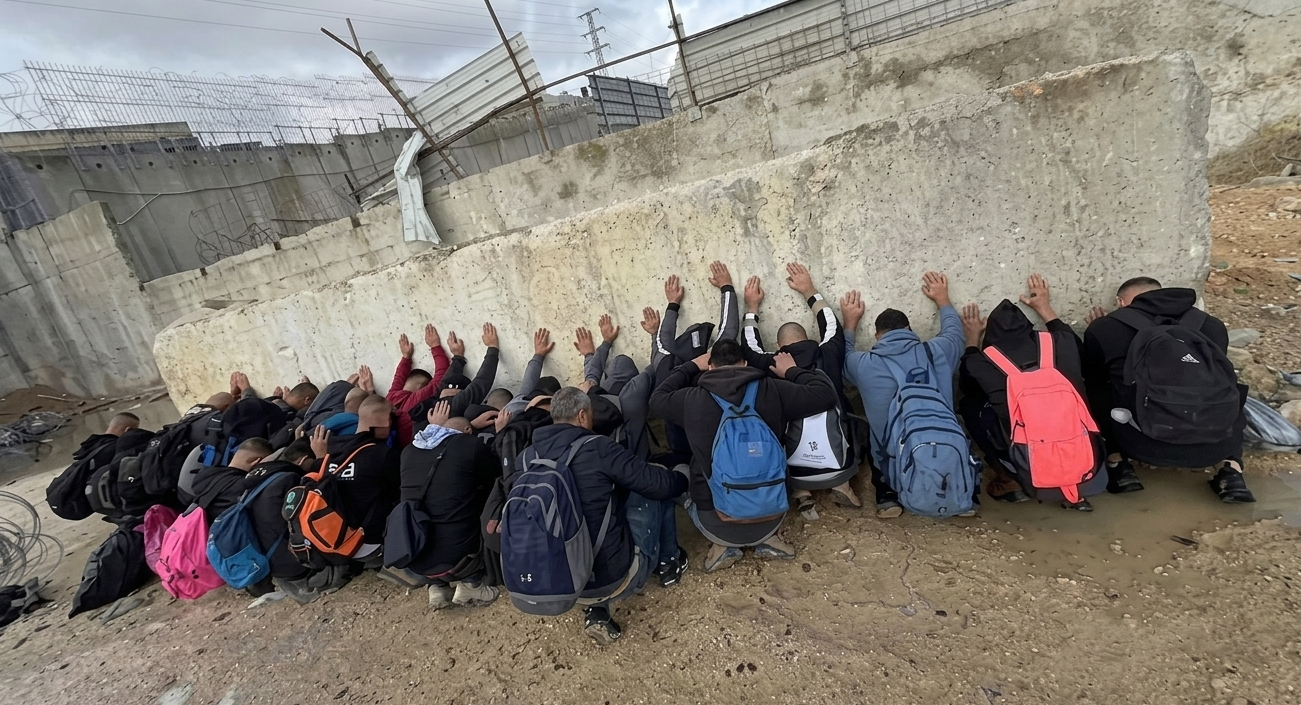
RAMALLAH, May 1, 2026 (WAFA) — In recent months, not a single day has passed without successive reports of Palestinian workers being pursued, detained, or injured while attempting to enter Israel for work by crossing the Israeli separation wall adjacent to the town of Al-Ram, north of occupied Jerusalem.
These incidents are usually accompanied by documented scenes and graphic images of workers bleeding on the wall after being shot by occupation forces—grim images born of a reality that has become the harshest for Palestinian workers. They have been forced to confront daily dangers that have reshaped their worsening tragedy over the past two and a half years, coinciding with the war of genocide on the Gaza Strip.
A dangerous gap
These daily scenes highlight the vast gap between workers worldwide and Palestinian workers, whose demands have shrunk under Israeli occupation. While the world marks International Workers’ Day on May 1 by demanding additional labor rights such as raising the minimum wage, Palestinian workers find themselves demanding the basic right to work and to earn a livelihood—one for which they risk death.
Yousef Aqel from the town of Biddya, in the central West Bank, is one of the workers who lost his life in recent months while trying to earn a living. Occupation forces shot him as he attempted to cross the separation wall in Al-Ram.
On December 23, Aqel died in the hospital after spending ten days in intensive care due to severe gunshot wounds to his lower limbs.
More than four months after his death, his brother Haitham—who was with him at the moment he was shot—still recounts the painful details of that day.
Haitham told WAFA: “We headed to Al-Ram to enter Israel for work along with dozens of other workers. We began climbing the ladder placed against the wall one by one.”
“When we reached the top of the wall, my brother Yousef—who was a few steps ahead of me—and I were surprised by gunfire. We quickly started descending. I reached the bottom of the ladder while Yousef was coming down slowly after being shot in both legs. I feared he would fall, so I went back up to help him down,” he added.
He continued: “Yousef lost a lot of blood on the ladder. We immediately took him to the hospital, where he remained for ten days before passing away.”
Yousef had worked inside Israel for nearly five years, but with the outbreak of the war on Gaza and the suspension of work permits, he lost his primary source of income and remained unemployed for six months.
As the economic situation worsened and faced with family responsibilities, Yousef—a father of two—began taking the risk of crossing through the wall. He would be away for about a month at work, return home for a few days, and then repeat the journey until he was injured and killed on his final attempt.
Yousef’s story was repeated throughout 2025, with 18 workers killed while trying to reach their jobs. More than 50 workers have been killed since October 7, 2023, in addition to many injuries, according to statistics from the General Federation of Palestinian Trade Unions.
A bitter reality
The dangers facing workers are not limited to death, injury, or arrest. Those who escape these fates face an equally harsh reality. The majority of workers have endured extremely difficult living conditions for over two and a half years, marked by a complete lack of income, leaving them unable to meet even their families’ most basic needs.
Abu Mohammad, 52, from Tubas governorate, who lost his job inside Israel, spoke to WAFA about his extremely difficult living conditions over the past two and a half years.
A father of eight, he said that like many workers, he has been unemployed for more than two years, leading to a severe decline in his living conditions. Many days, he cannot provide even the simplest necessities for his family. He also has two daughters in university and fears he will be unable to support their education or pay their tuition.
Over two years, Abu Mohammad tried every possible avenue to find work, but most attempts failed. The labor market in the West Bank has been devastated by restrictions, closures, and daily violations carried out by occupation forces alongside the war on Gaza. He has only managed to find occasional work for a few days at a time—income that is far from sufficient to support his family.
Despite living in Tubas and the northern Jordan Valley—an agricultural area that once absorbed large numbers of workers, especially during harvest seasons—he could not find work in agriculture either. Many workers in this sector have lost their jobs due to tightened control and restrictions imposed by occupation authorities, including checkpoints and gates.
“Today, workers are left at the mercy of fate—facing death, injury, and arrest, or an equally devastating fate of having no source of income,” he added.
For his part, Saeed Imran, a member of the media department of the General Federation of Palestinian Trade Unions, noted that workers have been facing extremely harsh conditions for more than two years. They have been prevented from reaching their workplaces inside the 1948 territories, forcing them to risk their lives by taking dangerous routes to find work. These routes often lead to tragic outcomes, including death, injury, or arrest.
He pointed out that around 50 workers have been killed since October 7, 2023.
Imran also highlighted that 38,000 cases of arrest among Palestinian workers have been recorded since that date. Some are later released, while others remain imprisoned, facing court proceedings and fines of up to 10,000 shekels—further worsening their situation.
Severe violations
Workers’ suffering does not end there. Other forms of abuse have emerged, including exploitation by Israeli employers who take advantage of workers’ vulnerability and pay them unfair wages.
Additionally, workers are exploited by brokers who charge large sums to smuggle them through alternative routes. These methods are often dangerous and degrading, sometimes resulting in detention—as happened less than a month ago when workers were forced to enter in a garbage truck.
Imran explained that Palestinian workers have long suffered under harsh conditions due to Israeli violations across many sectors. However, the situation has reached its most difficult and dangerous stage since the war on Gaza, with intensified methods of pursuit and increasing risks. He also pointed to plans by the far-right minister Itamar Ben-Gvir to establish a special prison for workers.
Recent statistics from the General Federation of Palestinian Trade Unions indicate that around 550,000 workers are unemployed, including 250,000 who previously worked inside the 1948 territories. Unemployment rates have reached unprecedented levels—85% in Gaza and 38% in the West Bank—reflecting the scale of the crisis affecting the Palestinian labor market and undermining the foundations of a dignified life for workers.
M.N