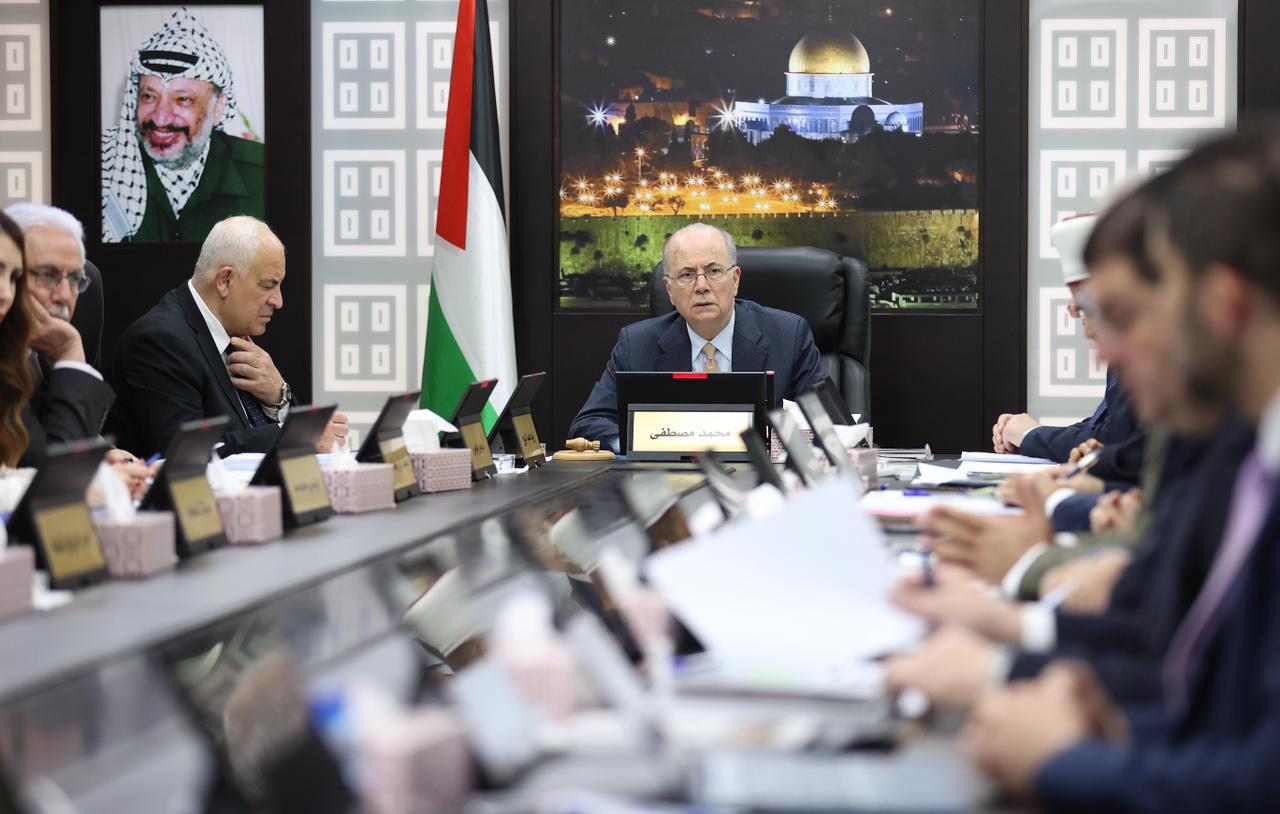
RAMALLAH, February 24, 2026 (WAFA) – At the opening of the weekly Cabinet session held today, Prime Minister Mohammad Mustafa briefed ministers on the latest political and diplomatic engagements aimed at defending the rights of the Palestinian people across international forums.
The Cabinet cautioned that the humanitarian situation in the Gaza Strip remains acutely precarious, pointing to an unjustifiable slowdown in the entry of humanitarian assistance and basic necessities. Such delays, it stressed, have exacerbated civilian hardship, particularly amid heavy rainfall that has inundated hundreds of makeshift shelters, further undermining already fragile coping mechanisms in the face of recurring winter storms. This unfolding crisis persists as residents continue to grapple with the devastating consequences of sustained Israeli military aggression and their far-reaching impact on every facet of daily life, despite the declared ceasefire.
In the same context, the Cabinet condemned the Israeli authorities’ decision to seize 2,000 dunums of land belonging to the towns of Sebastia and Burqa, north of Nablus. The move, it said, targets the archaeological site in Sebastia and undermines Palestinian historical heritage, coinciding with a surge in demolition notices and intensified demolition operations across various areas.
The Cabinet stressed that such dangerous escalation against Palestinian land requires a serious and firm international stance to deter Israel and halt its ongoing violations.
It also affirmed its readiness to coordinate and cooperate with the High Representative for Gaza to ensure the provision of essential services and to enable relief, recovery, and reconstruction programs during the transitional phase, in line with United Nations Security Council Resolution 2803, in a manner that advances efforts toward realizing an independent Palestinian state in accordance with international legitimacy resolutions.
In a separate development, the Cabinet received a briefing from the Minister of Agriculture regarding Israeli media claims alleging contamination of Palestinian vegetables with pesticide residues. The minister underscored the existence of a continuous inspection and monitoring system that operates in accordance with international standards.
it further explained that imported pesticides are subject to inspection and regulatory procedures by relevant Israeli authorities, given their control over crossings and borders, ensuring that only products meeting approved specifications enter the market.
The Ministry of Agriculture launched the 2025 Agricultural Pesticides Guide as a national reference regulating the safe and responsible use of pesticides. Following comprehensive testing, 198 pesticides were approved out of 530 previously circulated locally.
The Cabinet directed the expansion of cooperation with the private sector to counter what it described as Israeli allegations aimed at undermining national products and constraining the agricultural sector.
T.R.