JERUSALEM, December 21, 2009 (WAFA)- Office for the UN Coordination of Humanitarian Affairs occupied Palestinian territory (OCHA) said that the Israeli military activities from December 9-15, 2009 affected civilians while 11 Palestinians were injured by Israeli forces.
The OCHA report said this week, Israeli security forces injured 11 Palestinians throughout the West Bank, including East Jerusalem, compared to a weekly average of 17 Palestinian injuries since the beginning of 2009.
Five Palestinians were shot and injured by live ammunition and rubber‐coated metal bullets during the weekly anti‐Barrier demonstrations in Ni’lin village (Ramallah). Following the demonstration, the Israeli army closed the partial checkpoint (a checkpoint staffed on an ad‐hoc basis) at the entrance of the village for seven hours, preventing movement through the checkpoint. Another three injuries occurred during confrontations that erupted between Palestinians and Israeli forces in the Beit Safafa neighbourhood of East Jerusalem, after the Jerusalem municipality demolished a mechanical workshop lacking a building permit.
The remaining three Palestinians were injured when physically assaulted by Israeli security forces in the south (one) and in East Jerusalem (two).
Israeli forces conducted 92 search operations inside Palestinian villages, the majority of which took place in the northern West Bank (67). This compares to a weekly average of around 100 operations since the beginning of 2009. The number of Palestinians arrested during search operations in the northern West Bank has more than doubled this week( 41) compared to the last week (20).
Significant increase in settler-related incidents This week, there were 19 settler‐related incidents reported throughout the West Bank, almost twice the weekly average since the beginning of 2009 (eight). Of the total incidents, 11 affected Palestinians, resulting in the injury to four and in damage to property; the remaining eight incidents affected Israeli settlers, resulting in injury to three settlers.
During the reporting period, protests continued by settlers against the 10‐month freeze on new residential construction in West Bank settlements (excluding East Jerusalem), announced by the Israeli cabinet in late November 2009. A group of Israeli settlers entered Yasuf village (Salfit) on December 11 and set fire to the mosque, resulting in damage to the mosque’s library, carpets and loudspeakers. They also sprayed the Hebrew expression “price tag” on the mosque’s floor, in reference to their policy of avenging any settlement evacuation or freeze by the Israeli government.
After the attack, Palestinian residents clashed with members of the Israeli Border Police. In another related incident, Israeli settlers from the Karme Tzur settlement (Hebron) blocked Palestinian traffic on Road 60 next to the settlement entrance, hurling stones and damaging five Palestinian cars.
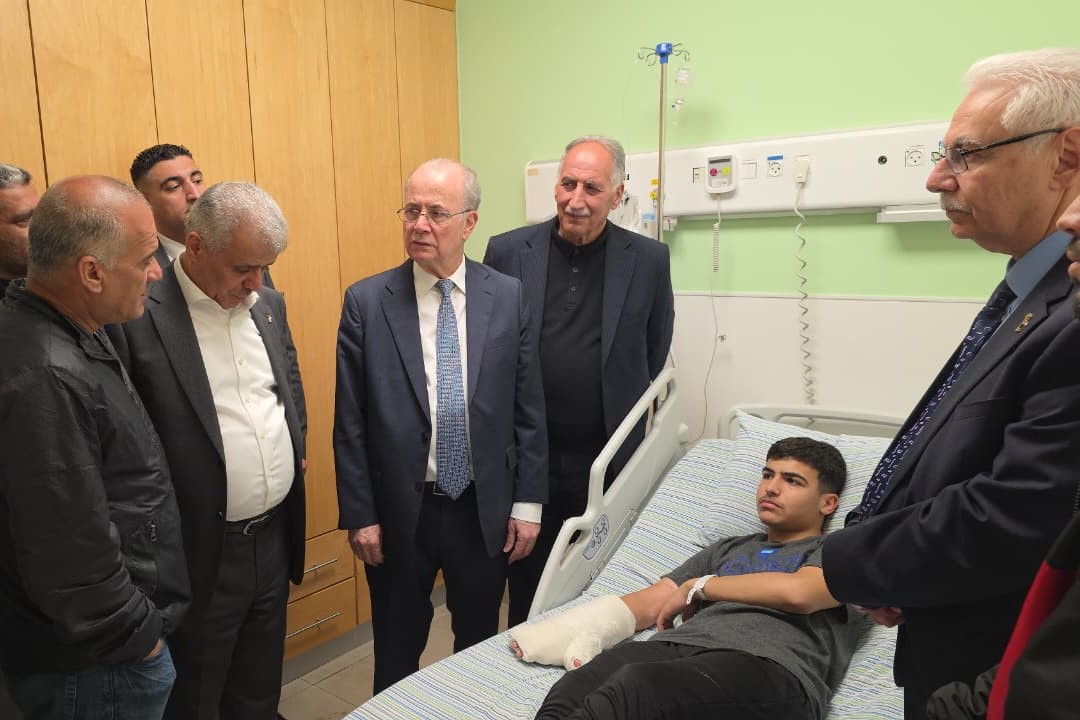
In four separate incidents, Israeli settlers physically assaulted and injured four Palestinians, including three boys. One of these incidents, which occurred onDecember 9, involved a 13 years‐old boy from Qarawat Bani Hassan village (Salfit), who was physically assaulted and injured by two Israeli settlers from the Revava settlement, while he was walking in the vicinity of the settlement with a knife. Due to the gravity of the injuries, the boy was evacuated to an Israeli hospital; after his condition stabilized, he was transferred to an Israeli detention center under suspicion of attempting to attack the settlement and released on the following day.
During the week, settlers from Adei Ad settlement outpost uprooted 260 olive seedlings from a plot of land belonging to a Palestinian farmer from Al Mughayyir village (Ramallah). According to the owner, the same plot of land has been previously vandalized in July 2009 and December 2008. In a separate incident, settlers from Tel Rumeida settlement in Hebron City (H2) ploughed over a plot of land belonging to Palestinians residents of the city.
Also this week, over 200 Israeli and international peace activists held a demonstration in the Sheikh Jarrah neighborhood protesting recent evictions of Palestinian residents of the neighborhood. During the demonstration, Israeli forces fired tear gas to disperse the protestors and physically assaulted several of them, injuring one Israeli activist. Moreover, 24 activists were arrested, 21 of whom were released on the condition that they stay away from the Sheikh Jarrah for 30 days. During this demonstration, dozens of Israeli settlers performed prayers beside one of the recently evacuated houses.
Of the three settlers injured this week by Palestinians, one was a woman, who was stabbed at a bus station near Gush Etzion settlement bloc (Bethlehem). The other two Israeli injuries resulted from stone‐throwing towards Israeli‐plated vehicles driving on roads in the Ramallah area.
Main Nablus-Jenin road closed off Since 10 December, the Shave Shomeron checkpoint, located on the main road connecting Jenin and Nablus governorates (Road 60), has been closed by Israeli military forces for all movement. As a result, all residents of the Jenin governorate (274,000) travelling southwards, as well as West Bank residents travelling to Jenin, are forced to make detours in order to reach their destinations. This step has been reportedly adopted to facilitate the rehabilitation of a segment of Road 60, north to the checkpoint, scheduled to take place during the next nine months.
Between August 2005 and August 2008, Palestinian movement through this checkpoint was totally banned. This closure was originally announced as a “temporary measure” in the context of the
evacuation of Israeli settlements in this area, as part of the disengagement plan.
Protection of Civilians: 9 - 15 December 2009 3
In Gaza Strip, an unarmed Palestinian civilian was shot and killed by the Israeli military near his house, located 700 metres from the Gaza‐Israel border, east of Al Bureij camp, on 12 December. According to Al Mezan human rights group, the killing occurred in the context of an armed clash, in the course of which, a Palestinian armed group fired anti‐tank missiles at Israeli military vehicles patrolling along the border fence, after which the Israeli forces responded by firing tank shells. A number of Palestinian homes were also damaged as a result of this firing. Since the end of the “Cast Lead” offensive on 18 January 2009, a total of 89 Palestinians and one Israeli have been killed and another 154 Palestinians and seven Israelis injured in the context of the Israeli‐Palestinian conflict in Gaza and southern Israel.
Israeli forces have continued to prevent access into areas next to the border fence and beyond a fishing area of three nautical miles from the shore, through opening warning fire towards people entering or approaching these areas. In one incident this week, Israeli soldiers opened fire at two Palestinian boys aged 16 and 17, who were collecting rubble near the border fence, northeast of Gaza City.
Subsequently, the soldiers entered the area, detaining the two boys and took them for interrogation within Israel; one of the boys was released after a few hours while the other remained in custody. In a separate incident, Israeli troops opened fire towards farmers working the land next to the border fence east of Khan Younis, forcing them to leave the area.
Also, on three separate occasions, Israeli forces launched an incursion a few hundred metres into the territory of Gaza and withdrew after conducting land‐leveling activities. On two separate occasions, Israeli naval forces opened fire towards Palestinian fishing boats, forcing them to return to shore; while no injuries or damage were reported, five fishermen were arrested and then released after a few hours and one boat was confiscated.