


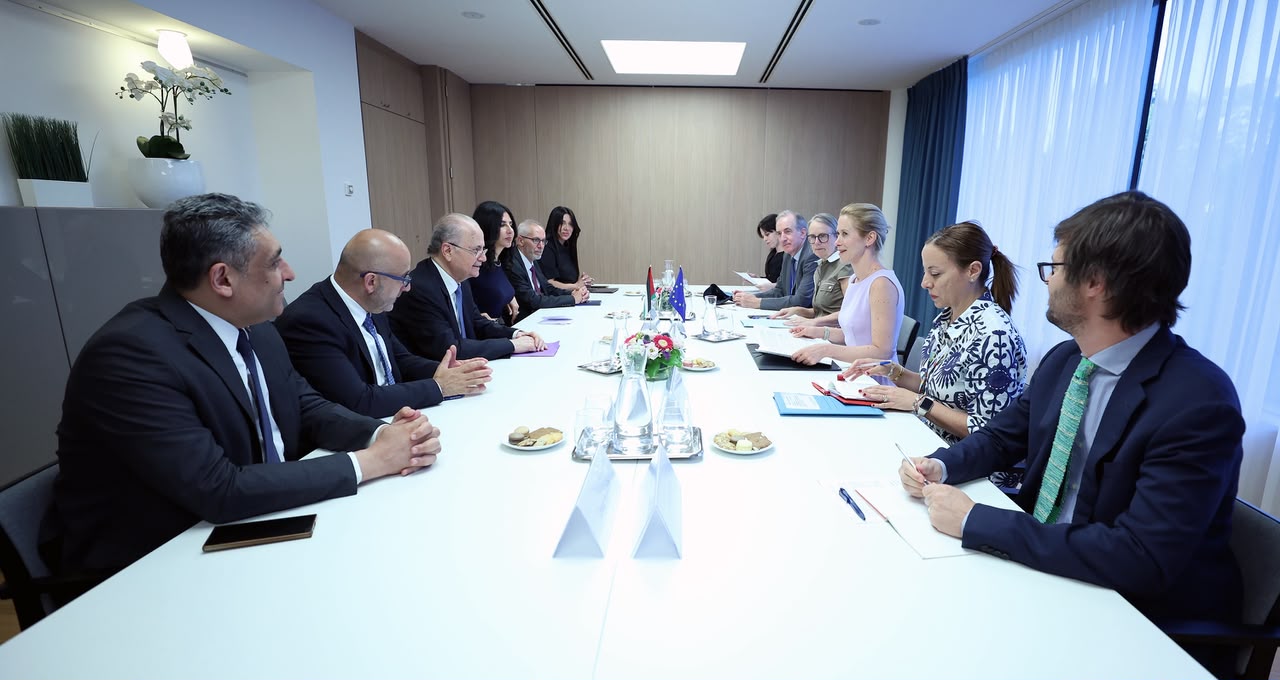
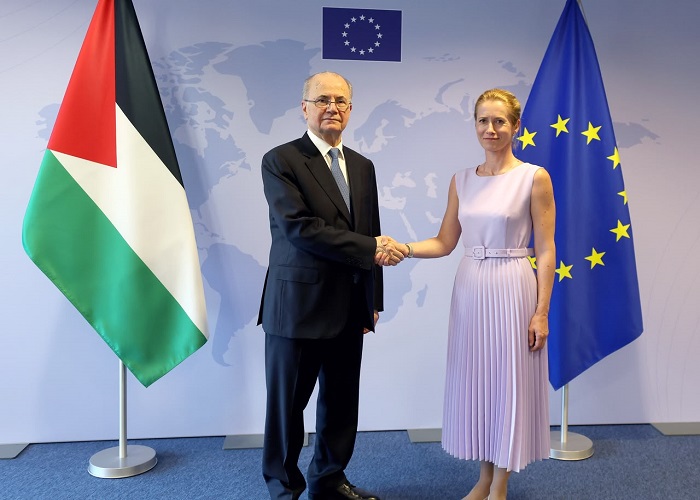
BRUSSELS, July 12, 2026 (WAFA) – Prime Minister Mohammad Mustafa on Sunday evening held talks with the European Union High Representative for Foreign Affairs and Security Policy and Vice-President of the European Commission, Kaja Kallas, on the latest political developments and the situation on the ground in the Gaza Strip and the West Bank, including Jerusalem, during a meeting in the Belgian capital, Brussels.
The meeting was attended by Minister of Finance Estefan Salameh, Palestine’s Ambassador to Belgium, Luxembourg, and the European Union, Amal Jadou Shakaa, and Undersecretary of the Ministry of Foreign Affairs and Expatriates for Political Affairs, Ambassador Omar Awadallah.
The Prime Minister stressed the need to increase international pressure on Israel to release the withheld Palestinian tax revenues to enable the government to fulfill its obligations toward the Palestinian people and continue providing essential services. He also rejected any arrangements that undermine Palestinian financial rights.
Mustafa briefed Kallas on the dangerous escalation in the West Bank, particularly colonists’ attacks and acts of violence against Palestinians, including attacks on villages and communities, which have reached unprecedented levels amid the support of some Israeli ministers who hold broad powers over affairs in the West Bank.
Mustafa stressed the need for the international community to exert further pressure on Israel to open crossings with the Gaza Strip and allow the entry of aid convoys, reconstruction supplies and early recovery materials, in light of the deteriorating humanitarian conditions and growing suffering among residents of the Strip. He also stressed the importance of mobilizing greater European support for Gaza’s recovery plan.
The two sides also discussed preparations for the upcoming Palestinian legislative elections. Mustafa stressed the importance of holding the elections as a democratic entitlement that reinforces legitimacy and provides citizens with the opportunity to choose their representatives.
Mustafa also presented an overview of the government’s reform and development program, particularly in the areas of financial management, governance and social protection programs.
He noted that international assessment reports have confirmed the government’s commitment to transparency and reform standards, including the development of the social assistance payment system based on need-based criteria rather than other considerations.
He stressed that the government will continue implementing reforms and monitoring their implementation in coordination with the European Union and international partners.
Mustafa and Kallas also discussed ways to strengthen bilateral relations between the European Union and Palestine and expand areas of economic, trade and political cooperation, noting that further developing the partnership with the EU would contribute to supporting the Palestinian economy and enhancing the capacity of national institutions.
For her part, Kallas affirmed the European Union’s continued commitment to supporting the implementation of the Palestinian reform plan, efforts to rebuild Gaza, remove rubble and facilitate medical evacuations, despite political challenges and restrictions imposed on the work of European missions.
Kallas also noted that the European Union is working to maintain its support for Palestinian institutions despite challenges related to program funding and continued Israeli restrictions.
T.R.


