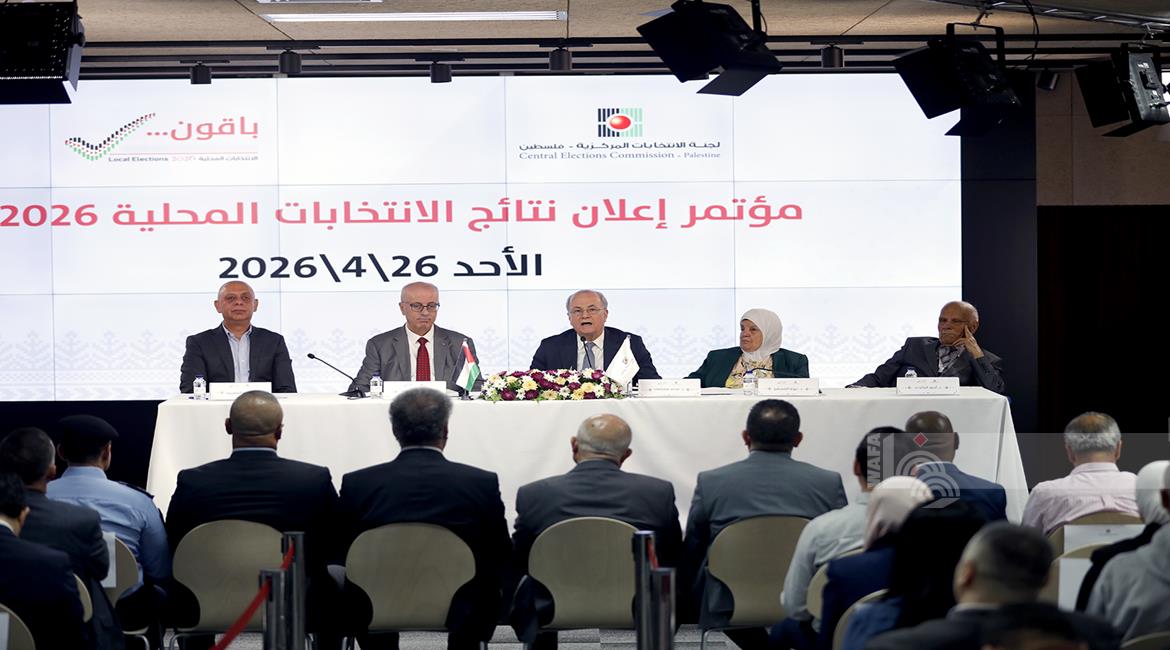
RAMALLAH, April 26, 2026 (WAFA) – The Central Elections Commission announced on Sunday the final results of the local elections held in 183 local councils in the West Bank, in addition to the city of Deir al-Balah in the Gaza Strip, including the number of votes and seats won by each list.
Head of the Commission, Rami Hamdallah, said during a press conference in Al-Bireh that the electoral process took place under highly complex conditions but was completed with integrity and transparency.
He explained that the new election law was applied for the first time, introducing an open-list system and a mixed individual system, which required extensive awareness programs and the training of thousands of trainers to ensure the success of the process.
Regarding the elections held in Deir al-Balah in central Gaza, Hamdallah said the commission treated the West Bank and Gaza Strip as a single geographic unit despite major challenges facing the process.
He noted that one of the main difficulties was the inability to bring in electoral materials, adding that residents in Gaza managed to locally print ballot papers and prepare boxes, enabling the elections to take place in the city.
Hamdallah said voter turnout reached 23 percent, attributing the low rate to reliance on an outdated civil registry amid the presence of thousands of fatalities and the displacement of entire families from Deir al-Balah to other areas.
He expressed hope that elections would soon be held in additional local councils across the Gaza Strip.
Hamdallah added that a total of around 522,000 voters cast their ballots, while 197 local bodies were won by acclamation. He said turnout in the West Bank reached 56 percent, compared with 53.7 percent in 2012, 53.8 percent in 2017, and 58 percent in 2022.
He noted that Salfit governorate recorded the highest turnout at 71 percent, while Deir al-Balah recorded the lowest at 23 percent. He also said invalid ballots stood at 4 percent, blank ballots at 1 percent, and valid ballots at 95 percent, attributing the low rate of invalid votes to intensive awareness campaigns. Women’s representation among winners reached 33 percent.
Meantime, Prime Minister Mohammed Mustafa congratulated the Central Elections Commission and the Palestinian people on this advanced national step on the path toward full and complete independence across all Palestinian territories, including the Gaza Strip and occupied Jerusalem.
Mustafa said that the local elections were held at a highly important time and under complex challenges and exceptional circumstances, stressing that their successful implementation in the West Bank and partially in the Gaza Strip constitutes an important first step within a broader national process aimed at consolidating democratic life, strengthening the resilience of national institutions, and achieving national unity.
The Prime Minister emphasized that local elections are not merely an administrative or technical procedure, but part of an integrated government vision aimed at strengthening the role of local authorities and enabling them to serve citizens.
He pointed out that the Ministry of Local Government will continue, as mandated by law, to support elected local councils in developing work systems, improving institutional performance, upgrading their classification, and enhancing services, in addition to completing financial settlement processes to ensure their sustainability.
Mustafa added that efforts will also continue to attract funding and grants necessary for infrastructure projects, contributing to strengthening municipalities and local governance bodies and increasing their impact on improving citizens’ lives.
He stressed that the Gaza Strip is an integral part of the State of Palestine and its people, affirming that the goal is to reunify the Strip with the West Bank under Palestinian legitimacy, as a prelude to establishing the state across all Palestinian territories.
Mustafa explained that the leadership welcomed UN Security Council Resolution 2803 and the subsequent arrangements for a ceasefire, calling for its full and swift implementation. He noted that the ceasefire has not yet been fully realized, and that the Israeli occupation’s presence in Gaza still exists and must be urgently ended.
He stressed the need to open all crossings for the urgent entry of humanitarian aid, and then move toward reconstruction needs, noting that the current level of aid remains far below what was agreed upon and what citizens require.
He also pointed to continued security instability, warning that it could be used as a pretext to delay reconstruction, and called for accelerating the implementation of transitional arrangements, which span 20 months following an initial four-month period.
On the economic front, Mustafa said that the occupation has not only imposed a blockade on Gaza but is also working to suffocate the West Bank, including Jerusalem, through political, security, and settlement tools, in addition to the continued withholding of Palestinian clearance revenues.
He added that these deductions have increased over the past 12 months, with no tax or customs revenues being transferred to the treasury of the State of Palestine.
The Prime Minister considered these measures to be “another occupation,” stressing that the government is working on two tracks: pressuring Israel to release withheld funds, and providing what is possible to thwart Israeli plans aimed at subjugating the Palestinian people.
Prime Minister Mohammed Mustafa said that over the past few months, the government has launched several support programs and projects directed at local authorities, which elected councils can benefit from to enhance their services.
He explained that these programs include $50 million through Arab and Islamic funds allocated to local governance bodies, as well as €40 million through the Municipal Development and Lending Fund, in addition to more than 170 million shekels in government support for local authorities from licensing fees, revenues from the Ministry of Transport and traffic fines.
He affirmed that these efforts aim to enhance services provided to citizens, particularly in the road and infrastructure sectors, contributing to improved service levels and efficiency across various areas, especially in roads and infrastructure.
M.N