By Rami Samara
RAMALLAH, May 23, 2026 (WAFA) – The killing of 16-year-old Palestinian boy Yousef Ali Ka’abneh was not viewed merely as another isolated death of a Palestinian at the hands of Israeli forces and colonists. Rather, it represented the bloody culmination of an integrated Israeli strategy aimed at creating “land without Palestinians.”
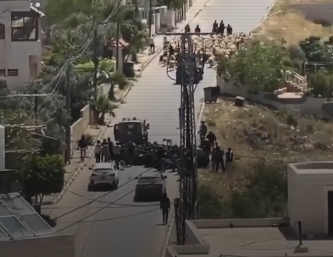
On the afternoon of May 13, Yousef Ka’abneh was shot dead by Israeli soldiers while residents attempted to confront an attack by Israeli colonists, carried out under army protection, targeting the towns of Sinjil, Jiljilya, and Abwein northeast of Ramallah. The assault ended with the theft of around 700 sheep.
According to local and rights organizations, the incident constituted a complete crime: a child killed while defending property, by soldiers deployed to protect colonists carrying out a daylight attack and livestock theft.
The Wall and Settlement Resistance Commission says Palestinian livestock, once a pillar of food security, has become a direct target of a systematic destruction campaign led by colonists under official protection, describing it as one of the fiercest “silent battles” over land seizure.
The commission documented 102 direct attacks affecting 4,796 livestock animals between the beginning of 2026 and mid-May alone.
Statistics from the Palestinian Ministry of Agriculture indicate that during 2025, at least 5,236 sheep were either stolen or killed by colonist groups across the occupied West Bank, causing financial losses estimated at nearly $1.8 million.
The ministry says the attacks extend throughout the West Bank and go beyond isolated incidents, reflecting a systematic pattern involving livestock theft, shootings, beatings, and even mass killings of poultry farms.
The violations also include indirect damage, such as poisoning or puncturing water tanks used for animals, demolishing wells, and destroying irrigation systems, particularly near settlement outposts and pastoral colonies.
According to ministry figures, losses in the water sector alone reached approximately $1.58 million across the West Bank in 2025, with Bedouin and herding communities among the hardest hit because of their dependence on water access for grazing livestock.
Hassan Mleihat, head of the Al-Baydar Organization for the Defense of Bedouin Rights, said the West Bank is witnessing a colonial escalation that amounts to organized crime, with livestock theft and killings becoming a strategic tool to impose demographic and geographic control, especially in Area C.
Mleihat said the attacks are not aimed merely at theft, but form part of a broader policy backed by the Israeli government and far-right actors to pressure Palestinians into displacement and land abandonment.
“These attacks target two core pillars of rural and Bedouin life: security and stability,” he said. “If theft does not cause fear, it ultimately leads to impoverishment and destruction of livelihoods.”
According to Al-Baydar’s documentation, roughly 22 Bedouin communities have already been displaced after residents moved elsewhere seeking safety and preserving what remained of their livelihoods.
One of the largest recorded livestock thefts occurred in the Shallal al-Auja community in March 2025, when colonist groups reportedly seized 800 sheep in a single night.
Mleihat added that colonists often move stolen livestock between different areas of the West Bank to complicate tracking efforts or deny theft allegations, later using the animals in pastoral settlement outposts.
He said this strategy is summarized by a slogan used among colonists: “Where our sheep reach, our feet reach.”
Under this approach, grazing becomes a mechanism for territorial expansion. Once colonists’ livestock enter a grazing or mountainous area, Palestinians are effectively prevented from accessing it, gradually transforming the land into de facto settlement-controlled territory.
Meanwhile, Abdullah Hammad of the Jerusalem Legal Aid and Human Rights Center described what he called systematic Israeli complicity involving colonists, soldiers, police, and courts.
Hammad said some colonists have become increasingly organized, marking stolen sheep with identifying symbols to claim ownership later if legal complaints are filed. Even when Palestinians provide video evidence, cases are frequently registered “against unknown persons.”
He also described what he called a newer tactic, in which colonists preemptively file complaints with Israeli police claiming Palestinians stole their sheep. Police then accompany the colonists to Palestinian communities and confiscate livestock directly from their owners.
Attempting to recover stolen livestock through Israeli legal channels, Hammad said, is “like entering the gates of hell,” as Palestinians must often travel alone to police stations located inside or near settlements and overcome major evidentiary obstacles.
He stressed the need for Palestinian authorities to establish livestock identification systems using numbered ear tags and official databases to facilitate legal claims and tracking of stolen animals.
Hammad added that occasional returns of confiscated livestock are often used to project an image of “justice” while only a small fraction of stolen herds are actually restored.
According to Palestinian institutions, the broader consequences of these attacks extend far beyond the immediate economic losses. Families lose primary sources of income, production of meat and dairy declines, grazing lands shrink, feed costs rise, and herders are forced into debt to rebuild stolen flocks.
Observers warn that, in the absence of accountability, 2026 may witness the highest recorded losses in the Palestinian livestock sector since such violations began to be systematically documented.
Attacks involving livestock theft, destruction of shelters, poisoning of grazing lands and water sources, and assaults on shepherds violate the Fourth Geneva Convention, particularly Article 53 prohibiting destruction of private property by an occupying power.
Depriving herding communities of livelihoods to force displacement violates Article 49 of the convention, which prohibits forcible transfer of protected populations.
M.N