By Ma'en Rimawi
RAMALLAH, May 24, 2026 (WAFA) – The Bedouin community of Khan al-Ahmar, east of occupied Jerusalem, once again stands at the center of a struggle over Palestinian presence, after ultranationalist Israeli Finance Minister Bezalel Smotrich renewed efforts to advance plans for its evacuation and the displacement of its residents.
The move is seen as part of a broader scheme that extends beyond a small community to the future of Jerusalem and the unity of Palestinian geography as a whole.
Following the International Criminal Court’s decision to seek an arrest warrant against him, Smotrich issued an immediate order to evacuate the community. Shortly afterward, Israeli authorities announced the establishment of a new outpost approximately 60 meters from the Khan al-Ahmar school, near the settlements of Ma’ale Adumim and Kfar Adumim.
The decision cannot be separated from a longstanding settlement project aimed at completing the so-called “Greater Jerusalem” plan extending toward the Dead Sea. The plan seeks to tighten the settlement ring around Jerusalem from the east and link settlement blocs together, effectively isolating the northern West Bank from the south and undermining the possibility of a geographically contiguous Palestinian state.
Khan al-Ahmar holds strategic importance due to its location. The community, home to around 45 families (approximately 320 residents), includes a school, mosque, and health clinic, and lies only about 12 kilometers from the Al-Aqsa Mosque.
With Israeli closures restricting access to Jerusalem from the north, south, and west, the area has become the last remaining eastern corridor linking Palestinians to the city, making its control a decisive step in the project to isolate Jerusalem from its Palestinian surroundings.
The head of the Khan al-Ahmar village council, Eid Khamees, told WAFA that the current displacement plan is an extension of a settlement project that began after the 1967 occupation, when the area was declared a closed military zone before later being transformed into major settlements such as Ma’ale Adumim, Kfar Adumim, and Alon.
He added that the area stretching from al-Eizariya to the Dead Sea is almost entirely devoid of Palestinian communities except for Khan al-Ahmar, making its removal central to linking surrounding settlements and establishing a continuous settlement belt around East Jerusalem.
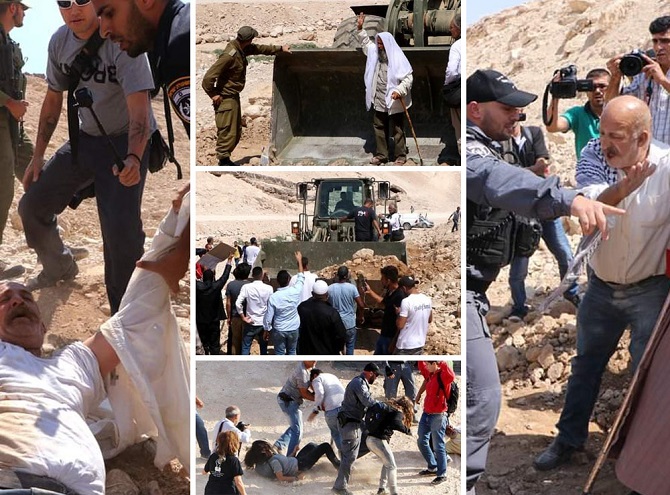
Khamees said residents live in constant fear of sudden demolitions, noting that night and day patrol groups have been formed and popular solidarity activities organized to maintain presence on the land.
He added that current conditions are more complex than in 2018, when international pressure helped stall demolition plans, due to escalating Israeli violations across the West Bank and reduced international attention amid regional crises and wars.
Residents emphasize that resilience must be matched with material support. The community, which relies mainly on livestock herding, faces continuous restrictions by colonists who prevent shepherds from accessing grazing areas.
Residents also face long-standing denial of work opportunities in nearby industrial zones, restrictions on construction, and repeated targeting of humanitarian and service projects.
Resident Mohammad Abu Dahouk, born in Khan al-Ahmar in 1955, said the community existed long before the 1967 occupation of the West Bank and Jerusalem, stressing that the goal of displacement is to seize large areas of land between Jerusalem and the Dead Sea.
He said residents live in constant anxiety, with many sleeping fully dressed in anticipation of sudden raids, adding: “This is the land we were born and raised on. Leaving it is extremely difficult regardless of pressure.”
Amir Dawood, director of publishing and documentation at the Colonization and Wall Resistance Commission, said the push to evacuate Khan al-Ahmar represents a dangerous escalation within Israel’s annexation policy aimed at emptying the Jerusalem periphery of its Palestinian population and further fragmenting the West Bank.
He told WAFA that Israel is exploiting current international preoccupation with regional crises to impose irreversible facts on the ground, noting that the “E1” area, where Khan al-Ahmar is located, is among the most strategically sensitive zones in the West Bank.
He added that the policy is not limited to Khan al-Ahmar but extends to Bedouin and pastoral communities in the Jordan Valley, the Jerusalem periphery, and Masafer Yatta, with the aim of controlling open spaces and emptying them of their indigenous population.
Dawood called for urgent political, legal, and diplomatic action beyond standard condemnations, including activating international accountability mechanisms and applying real pressure on Israel to halt forced displacement policies, while strengthening the resilience of residents.
He noted that Khan al-Ahmar has faced demolition and evacuation orders for years under the pretext of unlicensed construction, despite Israeli refusal to grant building permits. The case gained wide international attention in 2018 after warnings from the EU and UN that forced displacement would constitute a serious violation of international law amounting to a war crime.
Despite ongoing pressure and the establishment of additional settlement outposts in recent years, Khan al-Ahmar residents continue to hold onto their land, aware that their struggle extends beyond their community.
The village, though small in appearance, stands at a critical crossroads—not only for its residents, but for the future of Jerusalem, the territorial unity of the West Bank, and the prospects of an independent and contiguous Palestinian state.
M.N