


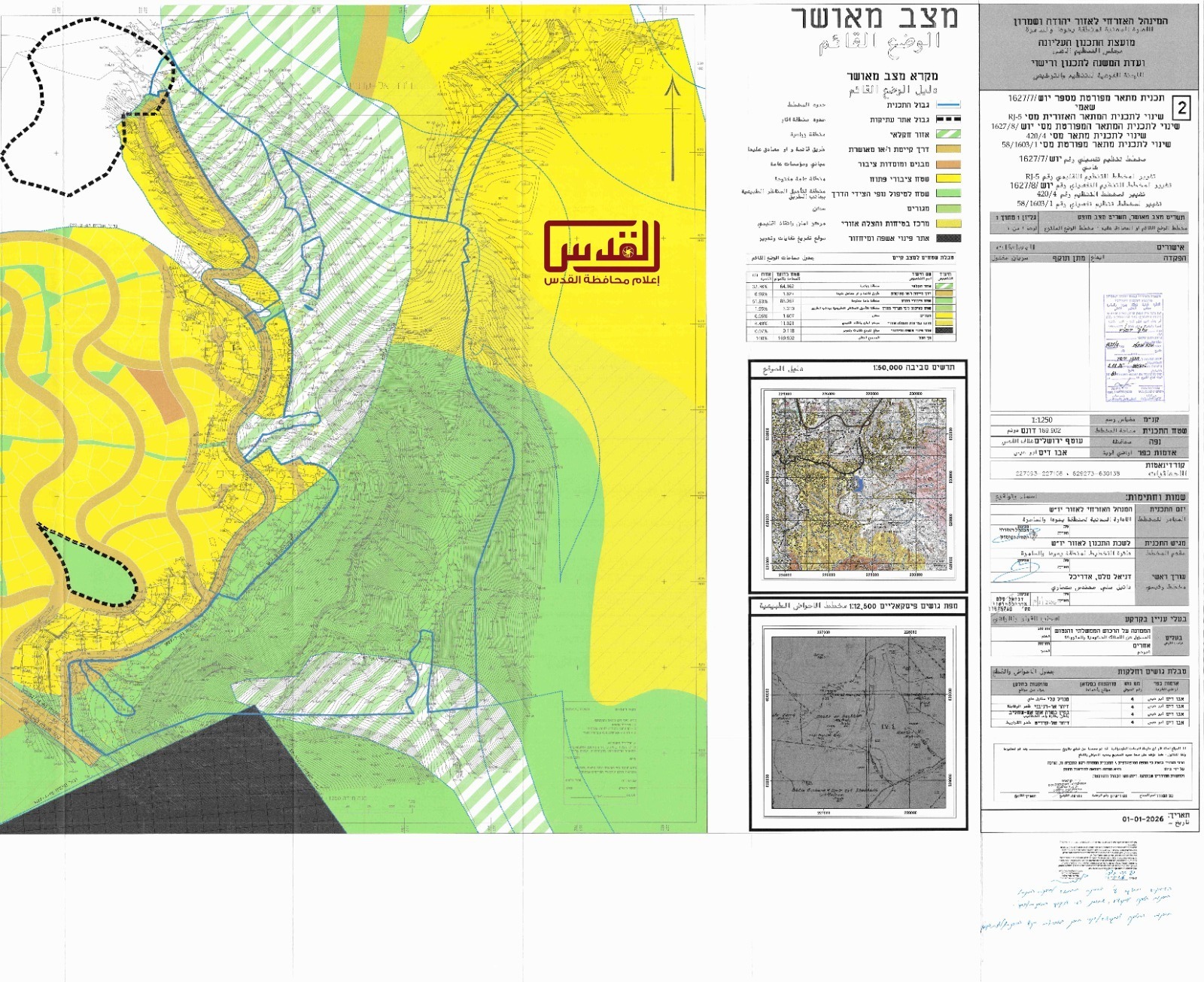
RAMALLAH, March 31, 2026 (WAFA) – The Jerusalem Governorate has warned of the dangers of the Israeli settlement plan No. (1627/7), known as “Shami Neighborhood,” describing it as an advanced tool to re-engineer the Bedouin presence in the Jerusalem periphery. The plan falls within ongoing Israeli policies aimed at reshaping the geographic and demographic reality east of occupied Jerusalem in favor of expansive settlement projects.
In a statement, the Governorate affirmed that Israeli occupation authorities deposited the plan on March 25, 2026, through the so-called Subcommittee for Planning and Licensing in the “Civil Administration.” The plan targets lands belonging to the town of Abu Dis within Basin No. (4), specifically in the areas of Dahr al-Raghabneh, Manazel Ali, Batin Bishara, Umm al-Shakhalib, and Dahr al-Qararit, covering an estimated area of 169.9 dunams.
The Governorate clarified that the plan aims to transform land use from agricultural and open spaces into a high-density urban residential neighborhood classified as “Residential B,” allocating approximately 79 dunams for housing and more than 35 dunams for roads. It also imposes a density of up to 12 housing units per dunam, with buildings reaching up to six stories.
The Governorate further noted that the plan directly targets several Bedouin communities, most notably the Khan al-Ahmar area, Abu Nuwar, and Arab al-Jahalin, in addition to Wadi Jmal, Jabal al-Baba, Wadi Snaysel, and Bir al-Maskoub (1 and 2). The plan seeks to forcibly transfer these communities from their open pastoral environment into a closed urban setting, leading to the dismantling of their social structure and the destruction of their livestock-based economy.
The Governorate stressed that this plan represents a direct and updated continuation of forced displacement policies that began in 1997, when groups from the Jahalin Bedouins were relocated to the outskirts of al-Eizariya to make way for settlement expansion, emphasizing that the occupation is now reproducing the same policies.
It also rejected Israeli claims of “consent” by representatives of the Bedouin communities, affirming that such claims lack credibility in the absence of free, prior, and informed consent, and in light of ongoing pressure and violations against these communities, which have repeatedly expressed their categorical rejection of any relocation or resettlement plans.
The Governorate highlighted that the plan is intrinsically linked to the E1 project, which aims to connect the settlement of Ma'ale Adumim to Jerusalem, thereby separating the northern and southern West Bank and undermining the possibility of a geographically contiguous Palestinian state. It noted that the Bedouin presence constitutes a spatial obstacle to this project, explaining the targeting of these communities through dismantlement and removal policies.
The statement affirmed that the plan constitutes a grave breach of international humanitarian law, particularly the absolute prohibition of the forcible transfer of protected persons under the Fourth Geneva Convention, as well as violations of the right to adequate housing and livelihood, and the prohibition of settlement activity in occupied territories.
The Governorate added that opening a 62-day objection period does not alter the coercive nature of the plan, given the absence of procedural justice and the imposition of complex restrictions that hinder Palestinians’ ability to effectively object.
Finally, the Jerusalem Governorate called on the international community to assume its legal and humanitarian responsibilities and take urgent action to halt the implementation of this plan, hold Israeli authorities accountable for policies of forced displacement, and support the resilience of targeted Bedouin communities while strengthening their presence on their lands as a first line of defense against displacement and colonization policies.
Y.S


