PM Mustafa: We will continue to protect our land, strengthen our people’s resilience, and build a Palestinian economy capable of sustaining production
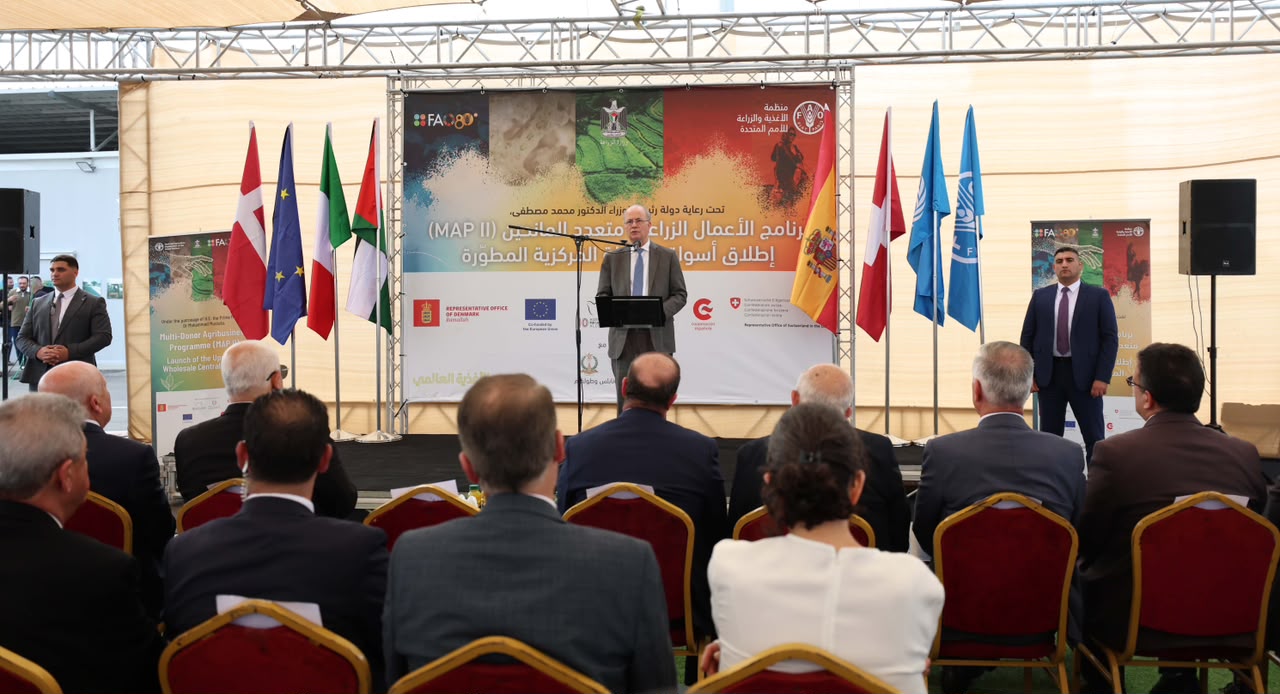
TULKARM, October 12, 2026 (WAFA) — Prime Minister Mohammad Mustafa inaugurated on Monday the Central Wholesale Market for Fruits and Vegetables in Tulkarm Governorate, as part of a project to complete the rehabilitation and development of three central markets in the West Bank.
The Prime Minister’s Office said in a statement that the project aims to organize the marketing of agricultural produce, improve market access, and expand economic opportunities for farmers and producers. The inauguration was attended by Tulkarm Governor Abdullah Kmeil, several ministers, international partners, and other official and community representatives.
Speaking at the inauguration, the Prime Minister said: “We are pleased to be in Tulkarm today to inaugurate an important project for farmers, traders, and local citizens. We want this market to help organize the marketing of agricultural produce, improve access to markets, and create broader economic opportunities for farmers and producers.”
He added that the market’s inauguration comes at a time when the Palestinian people are facing colonial settler terrorism and ongoing attacks against agricultural land, farmers, and their livelihoods, in an attempt to forcibly drive Palestinian citizens away from their land.
Mustafa noted that these attacks have continued across the governorates during the olive harvest season, including in Tulkarm Governorate. He highlighted recent attacks in Ramin, Beit Lid, and other areas, where farmers have been assaulted and their harvests and equipment stolen while picking olives.
The Prime Minister stressed that Palestinian farmers have the right to access their land, harvest its produce, and earn their livelihoods from it in safety and dignity.
He affirmed that the Government is not merely seeking to sustain the Palestinian economy but also to strengthen its capacity for growth despite the restrictions and challenges it faces. Through the Ministry of Agriculture, and in partnership with farmers, the private sector, and international institutions, the Government is working to translate this vision into tangible projects that protect agricultural production, expand market access, and strengthen the Palestinian economy.
He added that the development of the Tulkarm Central Market forms part of broader efforts to develop the Palestinian agricultural sector and enhance its competitiveness and capacity for growth.
The Prime Minister explained that government institutions had extended main and transmission water networks in Anabta, Kufr Abbush, Kufr Jammal, and other locations, in addition to rehabilitating and upgrading four key agricultural groundwater wells in An-Nazla Al-Gharbiya, Attil, and Tulkarm.
He added that the interventions also included the construction of 21 agricultural ponds and water collection reservoirs in Attil, Deir al-Ghusun, Zeita, and Baqa al-Sharqiya; the provision and installation of water storage tanks in Jbara and Allar; and the establishment of modern irrigation units and irrigation networks serving 50 farmers.
The Prime Minister further noted that approximately 50 kilometers of vital agricultural roads had been constructed and rehabilitated in Shufa, Iktaba, Kufr Sur, Kur, Saffarin, the Sha‘rawiya area, Kufr Jammal, Kufr Zibad, and other locations. In addition, approximately 155 dunums of agricultural land threatened with confiscation and located adjacent to the Israeli apartheid and annexation wall and settlements had been reclaimed and rehabilitated.
He stressed that government interventions also covered the provision of seedlings, greenhouses, livestock production, and emergency assistance, reaffirming the Government’s commitment to continuing these efforts to strengthen farmers’ steadfastness and support agricultural production.
Mustafa expressed his appreciation for the contributions of international partners, foremost among them the United Nations Food and Agriculture Organization (FAO), as well as the European Union, Denmark, Switzerland, and Spain, in implementing vital projects, improving services, and creating tangible economic opportunities for citizens.
The Prime Minister concluded by emphasizing the Government’s clear message from Tulkarm, stating: “Despite the occupation, the attacks, and all attempts to impose restrictions, we will continue working to protect our land, strengthen our people’s resilience, and build a Palestinian economy capable of sustaining production. The steadfastness of our people on their land requires more than determination; it requires the means to live, employment opportunities, and sources of livelihood.”
T.R.