


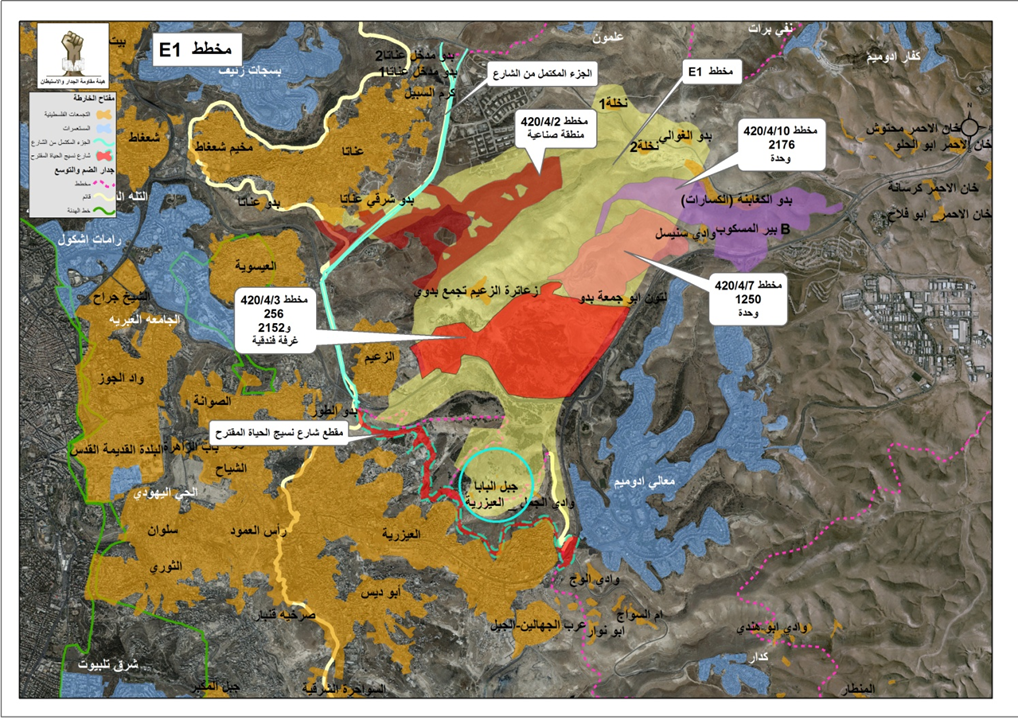
RAMALLAH, August 18, 2026 (WAFA) — Israeli occupation authorities on Tuesday issued a tender for the construction of 1,234 settlement units in the southern part of the E1 plan east of occupied Jerusalem, moving one of the most controversial settlement schemes from the approval and planning stage toward land marketing and practical implementation.
The tender, No. 186/2026, is based on approved detailed plan No. 420/4/7, one of the two main residential plans within the E1 project, alongside plan No. 420/4/10. The tender covers seven settlement complexes, with October 19, 2026 set as the deadline for submitting bids.
The Palestinian Wall and Settlement Resistance Commission said the tender should not be viewed as an ordinary housing project or a local expansion of the Ma'ale Adumim settlement, but as an implementation step in a broader geopolitical project aimed at reshaping the area between Jerusalem and the Jordan Valley.
The E1 plan covers approximately 12,000 dunams between Jerusalem and Ma'ale Adumim and comprises interconnected residential, industrial and tourism plans, as well as roads and infrastructure networks.
Plan 420/4/7, for which the tender was issued, covers the southern section of the settlement project, while plan 420/4/10 targets its eastern section. Israeli authorities approved the two plans in August 2025 for a combined 3,401 settlement units and published notices granting them legal validity in October of the same year. Tuesday's tender marks the start of marketing most of the units included in the southern plan, effectively moving from planning approval to selecting developers and preparing the project for construction.
The commission said the significance of the move lies in E1's strategic location along the geographic corridor linking the central and southern parts of the West Bank and connecting Jerusalem with its Palestinian surroundings. Implementation of plans 420/4/7 and 420/4/10, together with other plans in the area, would create a continuous settlement extension from Jerusalem eastward toward Ma'ale Adumim, further isolating occupied East Jerusalem from the West Bank and undermining its potential to serve as the capital of a future Palestinian state.
The project would also restrict Palestinian territorial contiguity between the Ramallah and al-Bireh, Jerusalem and Bethlehem governorates, turning movement between the northern and southern West Bank from natural geographic connectivity into restricted routes and tunnels controlled by the Israeli occupation authorities.
The commission said the project therefore goes beyond land seizure, extending to the restructuring of Palestinian movement and population distribution and confining Palestinians to disconnected enclaves surrounded by settlements, bypass roads and areas under Israeli control.
The so-called "fabric of life road," sections of which run from the vicinity of Anata toward al-Za'ayim and al-Eizariya, is also part of the broader E1 plan. Although Israel presents the road as a solution for Palestinian movement, the commission said it effectively replaces Palestinian geographic and territorial continuity with a separate, controlled traffic corridor, allowing settlement construction to proceed while channeling Palestinians onto designated bypass routes.
Implementation of the project directly threatens Palestinian and Bedouin communities around al-Za'ayim, al-Isawiya, Anata, al-Eizariya, Abu Dis, Khan al-Ahmar, Jabal al-Baba and Wadi al-Jamal. These communities are located within the area Israel seeks to reorganize around the settlement project and face increasing restrictions on construction, access to land, grazing and movement, as well as a growing risk of forced displacement.
E1 is also linked to the so-called "Greater Jerusalem" project, which seeks to surround Jerusalem with major settlement blocs: Ma'ale Adumim to the east, Givat Ze'ev to the north and Gush Etzion to the south. Integrating these blocs into the settlement network around Jerusalem would expand Israeli control while separating Palestinian communities from the city's historic, political and economic center.
According to the commission, Tuesday's tender represents a qualitative shift in the development of E1. The project is no longer merely a delayed plan or a political proposal used by successive Israeli governments, but has become an implementation program for allocating land and constructing settlement units.
The implementation of the plan constitutes a violation of international law prohibiting the transfer of the occupying power's civilian population into occupied territory and the imposition of permanent changes there. It also contradicts UN Security Council Resolution 2334, which affirmed the illegality of Israeli settlement activity in the occupied Palestinian territory, including East Jerusalem.
M.N


