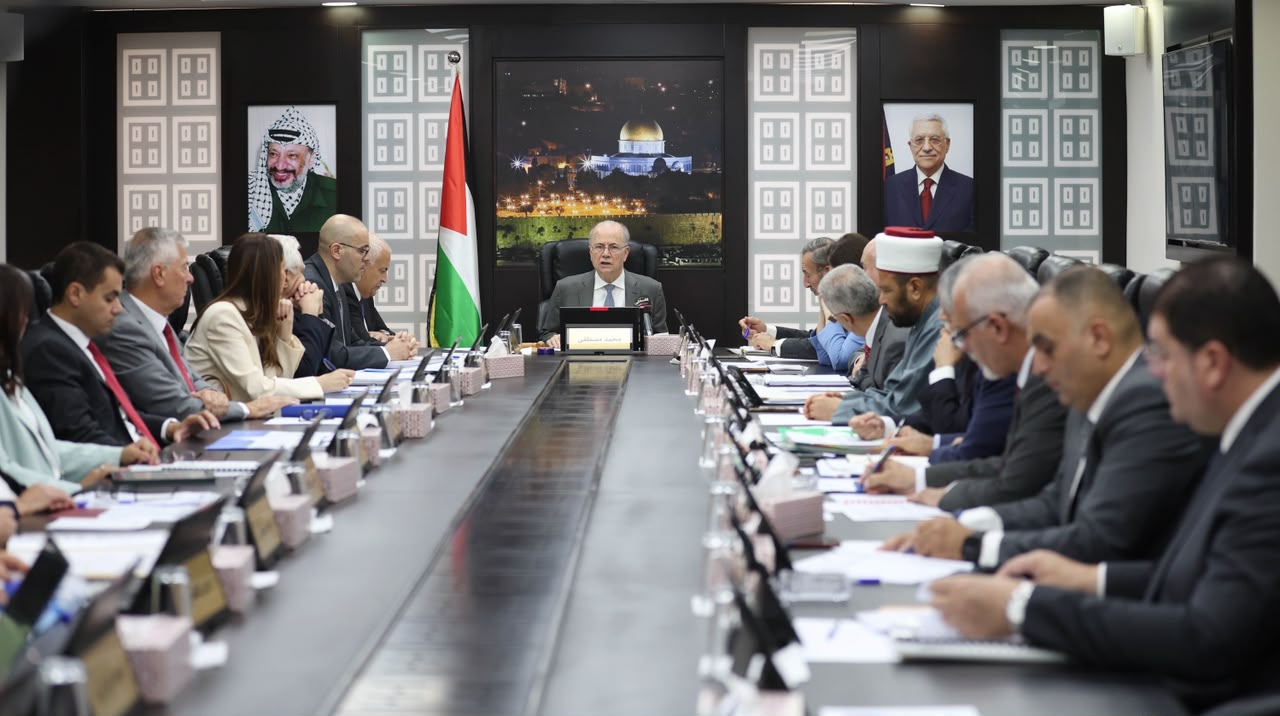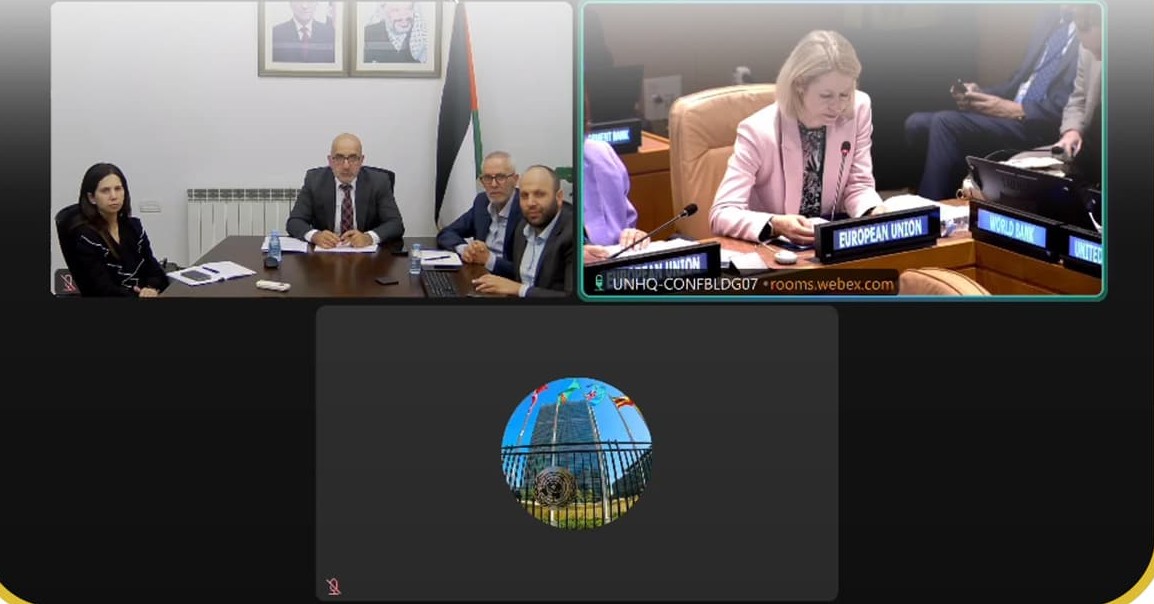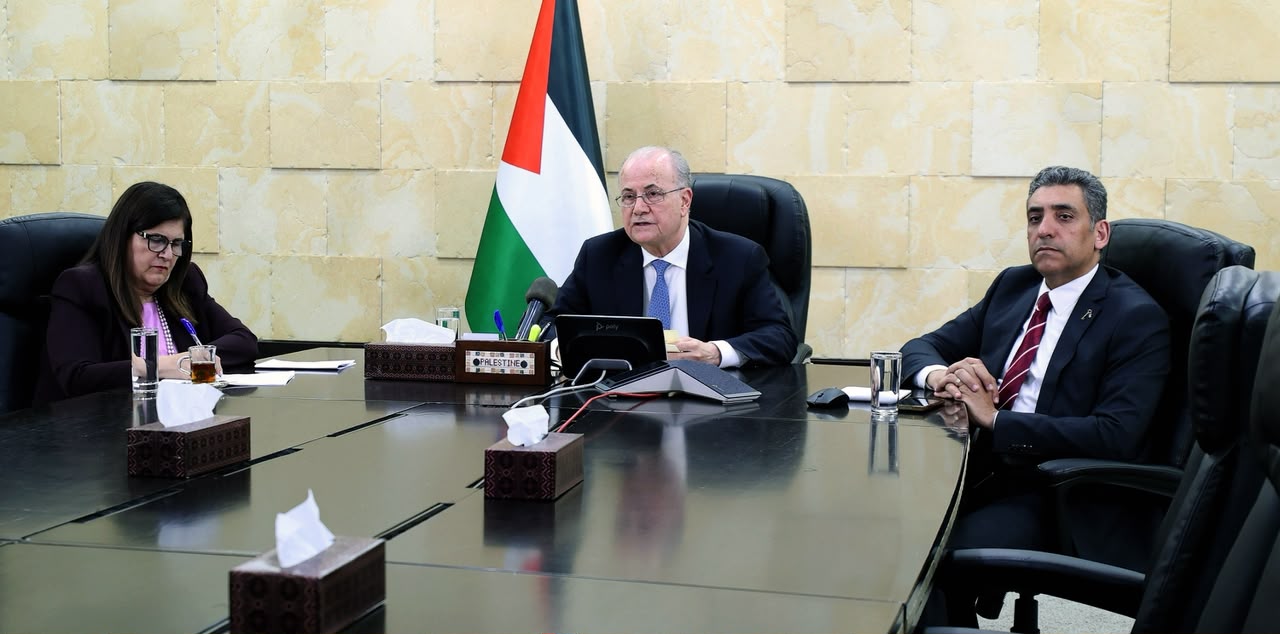
BRUSSELS, April 20, 2026 (WAFA) – Prime Minister Mohammad Mustafa stressed on Monday that preserving economic stability is a priority that requires urgent and sustainable donor aid.
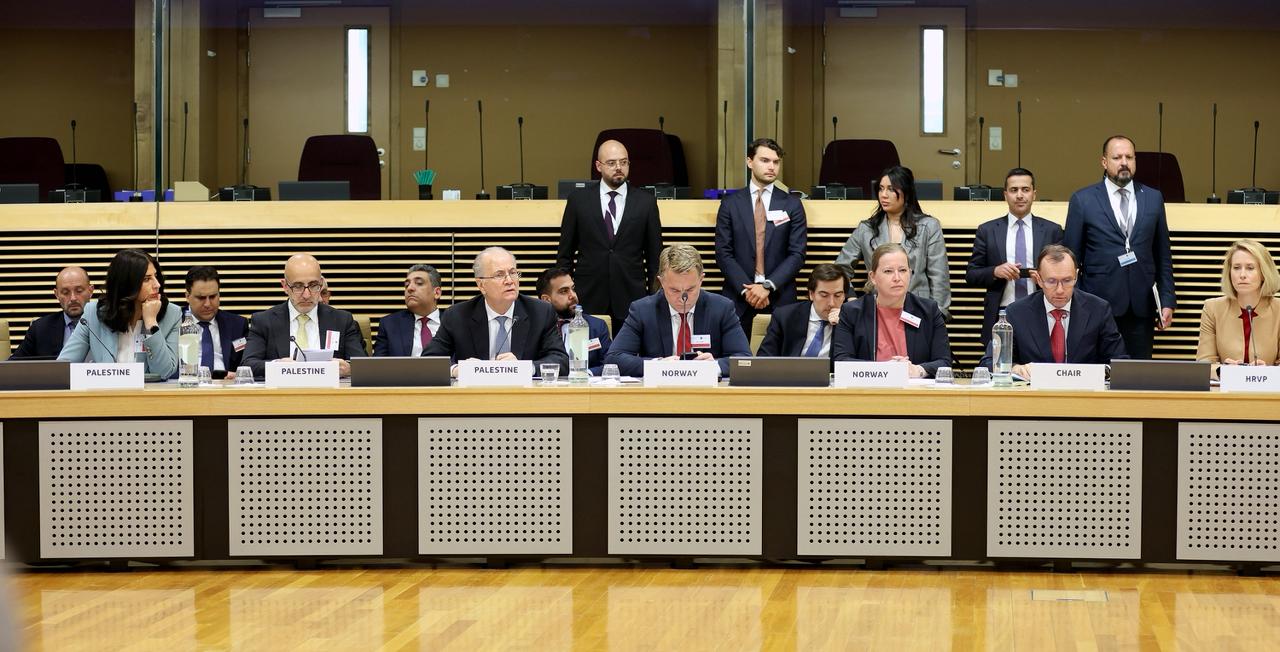
Addressing the representatives of over 30 states and international donors at the Spring Meeting of the Ad Hoc Liaison Committee (AHLC) in Brussels, Prime Minister Mustafa stated that the Palestinian government’s goal is to “stabilize the economy, strengthen institutions, and create the conditions for recovery, growth, and ultimately, self-reliance,” which requires sufficient and sustainable international financial aid.
Prime Minister Mustafa was accompanied by Minister of Finance and Planning, Estephan Salameh, and Palestine’s Ambassador to Belgium and the EU, Amal Jadou-Shakaa.
During his speech, Premier Mustafa presented the most formidable challenges to Palestine, along with the set of urgent intervention priorities.
He noted that the Government emphasizes a set of immediate priorities, most notably the immediate release of Palestinian clearance revenues, the removal of restrictions on our banking system liquidity constraints, providing emergency budget support to stabilize public finances, sustained investment in economic recovery and development programs, and the lifting of restrictions on Palestinian workers’ access to employment in Israel.
The following is the full text of the speech:
Statement by Mohammad Mustafa, Prime Minister of the State of Palestine, at the Meeting of the Ad Hoc Liaison Committee (AHLC) – Spring Meeting 2026, in Brussels
Excellencies, Ministers, Distinguished Delegates,
Thank you for your continued partnership and steadfast commitment to supporting Palestine and the Palestinian people during this exceptionally difficult period.
I would like to express my sincere appreciation to the Kingdom of Norway for chairing the AHLC, and to the European Union, the United States, the United Nations, the World Bank and the Quartet, for their sustained engagement.
Your support remains essential in preserving economic stability and strengthening institutional resilience in Palestine.
Excellencies,
The lessons of recent years are clear. War has not produced peace. Siege has not produced security. Occupation has not produced stability. Forced displacement will not produce legitimacy. And annexation will never produce coexistence. Only a just political solution can do that.
Today, the Palestinian economy is facing severe and interconnected challenges, while the viability of the two-state solution is being deliberately undermined.
In Gaza, the scale of destruction has led to an unprecedented economic collapse. Basic services, infrastructure, and productive sectors have been devastated, leaving nearly two million people in urgent need of humanitarian assistance, shelter, jobs, and a credible pathway to recovery.
In the West Bank, economic conditions continue to deteriorate. Israeli restrictions on movement and access, army incursions, settlers’ terror; and the economic siege are: constraining growth, increasing unemployment, and placing immense pressure on vulnerable communities.
The continued withholding of Palestinian clearance revenues, estimated at approximately five billion US dollars and representing the majority of our public income, has created acute liquidity constraints.
For a full year now, we have received no transfers of these revenues, placing severe pressure on our public servants, security personnel, teachers, and nurses. About half of the deductions (an average of $90 millions per month) are a punishment for what we spend on Gaza services and employees.
At the same time, constraints affecting the banking sector are limiting liquidity flows and access to credit, further weakening private sector activity and investment.
Moreover, Israeli restrictions on the Palestinian labor movement, the war on Gaza, and the contraction of the Palestinian economy have led to an increase in the unemployment rate to about 44% (approaching 80% in Gaza and 35% in the West Bank).
These practices must be addressed.
Ensuring accountability, the protection of civilians, and respecting the protocol that governs the Palestinian-Israeli economic relations (Paris Protocol) are not only a legal obligation, but a prerequisite for restoring stability and enabling any meaningful economic recovery.
Ladies and Gentlemen,
Despite these immense challenges, we remain firmly committed to advancing a comprehensive reform agenda and strengthening governance. The presentation made by our MOFP to the thematic session yesterday is a testimony to that.
We have taken concrete steps to modernize public financial management and enhance transparency and accountability across government institutions.
Our efforts on anti-corruption have been reinforced through stronger oversight mechanisms, improved regulatory frameworks, and a clear commitment to the rule of law.
At the same time, we have made tangible steps in implementing our expanded new needs-based social protection system to better support the most vulnerable segments of our population.
In the education sector, we are prioritizing continuity, quality, and resilience. Despite unprecedented disruptions, we are investing in maintaining access to education, modernizing curricula based on UNESCO standards, and strengthening institutional capacity in order to safeguard the future of our young generation.
Our Security Sector Reform efforts are focused on building a professional, accountable, and civilian-controlled security apparatus. We are investing in policing and in the justice system to ensure these institutions serve our people and uphold their rights.
We are advancing democratic renewal, with local elections scheduled next Saturday, April 25, in the West Bank, and taking place in Gaza for the first time in nearly two decades, starting in Deir Al-Balah. This step reinforces accountability, citizen participation, and institutional legitimacy, and reflects our commitment to maintaining democratic processes even under constraint.
These reforms are not only necessary—they are deliberate choices to build a more transparent, inclusive, and resilient Palestinian state.
Excellencies,
I will now turn to the Gaza dimension.
The guiding principle on Gaza must remain clear:
Gaza is not a humanitarian file alone — it is an integral part of the State of Palestine.
The successful implementation of UNSC resolution 2803 must lead to the swift execution of the transitional arrangements that enable the full return of the Palestinian Authority to governing Gaza, and the institutional reunification of Gaza and the West Bank.
We stand ready to engage in the implementation of the transitional arrangements, in partnership with the Office of the Higher Representative – Board of Peace, as well as regional and international actors, in full alignment with international law.
This includes re-establishing law and order, restoring essential services, and coordinating early economic recovery and reconstruction efforts.
The transitional arrangements must remain administrative, and fully anchored in a clear and orderly handover to Palestinian Authority governance. These arrangements shall not undermine the legal status of the Occupied Palestinian territory, Palestinian representation, or the territorial unity of the State of Palestine.
To support these efforts, we have established a dedicated Committee within the Prime Minister’s Office. This mechanism should serve as a central platform for coordination with the Office of the High Representative of the Board of Peace, ensuring alignment of our efforts, facilitating timely decision-making, enhancing implementation on the ground, and managing the handover at the end of the transitional period.
Excellencies,
At the same time, we are working with our international partners in the West Bank on urgent and targeted interventions to address rising unemployment and critical infrastructure needs, particularly in the most affected areas.
In this context, the Horizon Fund - jointly established by the United Nations and the Palestinian Government - is both timely and strategic.
The Fund represents a practical instrument to mobilize resources, stimulate investment, support early recovery, and create jobs.
It has the potential to restore confidence and improve economic conditions across both Gaza and the West Bank.
We encourage all partners to actively support this initiative as part of a broader effort to reverse current economic decline and improve security and stability.
Our objective is to stabilize the economy, strengthen institutions, and create the conditions for recovery, growth, and ultimately, self-reliance.
These efforts cannot succeed without predictable and adequate financial support.
We therefore emphasize three immediate priorities:
- The immediate release of Palestinian clearance revenues and the removal of restrictions on our banking system liquidity constraints.
- Emergency budget support to stabilize public finances.
- Sustained investment in economic recovery and development programs.
- The lifting of restrictions on Palestinian workers’ access to employment in Israel (in line with arrangements in place prior to October 2023).
Excellencies,
Let me conclude by reaffirming our unwavering commitment to reform, responsible governance, and genuine partnership.
However, it is equally important to emphasize that economic recovery and institutional reform cannot substitute for a comprehensive political solution.
Without addressing the underlying realities of occupation, restrictions, and violence, our collective efforts will remain constrained.
With your continued support, and with renewed political will, we can not only address immediate challenges, but also advance a credible pathway toward a just and lasting peace based on the two-state solution.
Thank you.
K.F.