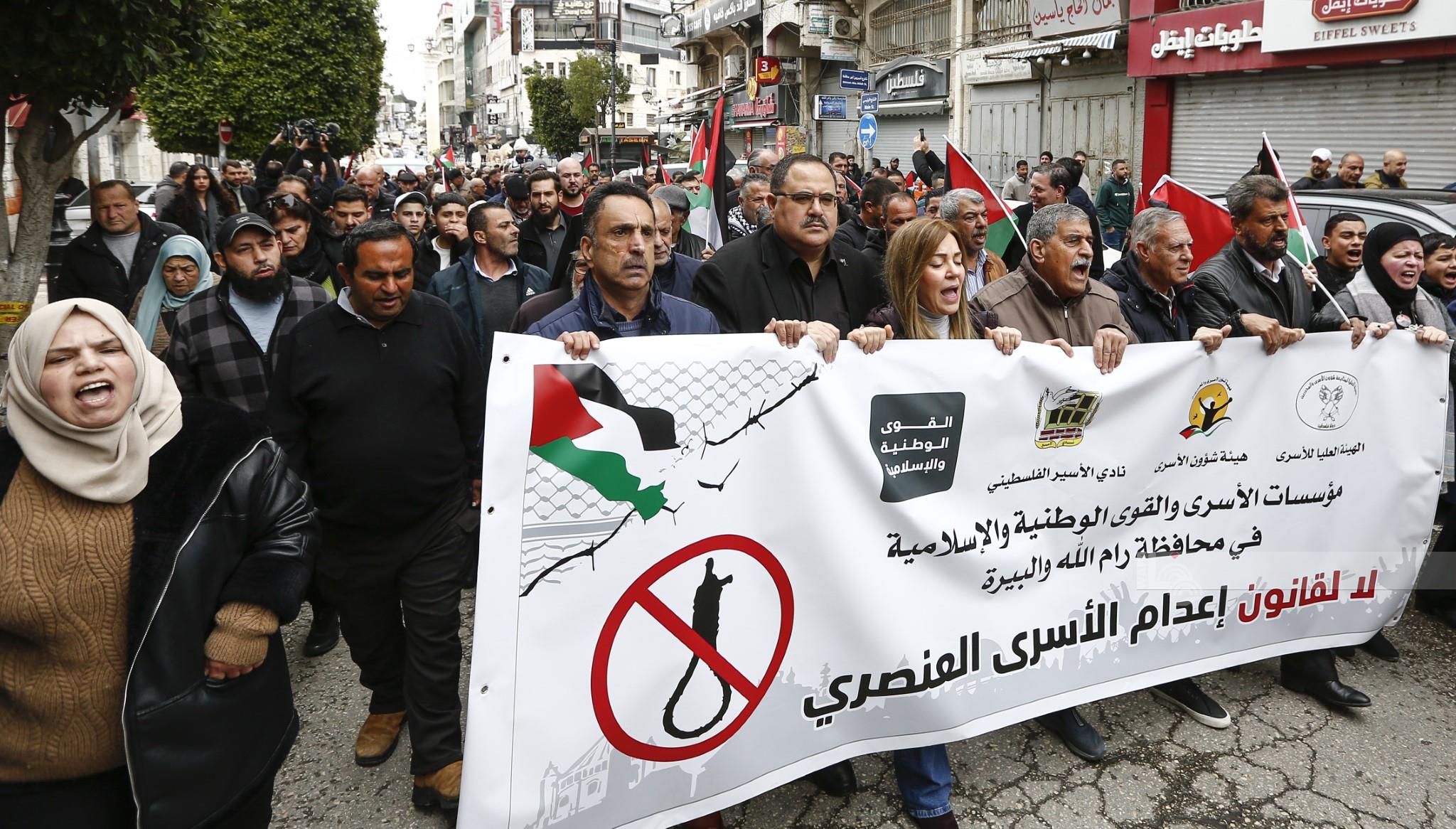
RAMALLAH, April 1, 2026 (WAFA) – Palestinians participated in a march through the streets of the city of Ramallah in protest against Israeli death penalty law for Palestinian prisoners.
The march, organized by Fatah, other national and Islamic factions, and prisoners' rights organizations in the Ramallah governorate, proceeded through the city center. Participants chanted slogans condemning the law and called on the international community to intervene to stop the occupation's crimes against prisoners.
Fatah and other national and Islamic factions had called for a general strike in the northern West Bank on Wednesday in protest against Israeli death penalty law for Palestinian prisoners.
On Monday, the Knesset passed the law in its second and third readings. Sixty-two members voted in favor, 48 voted against, and one abstained.
The law stipulates the imposition of the death penalty on individuals convicted of intentionally causing death in acts classified as “terrorism.” It also stipulates that no pardon may be granted in such cases, effectively making the sentence final and not subject to political or legal mitigation.
According to its text, the bill includes the imposition of a mandatory death penalty without requiring a unanimous judicial decision, and the execution of the death sentence by hanging by the Israeli Prison Service, with the sentence to be carried out within a specified period not exceeding 90 days from its issuance.
The law includes discrimination in its application between Israel and the West Bank. It stipulates the death penalty in the West Bank as the primary punishment, while granting the military court exceptional authority to impose life imprisonment in "special circumstances," subject to policies set by the defense minister.
The law allows the prime minister to request a delay in the execution under “special circumstances,” though such delays cannot exceed a total of 180 days, despite the stipulated 90-day implementation timeframe.
Y.S