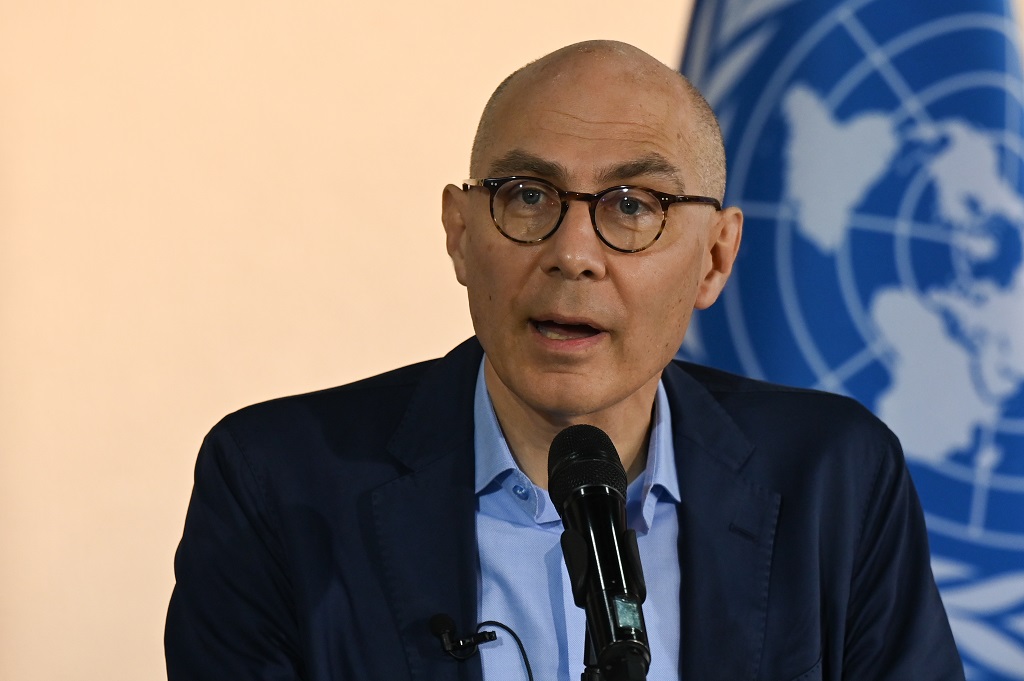
NEW YORK, September 28, 2026 (WAFA) – Permanent Observer of the State of Palestine to the United Nations, Minister Riyad Mansour, stressed that the rights affirmed in the Durban Declaration and Programme of Action 25 years ago must not be limited to remembrance, but must be implemented for all peoples without exception.
Mansour said in his address to the high-level meeting of the United Nations General Assembly to commemorate the 25th anniversary of the adoption of the Durban Declaration and Programme of Action, held today, Monday, that 25 years ago in Durban, the international community made a commitment to confront racism, racial discrimination, xenophobia, and related intolerance, and to protect the dignity and equality of every human being.
He welcomed the adoption of the political declaration and the reaffirmation of the Durban Declaration and Programme of Action, pointing out that the Durban process holds particular importance for the Palestinian people.
He explained that 25 years ago, the Durban Declaration expressed concern over the plight of the Palestinian people under foreign occupation and recognized their inalienable right to self-determination and to establish an independent state, while also recognizing the right of all states in the region to security.
He said that, instead of exercising their right to self-determination and living in freedom and dignity in their independent state, the Palestinian people continue to suffer under an illegal occupation and face ongoing genocide, ethnic cleansing, and apartheid.
Mansour pointed out that today’s declaration recalls that colonialism, genocide, apartheid, and slavery leave deep and lasting effects, and that racial discrimination, inequality, and displacement require action, stressing that historical injustice cannot be overcome through remembrance alone, but requires justice and reparations.
He stressed the need for Durban to remain a commitment to action for the victims of the past and present and for future generations, calling for the rejection of racism and discrimination in all their forms, as well as hatred directed against any people because of their identity, religion, origin, or plight.
Mansour emphasized the necessity of upholding the universality of human rights without selectivity, exceptions, or double standards, and renewed the State of Palestine’s commitment to the Durban Declaration and Programme of Action and to equality, justice, and human dignity.
He stressed that the responsibility 25 years after Durban is clear: the rights affirmed there must not be limited to remembrance, but must be implemented for all peoples without exception.
The Permanent Observer of the State of Palestine to the UN called for moving from statements to action, from condemnation to accountability, and from declarations of solidarity to implementation in confronting colonialism, forced displacement, and the annexation of occupied Palestinian land.
Mansour said in his address that Security Council Resolution 2334, adopted nearly a decade ago, affirms the inadmissibility of the acquisition of territory by force and condemns all measures aimed at altering the demographic composition, character, and status of the Palestinian territory occupied since 1967, including East Jerusalem. It also confirms that Israeli settlements have no legal validity and constitute a flagrant violation of international law, he said, while demanding an immediate and complete halt to all settlement activities.
He added that developments on the ground are moving in the opposite direction, as colonial settlements are expanding, Palestinian land is being seized, homes are being demolished, communities are being forcibly displaced, colonist attacks continue, and annexation measures are accelerating.
Mansour emphasized that annexation “is not just a future threat,” but is being advanced on the ground through violence, colonization, infrastructure, displacement, and land seizure, pointing out that this is taking place in the West Bank, including East Jerusalem, and in the Gaza Strip.
He warned against the colonial “E1” plan, stating that its goal, as explained by Israeli leaders, is to eliminate the Palestinian state, and with it any horizon for peace, and pointing out that the UN Secretary-General has described the advancement of the E1 settlement plan as a grave threat to the viability of a contiguous Palestinian state and the two-state solution. He called for the plan to be stopped.
He also pointed out that Israel seeks the collapse of the Palestinian Authority, considering that this would provide an opportunity to advance the final stages of a plan for the forced displacement of the Palestinian people and the annexation of their land.
Mansour emphasized that Palestinian principles consist of “no to occupation, no to annexation, no to forced displacement,” the reunification of the West Bank and the Gaza Strip under the Palestinian Authority, and the realization of the Palestinian people’s right to self-determination and the independence of the State of Palestine.
He stressed that Security Council resolutions cannot become optional, implemented by some and ignored by others, emphasizing that international law cannot operate according to the identity of those who violate it and that accountability cannot be subject to political considerations.
He called for measures to hold accountable those responsible for colonist attacks, forced displacement, and illegal settlement expansion; to disarm colonists; to stop the colonial “E1” plan; to protect civilians and Palestinian communities facing displacement and violence; and to strengthen the resilience of the Palestinian people and their institutions through sustained political and financial support, alongside support for UNRWA and the United Nations humanitarian system.
Mansour pointed to the advisory opinion issued by the International Court of Justice on July 19, 2024, which concluded that Israel’s continued presence in the occupied Palestinian territory is unlawful. He explained that the Court also addressed the responsibilities of other states, including the obligation not to recognize the situation arising from this unlawful presence and not to render aid or assistance in maintaining it.
He stressed the need for these findings to have a practical impact, and that no trade relations, financial flows, or other forms of assistance should contribute to perpetuating the illegal settlements, calling on all states to support the realization of the Palestinian people’s right to self-determination.
He said that the Palestinian people do not need another decade of reports documenting the disappearance of their land, but rather need protection, the preservation of their institutions, the consolidation of a continuous ceasefire, the flow of humanitarian aid, the reconstruction of Gaza, the protection of East Jerusalem and its Islamic and Christian holy sites, an end to colonization and annexation, and accountability.
Mansour emphasized that the Palestinian people need, above all, freedom and the realization of their inalienable right to self-determination and independence, stressing that Palestine cannot be erased, that the Palestinian people cannot be made invisible, and that their rights cannot be eliminated by occupation, colonization, or annexation.
He concluded by saying that the question is no longer whether the international community has said its word, but whether consequences will finally follow from those words, stressing that “a free Palestine is the gateway toward a peaceful Middle East.”
T.R.