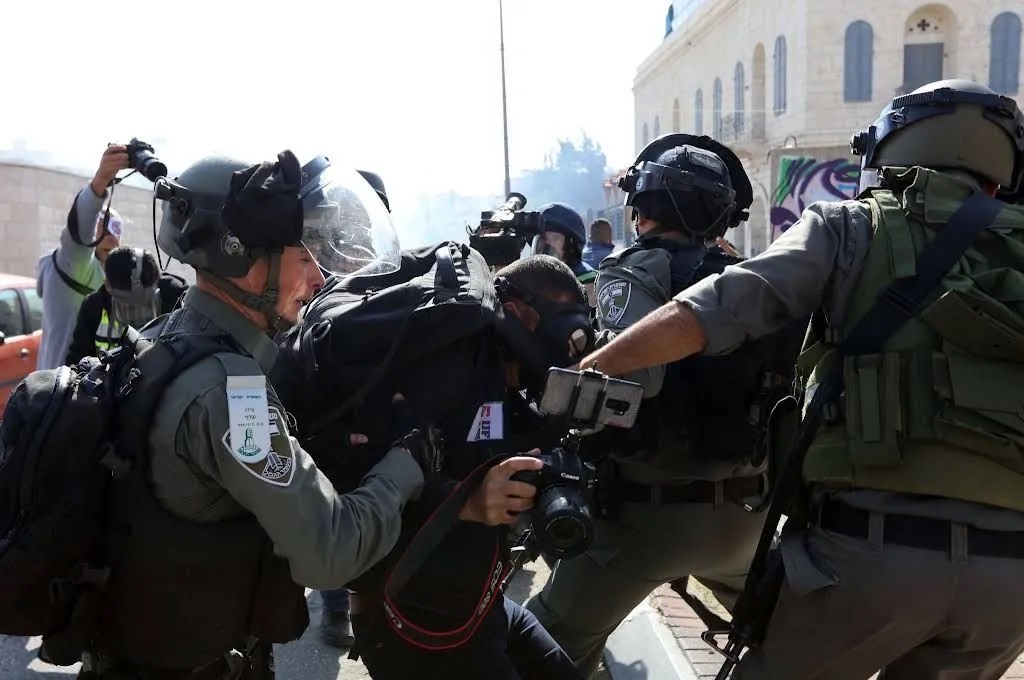
RAMALLAH, August 17, 2026 (WAFA) — The Palestinian Journalists Syndicate announced that it has documented 1,327 incidents of “detention and denial of media coverage” targeting journalists and media crews from 2023 through the first half of 2026.
The Syndicate characterized these figures as clear evidence of a continuous, systematic pattern of targeting journalistic activity, aimed at restricting field access and suppressing facts and evidence surrounding violations and crimes committed against the Palestinian people.
The Syndicate emphasized that obstructing the press from fulfilling its role not only targets journalists directly, but also deprives the public of its right to information and undermines efforts to document violations and hold perpetrators accountable.
According to a report compiled by the Syndicate’s Freedoms Committee on cases of detention and denial of media coverage, 314 incidents were documented in 2023, 396 in 2024, 425 in 2025, and 192 during the first half of 2026, bringing the total to 1,327 documented incidents.
The Syndicate clarified that these figures represent documented incidents of violations rather than the total number of affected journalists, noting that a single journalist may be subjected to multiple incidents of detention or denial of media coverage.
The Syndicate stated that the continuation and escalation of these occurrences over recent years dispel any attempt to present them as isolated incidents or transient security measures.
It stressed that the figures reveal a recurring mechanism designed to disrupt journalistic work, which begins with preventing media crews from reaching the scenes of events, detaining them, and confiscating or obstructing the use of their equipment, ultimately preventing journalists from broadcasting facts directly to the public. This takes place as the policy of barring independent foreign press from accessing the Gaza Strip persists, it said.
The Syndicate affirmed that the danger of detention and denial of media coverage extends beyond direct assaults on journalists, as obstructing their ability to access and document the scene of an event effectively impedes the public’s right to access information.
It added that, under wartime conditions, journalism serves as a critical tool for independently verifying facts; therefore, restricting journalistic work facilitates the spread of one-sided narratives and undermines the ability to document violations professionally and independently.
The Syndicate noted that data compiled by the Freedoms Committee for the first half of 2026 reveals a broader pattern of targeting journalists. Alongside the 192 documented incidents of detention and denial of media coverage, the Committee recorded 27 detentions, 29 instances of live-fire shooting, and 78 cases involving the firing of tear gas canisters and sound grenades.
The data also included 22 incidents involving the seizure or destruction of journalistic equipment, seven raids on homes or media institutions, and three cases involving the closure of media institutions.
The Syndicate stated that the combination of these measures within the same timeframe and geographic areas reflects a coercive environment aimed at undermining journalists’ ability to perform their professional duties freely and safely.
The Syndicate added that an analysis of the data over the four-year period demonstrates clear continuity in the policy of disrupting journalistic work, with 314 incidents of detention and denial of media coverage recorded in 2023, 396 in 2024, 425 in 2025, and 192 during the first six months of 2026.
The Syndicate affirmed that the sustained recording of hundreds of incidents annually, rather than their confinement to a specific timeframe, indicates that the targeting of journalistic freedom has become a permanent feature of the environment in which Palestinian journalists operate.
The Palestinian Journalists Syndicate stressed that denial of media coverage cannot be viewed merely as a violation of press freedom, but rather as an infringement on society’s right to information and its ability to build a documented record of violations.
It said that preventing a journalist from reaching the scene of an event deprives them not only of the opportunity to produce a news report, but also of crucial field testimony that may be essential to establishing facts and reconstructing events before human rights and judicial bodies, even years after they occur.
The Syndicate explained that international humanitarian law considers journalists engaged in dangerous professional missions to be civilians, provided they do not take a direct part in hostilities, and that practicing journalism, including photography and news reporting, does not make journalists lawful targets. Accordingly, it said that the use of detentions, threats, and restrictions to obstruct journalists because of their professional activities raises serious concerns about compliance with international rules protecting journalists and press freedom in conflict zones.
Head of the Freedoms Committee within the Palestinian Journalists Syndicate, Mohammad Al-Lahham, said that the figures documented by the Syndicate do not reflect a series of isolated attacks against individual journalists, but rather reveal a recurring pattern of using military, security, and judicial measures to restrict journalists’ ability to access, document, and publish information.
Al-Lahham added that the documented figures, along with the broader pattern of attacks targeting journalists, confirm that the issue extends beyond the notion of a temporary security measure, particularly as independent international media continue to be barred from entering the Gaza Strip.
He stressed that the combination of killings, detention, restrictions, threats, and destruction requires these incidents to be addressed as an integrated human rights and legal issue, calling for an independent and systematic international investigation into the nature and objectives of this policy, as well as its compliance with international law.
The Syndicate affirmed that protecting journalists and safeguarding their right to access and freely convey information are not merely professional matters concerning media personnel, but are essential components of the public’s right to information.
It called on international and human rights institutions, as well as organizations dedicated to press freedom, to take decisive measures to ensure the protection of Palestinian journalists, hold those responsible for violations accountable, and end the policy of restricting media coverage and withholding facts from the public.
T.R.