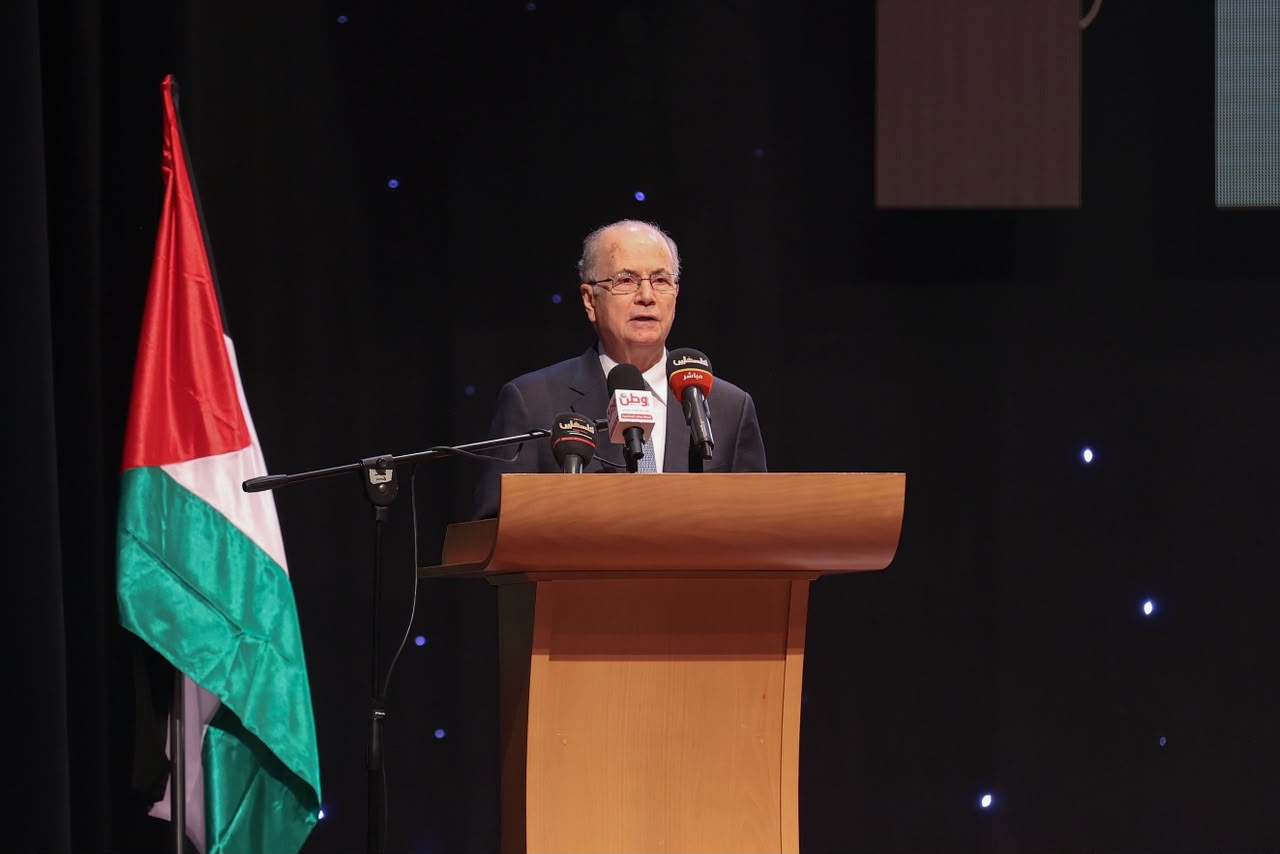
RAMALLAH, July 9, 2026 (WAFA) – Prime Minister Mohammad Mustafa stated that the Palestinian people are facing a comprehensive settler-colonial project, designed to uproot them from their land, undermine their national rights, impose annexation and displacement, weaken Palestinian institutions, and reshape the political and legal reality in favor of force rather than international law and justice.
This came in his address during the National Conference of the Bar Association, held today, Thursday, under the title: "Settler-Settlement in Palestine: Between Policies of Annexation and Displacement and the Obligations of International Justice," on the occasion of Palestinian Lawyers' Day, which falls on July 9th each year.
He added that the most dangerous aspect of the occupation project is that it is not limited to confiscating land, but also seeks to confiscate time, identity, and narrative, to make the occupation permanent, settlement a fait accompli, and annexation an imposed reality, and to make the absence of an independent Palestinian state a reality that the world can accept and coexist with.
Mustafa continued, "It is no longer a secret that the current fascist Israeli government is proceeding with what its leadership calls the 'Decisive Plan,' which clearly aims to undermine the two-state solution and prevent the establishment of an independent and sovereign Palestinian state, despite the unprecedented international support and consensus this solution enjoys."
He pointed out that this policy is embodied in two complementary tracks. In the Gaza Strip, the war of destruction, starvation, and displacement continues, along with attempts to marginalize the Palestinian National Authority and prevent it from fully assuming its national responsibilities.
In the West Bank, Mustafa explained, "settlement expansion continues, the reality of annexation is being imposed, and settler attacks are escalating, alongside policies of financial strangulation and the withholding of Palestinian funds."
The Prime Minister explained that despite the different tools, the goal is the same: to break the will of the people, weaken national institutions and their ability to perform their duties and serve the people, and undermine the foundations of the Palestinian state, preventing its realization on the ground.
He emphasized that the Palestinian people, throughout their long history, have proven that their will is stronger than policies of exclusion and displacement, and that their social cohesion, national solidarity, and steadfastness on their land constitute the first line of defense against the settler-colonial project.
He said, "Every village that stands firm, every farmer who clings to his land, every family that refuses displacement, and every national institution that continues to fulfill its mission despite the exceptional circumstances, is contributing to protecting the national project and thwarting the annexation and displacement plans."
He affirmed that the national response to this fascist project will not be merely a temporary reaction, but rather a comprehensive national strategy based on strengthening the resilience of citizens, consolidating social solidarity and mutual support, reinforcing the rule of law and the independence of the judiciary, continuing reform and institutional building, reunifying the two parts of the homeland, and building upon the political, legal, and diplomatic achievements already attained, until the realization of a fully sovereign and independent state with Jerusalem as its capital.
He pointed out that the Palestinian issue is no longer merely a test of respect for the rights of a people under occupation, but also of the credibility of international justice itself and its ability to enforce the principles upon which it is founded.
International law is clear in rejecting settlements, rejecting annexation by force, prohibiting forced displacement, and protecting populations under occupation. However, the problem today lies not in the absence of rules, but in the weakness of their enforcement, their selectivity, and the continued impunity.
He added that discussing the duties of international justice is not limited to issuing statements and judgments, but also includes the responsibility of the international community to ensure respect for international law, enforce its resolutions, prevent impunity, protect civilians, and safeguard the rights of peoples to self-determination. A law that fails to be implemented loses part of its function, and justice that is not delivered in a timely manner remains incomplete.
He emphasized that this should compel us not only to adhere to the law but to adhere to it even more firmly, building upon all that has been achieved. Every legal opinion, every judicial decision, every documented file, and every new recognition of the State of Palestine constitutes an asset that must be transformed into cumulative political, diplomatic, and legal power.
The Prime Minister called for making Palestine a model of a state that builds its institutions on the basis of the rule of law, despite the occupation. International justice does not begin only in New York or The Hague, but in every Palestinian court, in every institution that respects the law, and in every citizen who feels that their rights are protected, their dignity preserved, and that their state abides by the law in its dealings with them. Therefore, defending international justice and building national justice are not parallel paths, but rather Two paths that reinforce each other.
He emphasized that reform is not merely an administrative program to improve performance, nor is it a response to external circumstances or requirements. In the Palestinian case, reform is a national choice and a sovereign act inseparable from the struggle to achieve the national project. Building strong institutions and upholding the rule of law are integral to the battle to establish an independent Palestinian state.
He stated, "Under occupation, sovereignty is not exercised solely over borders and crossings, but also through building strong national institutions, developing legislation, strengthening the independence of the judiciary, enhancing the efficiency of public administration, providing better services to citizens, and solidifying citizens' trust in their state."
In this context, he noted that the government has made significant progress in implementing its reform program and is working closely with all national institutions to modernize public administration, accelerate digital transformation, develop services, enhance transparency, and improve the legal environment that citizens need.
He pointed out that the justice sector occupies a special place in all of this, given that citizens' trust is the true capital of any justice system.
He stated that justice is not measured solely by the soundness of judgments, but also by the speed of access to them, the clarity of procedures, the efficiency of services, and their ability to protect rights without delays that render rights meaningless. Therefore, developing the justice sector, including developing legislation, expediting litigation procedures, promoting digital transformation, and expanding mediation, arbitration, and other means, is crucial.
Y.S/M.N