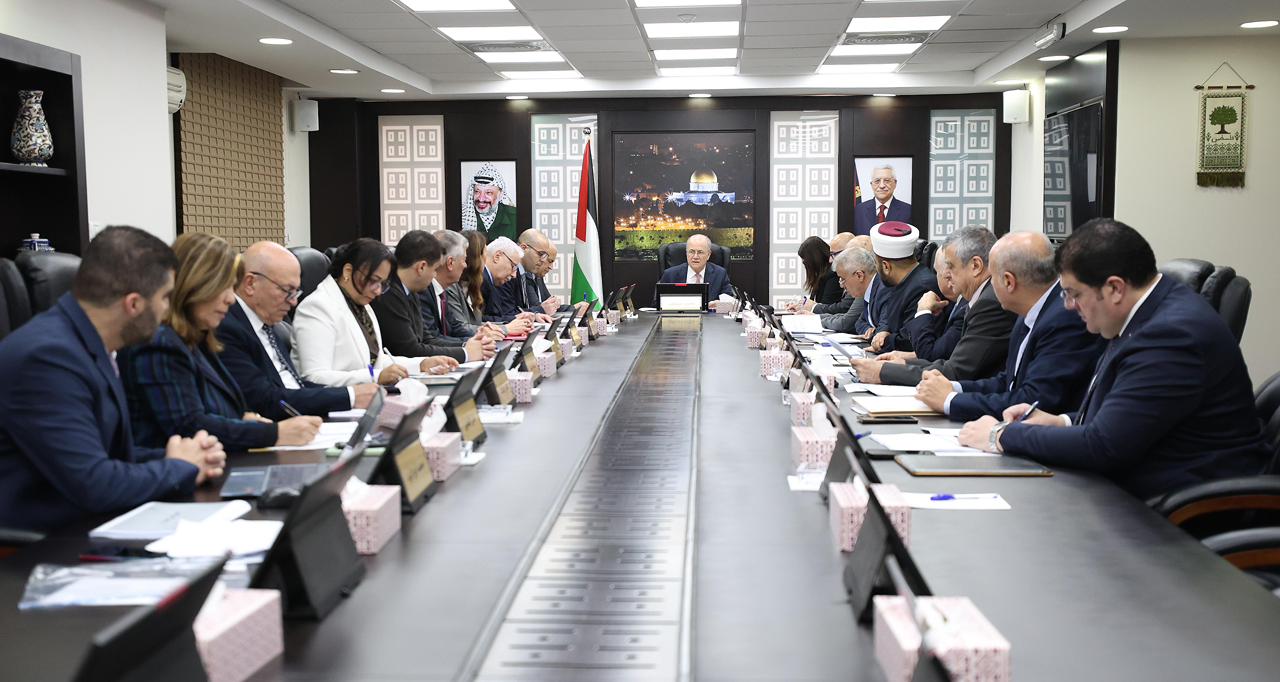
RAMALLAH, March 17, 2026 (WAFA) – The Palestinian Cabinet approved during its weekly session on Tuesday the draft budget for 2026, which will be referred to President Mahmoud Abbas for approval in accordance with legal procedures.
The emergency budget responds to the complex political, economic, and social realities, amid expectations that the Israeli government will continue withholding Palestinian clearance revenues. Accordingly, available cash flows will be directed toward essential services, primarily health, education, security, and social protection, while continuing to pay a portion of public sector employees’ salaries in line with available financial resources.
The proposed budget also takes into account the possibility that financial restrictions and Israeli measures will continue. As a result, the government has adopted a strict austerity approach to managing resources and controlling spending since 2025, with efforts to reinforce these measures in 2026 to ensure the continued delivery of essential services.
According to the draft budget, total revenues are expected to reach 15.7 billion shekels, including clearance revenues if they are released, while projected expenditures are estimated at approximately 17.6 billion shekels, representing a 5.8 percent decrease compared with the 2025 budget. If Israel continues to withhold clearance funds, the budget deficit could reach about 70 percent.
As part of preparations for a budget responsive to emergency developments, the draft includes increasing the emergency and rapid response allocation from about 40 million shekels to 516 million shekels to address urgent situations.
According to a statement issued by the Palestinian Government Communication Center, the Palestinian Ministry of Finance will intensify measures to enhance domestic revenues without affecting low-income groups. At the same time, there will be significant reductions in non-essential spending while maintaining government subsidies for water, electricity, fuel, refugee camps, and health insurance services, amounting to approximately 1.3 billion shekels. A comprehensive review of these subsidies will also be conducted to ensure they reach the most vulnerable groups.
In response to difficult economic conditions, particularly for low-income households, social protection allocations for 2026 are expected to reach nearly 1.2 billion shekels through various official institutions, in addition to support expected to be mobilized from donor partners.
As part of the government’s reform program, the public wage bill was reduced by approximately 120 million shekels in 2025. The government will continue implementing additional measures in 2026, including a complete freeze on new hiring.
Significant progress has also been made in settlements with local authorities and electricity and water companies, known as “net lending,” which was reduced by more than half last year. Additional reform measures will continue throughout 2026.
The draft budget also includes plans to complete essential development projects currently under implementation at a cost of 427 million shekels, alongside expected external support that could bring the total development funding to about 880 million shekels across various sectors.
M.N