By Rami Samara
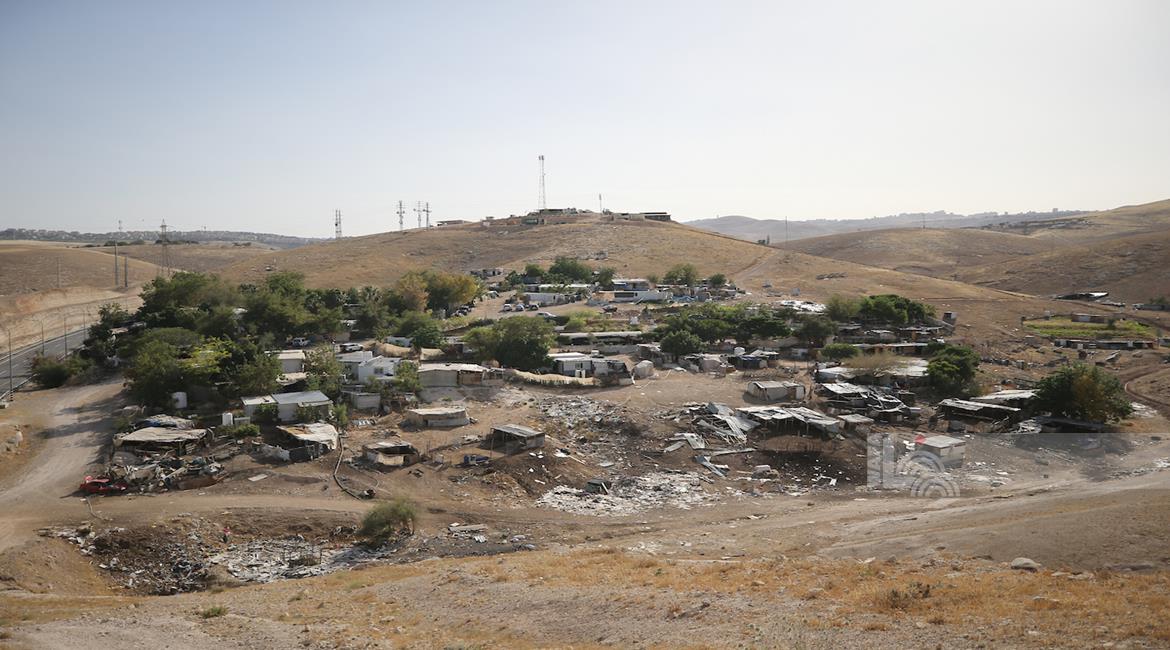
JERUSALEM, June 15, 2026 (WAFA) – There is no peaceful sleep for them, nor stability that spares their dreams, nor land that accommodates the footsteps of their children, nor pastures sufficient for their livestock. Only water. This is what residents of the Bedouin community of Khan al-Ahmar, east of occupied Jerusalem, say they are fighting for today, amid escalating Israeli restrictions.
“Six times in one month” is the number of occasions recorded by the head of the Khan al-Ahmar village council, Eid al-Jahalin, in which Israeli settlers cut off water supplies to Bedouin communities stationed east of occupied Jerusalem—driven, as he describes, by a stroke of the pen of the architect of a surge in settlement expansion projects.
The village is located about 16 kilometers along the Jerusalem–Jericho road. It holds special strategic importance due to its position in the area linking the northern West Bank with its south. It covers around 40 dunums and is surrounded by several towns, including Anata, Issawiya, and Al-Eizariya.
The matter has not stopped at “thirsting them out.” Since Israel’s Finance Minister Bezalel Smotrich signed an immediate evacuation order for the village about a month ago, the pace of intimidation, raids, and threats has escalated, while the army and its settlement arm have imposed a siege affecting all living things.
“We have become thirsty and unsafe, as if in prisons,” says al-Jahalin, describing what he calls an “insane” rise in settler attacks, as well as threats of a “alternative homeland” whose details have partially emerged in recent months, especially after the evacuation order was signed.
At that time, the far-right minister said “this is only the beginning,” boasting of more than one hundred new settlements and 160 agricultural-herding outposts, and of placing hundreds of thousands of dunams under the control of nearly one million settlers—all to make settlement “irreversible” and the idea of a Palestinian state “a hopeless dream.”
Al-Jahalin believes what is happening in Khan al-Ahmar is part of a broader plan targeting Jerusalem: removing residents from their lands and then imposing “sovereignty” over them.
The arbitrary evacuation orders for Khan al-Ahmar coincide with the submission of a settlement plan numbered (1627/7), known as the “Shami Neighborhood,” which the Jerusalem Governorate has warned about, describing it as “an advanced tool for reshaping the Bedouin presence” in the Jerusalem wilderness.
The governorate explained that the plan was submitted through the so-called subcommittee for planning and licensing of the so-called “Civil Administration,” targeting the lands of Abu Dis over an area of approximately 169.9 dunams.
The plan, promoted by Israel as a process of “development and preparation,” actually aims to convert agricultural and open land into a dense urban residential neighborhood with a building density of up to 12 housing units per dunam and buildings up to six stories high.
Recent Israeli media reports revealed that the proposed neighborhood for Palestinians in East Jerusalem’s wilderness will include 484 apartments, with a population density of at least 20 people per dunam, while planned density in settlement neighborhoods does not exceed six people per dunum.
Al-Jahalin describes this forced planning as a “death project sprinkled with sugar,” explaining that packing Bedouins into narrow residential buildings would turn their lives into large prisons.
Hassan Mleihat, general supervisor of the Al-Baydar human rights organization, agrees, stating that confining Bedouins to an urban environment would completely destroy their way of life and their livelihood, which depends on livestock that requires open spaces and constant movement.
The attempts to empty Bedouin communities—such as Khan al-Ahmar, Abu al-Nuwar, Wadi Jamal, and Jabal al-Baba—cannot be understood in isolation from the broader E1 settlement project.
Abdullah Abu Rahma, director general of public work at the Wall and Settlement Resistance Commission, explains that the concentration of Bedouins east of Jerusalem is primarily intended to advance this project, which is considered one of the most dangerous for the future of the West Bank.
The goal is to create geographical continuity between settlement blocs, starting from the settlements of Ma’ale Adumim, Mishor Adumim, and Kedar, reaching the city of Jerusalem.
This view is reinforced by Israeli reports documenting that the occupation army has begun paving the “Fabric of Life” road, a bypass settlement road intended to completely isolate Palestinians from the area, accelerating the expulsion of Bedouins from its surroundings.
According to Abu Rahma, this plan will lead to the complete separation of the northern and southern West Bank and will isolate Jerusalem from surrounding Palestinian villages. Mleihat also points to equally serious strategic dimensions, including direct control over natural resources in Area C and the imposition of military-political control extending to the Jordanian border.
The Jerusalem Governorate asserts that the plan constitutes a blatant violation of international humanitarian law, as forced transfer or deportation of civilians is prohibited under Article 49 of the Fourth Geneva Convention.
The Rome Statute of the International Criminal Court also classifies deportation and unlawful transfer, whether direct or indirect, as a clear war crime.
Israel’s open challenge to international law has led 11 European countries (including Britain, France, Germany, and Italy) to issue a joint statement warning contractors involved in settlement construction tenders in the area of legal consequences for involvement in violations amounting to crimes against humanity.
Amid these existential challenges, Abu Rahma emphasizes the continuation of popular resistance against these plans, alongside intensified diplomatic efforts to build effective international pressure on the Israeli government to stop displacement.
Hassan Mleihat outlines ways to foil the plan, most notably: providing immediate relief, financial, and legal support to Bedouin communities; strengthening popular presence and steadfastness within targeted communities; launching a comprehensive media and human rights campaign to confront the apartheid system; and shaping international and Arab public opinion pressure.
As for Eid al-Jahalin, he believes they have no choice but to remain—whether water is cut, houses are demolished, or alternative housing sites are established, as he puts it.
M.N