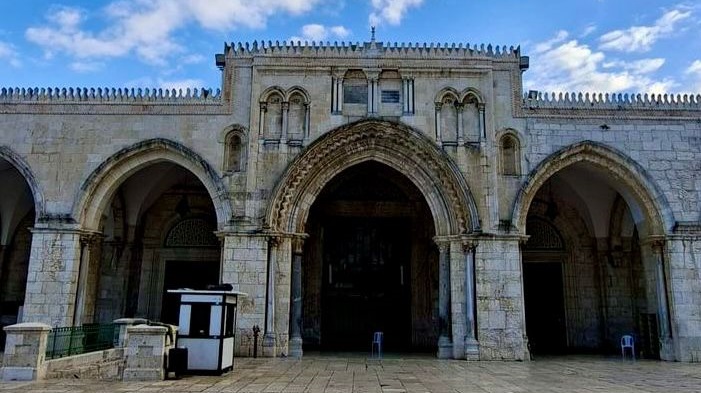
JERUSALEM, March 17, 2026 (WAFA) – Israeli occupation authorities have continued the closure of Al-Aqsa Mosque compound in occupied Jerusalem to Muslims worshippers for the 18th consecutive day, citing security pretexts.
The Jerusalem Governorate affirmed its firm rejection of this measure, stressing that its position does not stem from ignoring considerations related to the safety of worshippers, or downplaying the importance of preserving lives, but rather from a firm legal and political principle concerning the authority exclusively entrusted with managing the affairs of Al-Aqsa Mosque and all other holy sites in Jerusalem.
It clarified that the management of the Al-Aqsa Mosque, including organizing entry and opening or closing its gates when necessary, is an exclusive authority of the Islamic Waqf Department in Jerusalem, affiliated with the Jordanian Ministry of Awqaf, Islamic Affairs and Holy Places, based on the Hashemite custodianship over the Islamic and Christian holy sites in Jerusalem, a custodianship that is internationally recognized, and even implicitly and practically acknowledged by the occupying authorities themselves through long-standing agreements.
It pointed out that the recent experience during the COVID-19 pandemic provides clear evidence of the competent authority; the decision to close Al-Aqsa Mosque at that time was not issued by the Israeli police, but rather by the Islamic Waqf Department itself, which made the decision voluntarily and responsibly, based on its duty to protect worshippers and limit the spread of the pandemic. This confirms that managing the affairs of the mosque, including exceptional closure decisions, is an inherent right of the Waqf and not within the purview of any other entity.
It considered any intervention by the Israeli police in closing Al-Aqsa Mosque or regulating access to it as a direct violation of these authorities and an attempt to impose a new reality that strips the Waqf of its legal and religious role, undermining one of the key pillars of the historical and legal status quo in Jerusalem.
It noted that the danger of this measure lies not only in the closure of Al-Aqsa Mosque itself, but also in establishing a dangerous precedent that opens the door to transforming this intervention into a systematic policy. If occupation authorities monopolize the decision to open and close holy sites, they could, in the future, prevent worship at any time under the pretext of “security” or in response to pressure from settler groups seeking to impose Judaization in the Old City, especially targeting Al-Aqsa Mosque.
According to the statement, this behavior is not limited to Al-Aqsa Mosque alone, but extends to the Church of the Holy Sepulchre, reflecting a boarder trend toward security control over Islamic and Christian holy sites in Jerusalem, in clear violation of international law and the historical arrangements governing the administration of these holy places.
For the first time since 1967, Israeli authorities have prevented worshippers from performing prayers and religious rituals at the Al-Aqsa Mosque, as worshippers were absent from the last Friday of the holy month of Ramadan.
Y.S