By Bassam Abu Al-Rob
NABLUS, July 26, 2026 (WAFA) - The events that unfolded this month in the Palestinian towns of Beit Furik, Tell and Sarra have reinforced a recurring pattern across the occupied West Bank: violent attacks by Israeli colonists, followed by rapid measures that further entrench Israel's colonial project through land seizures, road construction and the establishment of new colonial outposts.
The fires that broke out near Israeli colonial outposts were not isolated incidents. Rather, they became the latest justification for a wave of attacks, military raids and changes on the ground that have resulted in further loss of Palestinian land.
The latest developments began on 18 July, when fires broke out near the Israeli colonial outpost of Havat Gilad, southwest of Nablus. Israeli officials blamed Palestinians for the fires, despite the affected area being inaccessible to Palestinians because of Israeli military restrictions. These allegations have repeatedly been used to justify assaults on neighbouring Palestinian communities and advance colonial expansion.
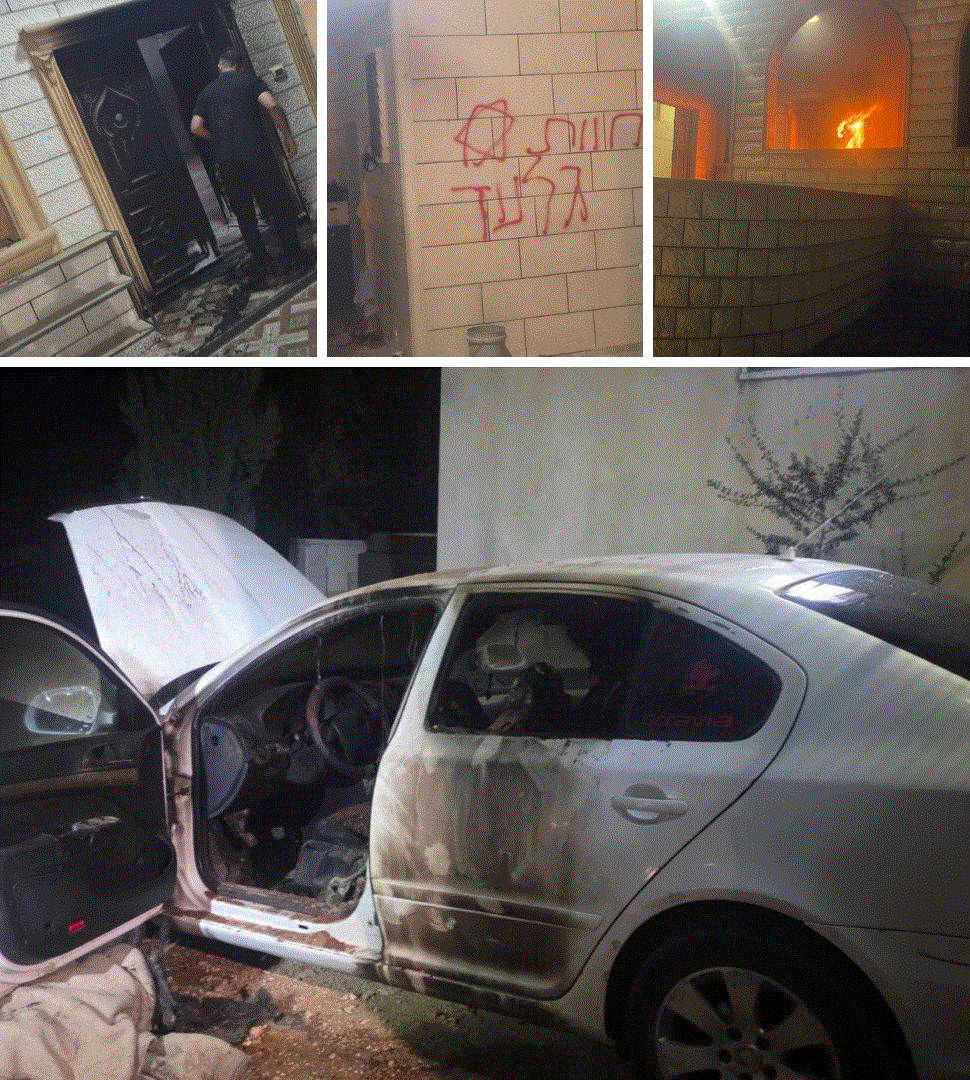
Soon after the fires, Israeli colonists attacked the town of Tell, southwest of Nablus, setting fire to the home of resident Suhaib Radwan. As Israeli firefighting teams worked to contain the blaze, Israeli bulldozers began clearing Palestinian land and opening roads around the area, signalling the start of new infrastructure works linked to nearby colonial outposts.
A similar sequence unfolded days later in Beit Furik, east of Nablus. On 23 July, fires erupted in agricultural fields between Beit Furik and Beit Dajan, once again followed by Israeli accusations against Palestinians. Meantime, surveillance footage showed an Israeli colonist starting the fire.
The incident quickly escalated into deadly violence after Israeli colonists prevented Palestinian farmers and residents from reaching the area to extinguish the flames before opening fire on those who approached, according to Beit Furik Mayor Youssef Hanani. The attack killed two Palestinians and wounded several others.
Hanani said that immediately afterwards, Israeli authorities brought five bulldozers into the area and began constructing roads linking existing colonial outposts while destroying water wells and uprooting trees. He described the offensive as part of a broader Israeli policy aimed at seizing more Palestinian land under the pretext of protecting colonists.
He added that the location, situated near a bypass road and existing colonial outposts, has become a strategic target for further expansion, with Israeli authorities and colonists seeking to impose new realities on the ground and force Palestinian farmers from their land.
According to Hanani, attacks against Beit Furik have intensified in recent weeks, with Israeli colonists setting fire to another Palestinian home in the western part of the town only days after the deadly assault.
The violence escalated further on Friday, when large groups of Israeli colonists stormed the southern part of Tell. Residents confronted the incursion, and four members of the Ramadan family were killed while four others were wounded, three of them critically.
Almost immediately afterwards, Israeli bulldozers began clearing land belonging to Tell and neighbouring Sarra, both located near Havat Gilad and the Route 60 highway. At the same time, Israeli colonists attacked Sarra, burning six Palestinian homes, destroying three vehicles and injuring three residents.
Tell Village Council head Walid Zidan said the sequence of events demonstrated that the attacks were intended to facilitate Israeli colonial expansion rather than being spontaneous acts of violence. He said that within hours of the killings, Israeli machinery had begun bulldozing more than 200 dunams of Palestinian land and uprooting hundreds of olive trees.
According to Zidan, Israeli colonists had already established an outpost east of the village near Al-Murabba checkpoint before moving to establish another south of Tell, only around 200 metres from Palestinian homes in Areas A and B.
He rejected Israeli claims that the colonists had entered the area for recreation, saying they had first attempted to attack Palestinian homes east of the village before moving south, where residents confronted them. The confrontation was followed by a large-scale Israeli military raid that included mass arrests, the surveying of a Palestinian home for demolition and preventing its owners from returning.
Videos circulated widely on social media after the killing of an Israeli colonist and a soldier showed Israeli colonists and movement leaders openly calling for revenge, the destruction of Palestinian villages and the seizure of more Palestinian land. Palestinian observers say such rhetoric reflects an increasingly emboldened settlement movement operating with official backing.
Israeli affairs analyst Ismat Mansour said these calls have become increasingly public and normalised within Israeli political discourse. He argued that the widespread destruction inflicted on Gaza and southern Lebanon has contributed to making calls for the destruction of Palestinian communities appear more acceptable inside Israel than in previous years.
Mansour noted that Israeli military and Shin Bet investigations found that the recent fires were not deliberately started by Palestinians. Nevertheless, he said Israeli colonists continue to exploit such incidents to portray Palestinians as carrying out organised attacks, creating a pretext for further violence, military operations and land confiscation.
He also argued that Israeli authorities rarely hold colonists accountable for attacks against Palestinians, saying the army and police provide protection that enables continued violence and expansion.
According to Mansour, Israel's far-right leadership is seeking to maximise territorial gains before the country's October elections, accelerating the establishment of colonial outposts, settlement farms and infrastructure across the occupied West Bank while political conditions remain favourable.
He added that criticism of colonist violence has also grown within parts of Israeli society, with some Israeli commentators warning that repeated incursions into Palestinian communities and escalating attacks risk leading to wider political, economic and security consequences.
Figures released by the Palestinian Wall and Settlement Resistance Commission underscore the scale of the phenomenon. The commission says Israeli forces and colonists carried out 11,074 attacks against Palestinians and their property during the first half of 2026 alone. These included land confiscation, settlement expansion, forced displacement, field executions, bulldozing, tree uprooting, property destruction and movement restrictions imposed through military checkpoints and road closures. Hebron recorded the highest number of attacks with 2,224 incidents, followed by Ramallah and Al-Bireh with 2,175, Nablus with 2,095 and Bethlehem with 1,137.
For Palestinians living in Beit Furik, Tell and Sarra, the recent events represent more than a series of violent attacks. They are viewed as part of a broader Israeli strategy in which violence against Palestinian communities is followed by irreversible changes on the ground, steadily expanding Israel's colonial presence while shrinking the land available to its Palestinian owners.
M.N