


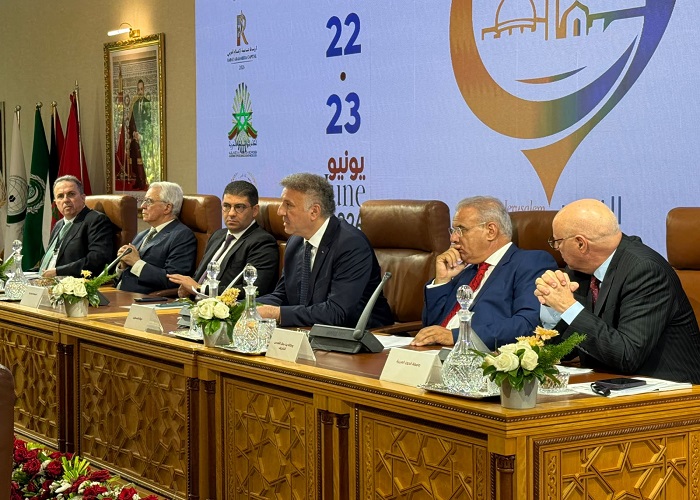
RABAT, June 22, 2026 (WAFA) – A high-level discussion panel titled “Jerusalem: A Global Narrative for Peace” opened on Monday in the Moroccan capital, Rabat, with the participation of the general supervisor of official Palestinian media, Minister Ahmad Assaf, Moroccan Minister of Youth, Culture and Communication Mohamed Mehdi Bensaid, and several official, diplomatic and media figures.
In his opening remarks, Assaf said Palestine’s participation in the forum comes amid growing Arab and international interest in Jerusalem and within the framework of Rabat’s designation as the Capital of Arab Media for 2026, reflecting the centrality of the Palestinian cause and Jerusalem in Arab and international media discourse.
Minister Assaf affirmed that Jerusalem represents the core of the conflict and a symbol of Palestinian national identity, stressing that no path to peace can be achieved without a just resolution to the issue of Jerusalem and the rights of the Palestinian people in the city, as a central issue that cannot be bypassed or marginalized.
He said the Palestinian narrative is subject to continuous attempts at distortion and falsification, calling for building a strong, professional media narrative based on facts and documentation, capable of addressing global public opinion in an effective professional language.
He highlighted the importance of the role of Arab and international media in conveying an accurate picture of developments in Jerusalem and Gaza, free from misleading narratives, in a way that enhances international awareness of the reality on the ground.
Assaf affirmed that Jerusalem will remain a permanent capital for responsible Arab and international media committed to truth and a central platform for a professional narrative rooted in the values of freedom, justice and peace.
He noted that Jerusalem is a city of diverse religions and cultures and a historic model of human coexistence, where Muslims, Christians and others live within a unified social fabric that reflects the inclusive Palestinian identity.
He further affirmed that international law and United Nations resolutions confirm that Jerusalem is an occupied city, and that any unilateral measures aimed at altering its legal status or historical character are internationally rejected and constitute a clear violation of international legitimacy.
He added that Jerusalem is considered one of the final-status issues that must be resolved through fair negotiations based on international legitimacy and the inalienable rights of the Palestinian people, foremost among them their right to their capital.
He pointed out that Israel is exploiting its aggression on the Gaza Strip and the accompanying international preoccupation to impose facts on the ground in Jerusalem and entrench its policies in the holy city, including tightening restrictions on holy sites and pressuring the Palestinian presence there.
He pointed out that both Al-Aqsa Mosque and the Church of the Holy Sepulchre are facing restrictive measures, including limitations on access for Muslim and Christian worshippers, as well as repeated incursions and attempts to impose temporal and spatial division at Al-Aqsa Mosque.
Assaf concluded by stressing that protecting Jerusalem and its holy sites is a collective responsibility requiring serious international action to safeguard freedom of worship and preserve the city’s historical identity.
He also expressed appreciation to the Kingdom of Morocco, King Mohammed VI, Chairman of the Al-Quds Committee, and the Bayt Mal Al-Quds Asharif Agency for their continued support for the Palestinian cause and Jerusalem, praising the agency’s role in strengthening the resilience of Jerusalemites and preserving the city’s identity and institutions.
For his part, the Moroccan Minister of Youth, Culture and Communication said Morocco was proud to host the forum, noting that it reflects the prominent place of the Palestinian cause and Jerusalem in both the official and popular Moroccan conscience.
He stressed the importance of strengthening Arab cooperation in media, culture and communication to promote a balanced and professional narrative on Jerusalem based on documentation and objectivity and capable of countering misinformation and distortion.
Bensaid affirmed that Jerusalem, with its religious and historical significance, remains a unifying cause for the Arab and Islamic nations, adding that Morocco, under the leadership of King Mohammed VI, continues its political, diplomatic and humanitarian efforts to support Jerusalemites and preserve the city’s Islamic and Christian holy sites and identity.
He affirmed that the meeting represents an opportunity to strengthen joint Arab media dialogue and develop media discourse tools in line with global transformations, contributing to the delivery of the Palestinian narrative across various international platforms.
T.R.


