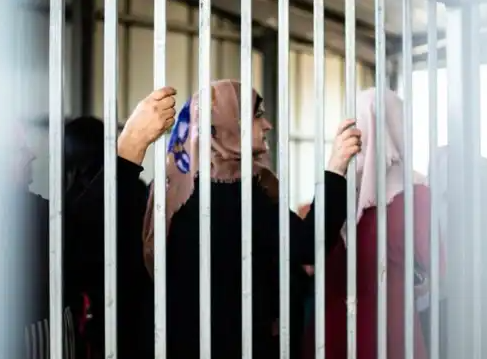
RAMALLAH, August 31, 2026 (WAFA) – The Commission of Detainees and Ex-Detainees Affairs stated that Palestinian female detainees held in Israel’s Damon Prison are enduring harsh detention conditions, with their suffering compounded by overcrowding, shortages of basic necessities, poor-quality food, medical neglect, repeated searches and raids, and punitive measures.
In a statement issued today, the Commission noted that reports and testimonies from female detainees confirm these conditions are taking a heavy toll on their physical and psychological well-being, rendering their detention increasingly difficult.
The Commission highlighted several medical cases involving female detainees held in Israeli detention facilities, including that of Abeer Odeh from Tulkarm. According to the Commission, before her detention, Odeh suffered from paralysis of the esophagus and underwent more than one surgical procedure on her esophagus and diaphragm. Twenty-five percent of her intestines were removed, and a cervical tumor was also surgically removed. She also suffers from six discs in her back, in addition to asthma and respiratory problems.
Odeh, who is held under administrative detention, said that prior to her detention, she regularly received medication for acid reflux, irritable bowel syndrome, and sinus allergies. Since her detention, however, she has only received medication for her stomach condition. She currently suffers from scabies, with visible sores on her hands.
She said that on August 17, 2026, the prison administration forcibly suppressed female detainees in Rooms 8 and 3. The following day, female detainees in Section 3 were forcibly suppressed and removed from the section, while their rooms were emptied of their contents and their personal belongings and clothing were confiscated.
The Commission also cited the case of Yasmeen Shaaban from Jenin, who suffers from a uterine injury after being beaten during her detention. Shaaban was taken to the medical clinic of the prison service and subsequently transferred to a hospital, where she underwent a minor surgical procedure. Upon her release from prison as part of the previous prisoner exchange deal on October 31, 2019, she resumed treatment and was scheduled to undergo surgery. However, the surgery was not performed because she was detained again on May 18, 2025.
Shaaban is a former detainee who spent nearly nine years in Israeli prisons. She is currently held under administrative detention and has received five administrative detention orders. Her current detention is scheduled to end on November 13, 2026.
The Commission also cited the case of Nadine Al-Daghameen from the town of Al-Samu in Hebron, who is held under administrative detention and suffers from an allergy accompanied by a skin rash that began at the start of this month. According to the Commission, the condition affects her daily life and prevents her from sleeping. Despite her repeated requests to be examined at the medical clinic, the prison administration has deliberately refused to provide her with any ointment or medication to alleviate her symptoms.
Another case highlighted by the Commission is that of Shahed Aadi from Beit Ummar in Hebron, who suffers from scabies accompanied by severe itching that has been worsening over time.
The Commission said that Israel’s far-right National Security Minister Itamar Ben-Gvir raided the prison on Wednesday, August 19, 2026, and boasted of being directly responsible for imposing restrictions on male and female detainees in Israeli prisons, while issuing threats against them.
According to the Commission, about 92 Palestinian female detainees are currently held in Israeli prisons and detention facilities.
Meanwhile, the Commission also highlighted the case of female detainee and physician Dima Mohammad Amin, 54, whose health has deteriorated since her detention on August 18.
Following a visit by her lawyer to the Al-Moscobiyeh Interrogation Center, the Commission reported that Dr. Dima Mohammad Amin Barakat developed symptoms of a heart attack and subsequently underwent cardiac catheterization following her detention. She continues to suffer from low blood sugar levels, fluctuations in blood pressure, high cholesterol, and dizziness.
Amin, a gynecologist practicing in Ramallah, described the harsh detention conditions during her lawyer’s visit, pointing to the absence of the most basic necessities of life inside the cell and the severe psychological pressure resulting from these conditions.
She said that being held alone in a cell for prolonged periods, coupled with the harsh detention conditions, causes significant psychological distress. She also pointed to the acute shortage of clothing, saying that she has only the clothes she was wearing when she was detained, forcing her to wash them and put them back on while they are still wet.
She added that the cell offers no privacy and lacks a suitable space for changing clothes, while the food provided remains insufficient. She said that prison guards deliberately engage in continuous shouting, banging on cell doors, random searches, and repeated insults, further exacerbating the harsh detention conditions.
Regarding yard time, known as the “fura,” Amin said: “We are forcibly taken out, dragged and humiliated, and made to stand in a corner for some time without being allowed to move.”
The Commission said that Amin’s account reflects the harsh conditions she is enduring at the interrogation center, particularly given her health condition, which requires continuous medical monitoring and care amid deliberate medical neglect.
T.R.