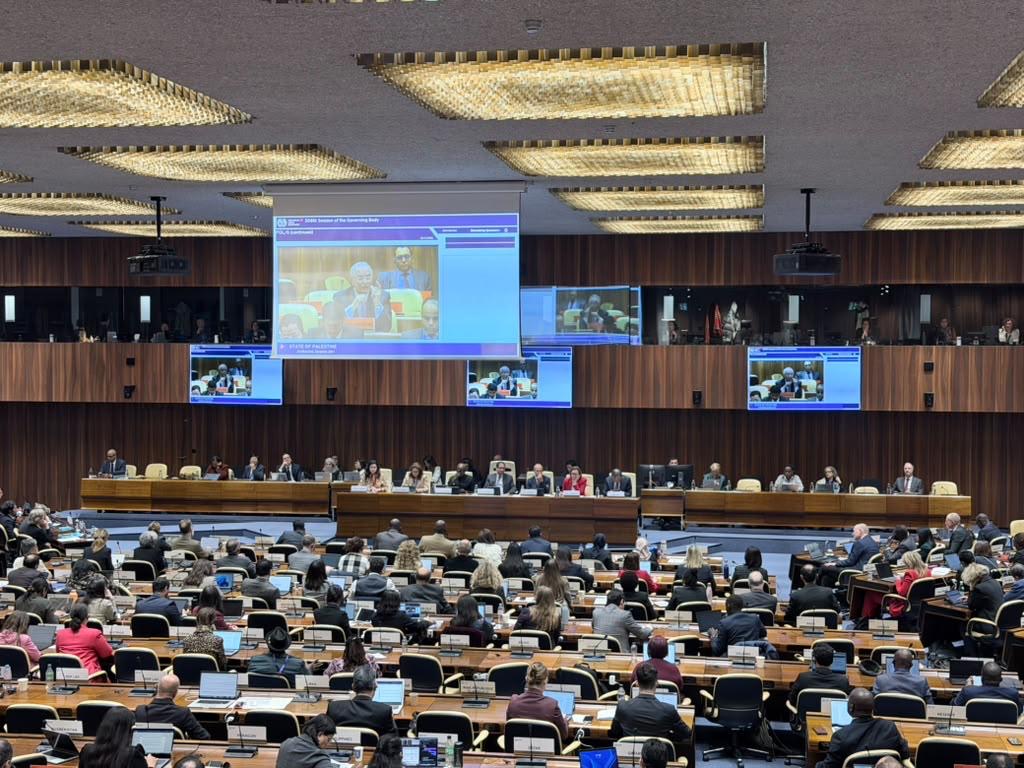
GENEVA, November 13, 2026 (WAFA) – The Governing Body of the International Labour Organization (ILO) unanimously adopted a decision during its 358th Session concerning the enhanced development cooperation programme in the occupied Palestinian Territory.
The session was attended by the tripartite Palestinian delegation, comprising the Permanent Observer of the State of Palestine to the United Nations and other international organizations in Geneva, Ambassador Ibrahim Khraishi; Secretary-General of the Palestinian General Federation of Trade Unions (PGFTU), Shaher Saed; and President of the Federation of Palestinian Chambers of Commerce, Industry and Agriculture (FPCCIA), Abdo Idris. Also attending were ILO Director-General Gilbert F. Houngbo, representatives of regional offices, and representatives of employers and workers.
The decision follows a review of the implementation results of the third Decent Work Programme for the occupied Palestinian Territory (2023–2025), the conclusion of the Emergency Response Plan and its associated recovery programme, and the transition to the Decent Work and Recovery Programme for 2026–2029.
The transition aims to strengthen the rights of Palestinian workers, protect their livelihoods, and support employment opportunities, social protection, economic recovery, and reconstruction efforts.
In the statement delivered on behalf of the State of Palestine, Ambassador Khraishi thanked the ILO Director-General and its offices for preparing the report and continuing to support Palestinian workers. He also commended the positions of Member States and the Employers’ and Workers’ groups in expressing solidarity with Palestine.
He also welcomed the transition to the 2026–2029 Decent Work and Recovery Programme, as well as the Business Recovery Initiative, which has contributed to supporting several Palestinian economic enterprises and restoring jobs. He stressed the importance of continuing and expanding these efforts.
For his part, Saed reviewed the hardships facing Palestinian workers, noting the loss of approximately 250,000 jobs and nearly $2 billion in labor income.
He stressed that the declaration of a ceasefire has not ended the challenges, given the ongoing Israeli attacks, movement restrictions, and destruction of livelihoods, and called for protecting workers and restoring employment opportunities.
The session featured extensive interventions, during which countries and regional groups affirmed their solidarity with the Palestinian people and support for the decision.
The Arab Group, the African Group, the Organization of Islamic Cooperation (OIC), and the Gulf Cooperation Council (GCC) reaffirmed their support for the rights of Palestinian workers, calling for sustainable and flexible funding to promote employment, strengthen social protection, and restore enterprises and productive capacities.
Egypt announced its full support for the decision and stressed the need to link relief efforts to recovery and reconstruction.
Meanwhile, Saudi Arabia, Jordan, Algeria, Morocco, Tunisia, the Sultanate of Oman, and Lebanon emphasized the importance of supporting Palestinian institutions, protecting workers’ rights, expanding job opportunities, and strengthening the resilience of the national economy.
Brazil, China, Bangladesh, Türkiye, and Cuba affirmed their support for the Organization’s efforts, as well as its recovery and social protection programmes.
Furthermore, the United Kingdom, Lithuania, and France stressed the need to rebuild the economy, provide decent work, and ensure the delivery of humanitarian aid as quickly as possible.
Brunei, Malaysia, and Indonesia also underscored the importance of supporting Palestinian enterprises and enhancing women’s participation in the labor market.
For her part, Chairperson of the Workers’ Group Catelene Passchier affirmed the Group’s solidarity with Palestinian workers and the need to protect their rights and dignity and provide them with decent work.
She expressed her support for the decision, calling for the mobilization of the necessary resources to implement the Decent Work and Recovery Programme and ensure the participation of workers and their representatives in setting its priorities.
In turn, Employers’ representative Matthias Thorns stressed the need to restore the productive capacities of the Palestinian economy, facilitate enterprises’ access to markets and financing, expand recovery initiatives, and support women’s participation in the labor market.
Representatives of the International Labour Organization affirmed that the next phase will focus on promoting economic recovery, protecting working conditions, wages, and workers’ rights, and expanding support for small and medium-sized enterprises (SMEs), thereby helping to translate international pledges into real job opportunities and improve the living conditions of the Palestinian people.
T.R.