


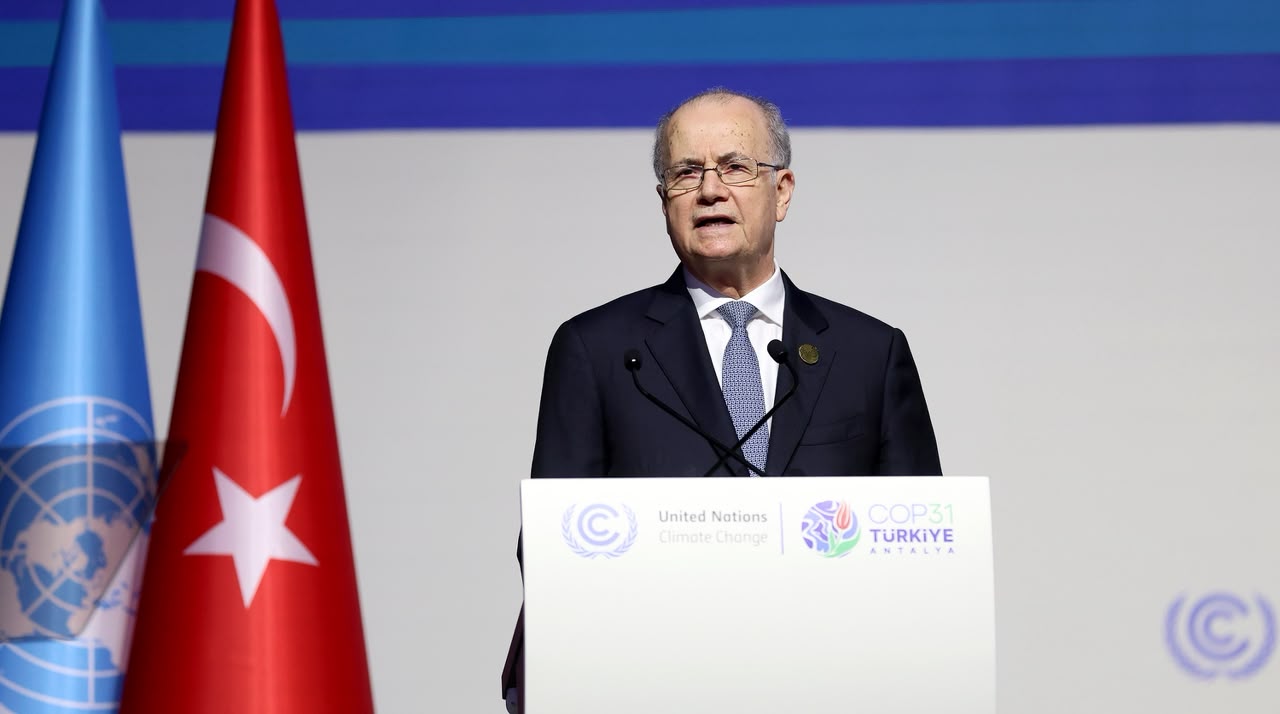
RAMALLAH, November 12, 2026 (WAFA) – Prime Minister Mohammad Mustafa said that the challenges facing Palestine, including those related to climate change, are compounded by the ongoing Israeli occupation and restrictions on access to land, water and natural resources.
Mustafa stressed that Gaza today embodies the painful intersection of humanitarian, environmental and climate challenges, explaining that the widespread destruction of water, sewage and energy networks, agricultural land and waste management systems has exacerbated environmental and health risks and undermined the population's ability to adapt and build resilience.
He made the remarks during his address to the World Leaders' Summit at the 31st Conference of the Parties to the United Nations Framework Convention on Climate Change (COP31), held in the Turkish city of Antalya on Thursday. He delivered the speech on behalf of President Mahmoud Abbas, in the presence of Palestine's Permanent Observer to the United Nations Riyad Mansour, Palestinian Ambassador to Türkiye Nasri Abu Jaish, and Environment Quality Authority Chairman Zaghloul Samhan.
"The reconstruction of Gaza is not merely a humanitarian and development necessity, but also an opportunity to rebuild on green and sustainable foundations," Mustafa said, calling for an international partnership to support recovery and reconstruction efforts and integrate clean energy, sustainable water and waste management, and the protection of natural resources into rebuilding plans.
Mustafa noted that the World Leaders' Climate Summit in Antalya comes at a critical moment that requires moving from climate pledges to concrete action. Climate change, he said, is no longer a future threat but a reality affecting people's water, food, health and economic security, particularly in the most vulnerable communities.
The Prime Minister expressed his appreciation to Turkish President Recep Tayyip Erdoğan and the Republic of Türkiye for hosting the summit. He commended Erdoğan for forcefully and clearly highlighting the disasters endured by the Palestinian people as a result of the occupation and genocidal war, particularly in the Gaza Strip, as well as the suffering caused by heavy rains that flooded tens of thousands of displacement tents in recent days.
"Hosting this summit on the shores of the Mediterranean reminds us that climate change has become a reality affecting every aspect of people's lives," Mustafa said, affirming that Palestine believes climate justice must be at the heart of international climate action. He stressed that peoples who contribute the least to emissions but suffer the most from climate change deserve fair support to protect their resources and strengthen their resilience.
Mustafa added that Palestine continues to meet its climate commitments, noting that its third Nationally Determined Contribution (NDC) had been adopted and submitted to the Secretariat of the United Nations Framework Convention on Climate Change, reaffirming its commitment to the goals of the Paris Agreement, emissions reduction, and strengthening climate adaptation and resilience.
He said Palestine prioritizes investment in water resource management, climate-smart agriculture, renewable energy, biodiversity protection and strengthening the resilience of local communities, as integral components of its national strategy for resilience and sustainable development.
Mustafa stressed that translating these commitments into tangible results requires lifting restrictions on Palestinian natural resources, providing accessible climate finance, transferring technology and building national capacities.
He also emphasized that the success of the Antalya conference should be measured by its ability to turn ambitions into results by accelerating the implementation of the Paris Agreement, fulfilling climate finance commitments, strengthening adaptation, supporting the most vulnerable communities and ensuring a just transition to a low-emissions economy.
"Palestine's message is clear: no people should be denied their right to sustainable development or their ability to confront climate change because of occupation or conflict," he said.
Mustafa called for the summit to serve as a platform for strengthening international solidarity and translating climate justice into partnerships, investments and tangible results, paving the way for a safer, more sustainable and just future for generations to come.
Y.S


