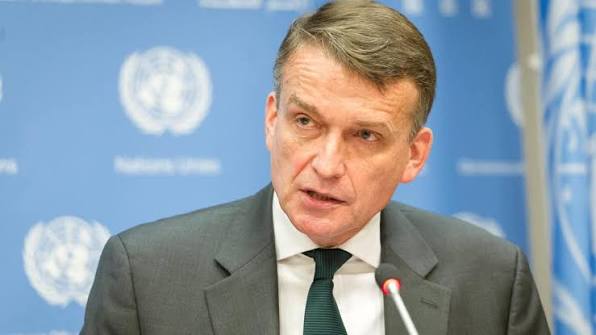
NEW YORK, September 25, 2026 (WAFA) – UNRWA Commissioner-General ad interim Christian Saunders stated on Thursday that the Agency faces an extraordinary financial crisis with a cashflow deficit of US$100 million.
Speaking at the Ministerial Meeting on the Margins of the 81st UN General Assembly in New York, Saunders said: “This is an extraordinarily challenging time for the Middle East and for the world. For Palestine Refugees, hardships multiply as hope for the future wanes.”
He added that the Gaza ceasefire “has brought some relief, but millions live in profound insecurity.”
He noted that as the winter approaches, the Agency’s humanitarian partners are “warning of major gaps in our response, driven by severe funding shortfalls and continued restrictions on the entry of critical supplies.”
“94 per cent of people lack proper shelter. 90 per cent experience frequently disrupted access to clean water. 98 per cent of households live near environmental hazards, including sewage, rubble and rodents,” he elaborated.
He also noted that with more than 10,000 personnel on the ground, UNRWA continues to provide services and assistance to 1.7 million people.
“Our work ranges from managing more than 80 emergency shelters and bringing hundreds of thousands of children back to learning, to delivering some 70,000 medical consultations each week and providing clean water, sanitation and hygiene services to well over a million people.”
He added that the scale of UNRWA’s operation in Gaza remains immense and the trust of the community is steadfast.
“UNRWA remains an institution of considerable humanitarian and strategic value, with capabilities and expertise that are difficult to replicate today, in the humanitarian response, and tomorrow, in recovery and reconstruction.”
As for the situation in the occupied West Bank, Saunders said that it is alarming and increasingly becoming untenable.
“The displacement of Palestinians is at levels unseen since 1967 and settler violence goes unchecked, creating intolerable conditions of life.”
As for the situation in occupied East Jerusalem, Saunders said that the measures taken by the Israeli occupation authorities to curb UNRWA’s operations culminated in the seizure of the Agency’s HQ, vocational training centre, schools and health infrastructure.
He stressed that “these actions in no way diminish the rights of Palestine Refugees nor contribute to resolving the Palestinian question.”
“But without a meaningful response grounded in international law and the United Nations Charter, we risk irreversibly eroding the foundations for a viable Palestinian state,” he warned.
Highlighting UNRWA’s role that is not restricted to the occupied Palestinian Territory, Saunders said that the Agency continues to play a vital, stabilising role in Jordan, Lebanon and Syria.
He noted that the Agency’s extraordinary financial crisis has forced the Agency to take strict austerity and cost-control measures and reduce service-delivery hours by 20 per cent, with corresponding salary cuts for most local staff.
On the issue of neutrality, he said that UNRWA continues to steadily implement the recommendations arising from the Independent Review of UNRWA’s neutrality.
“41 out of 50 recommendations – more than 80 per cent – are now fully implemented. Most of the remaining recommendations are under implementation.”
He affirmed that UNRWA’s commitment to “safeguarding the integrity and neutrality of our workforce, and to honouring the trust placed in UNRWA by Member States, is unwavering.”
He noted that the Agency was working towards the delivery of services in a more cost-effective, efficient and data-informed manner, including by leveraging new technologies and closer cooperation with our partners, and that it was also placing greater emphasis on livelihoods and empowering Palestinian youth.
He appealed for UNRWA to be allowed “the space to operate within the Occupied Palestinian Territory in accordance with its mandate” and provided with the financial support to continue operating today and tomorrow “as we modernise and find better ways to serve Palestine Refugees.”
K.F.