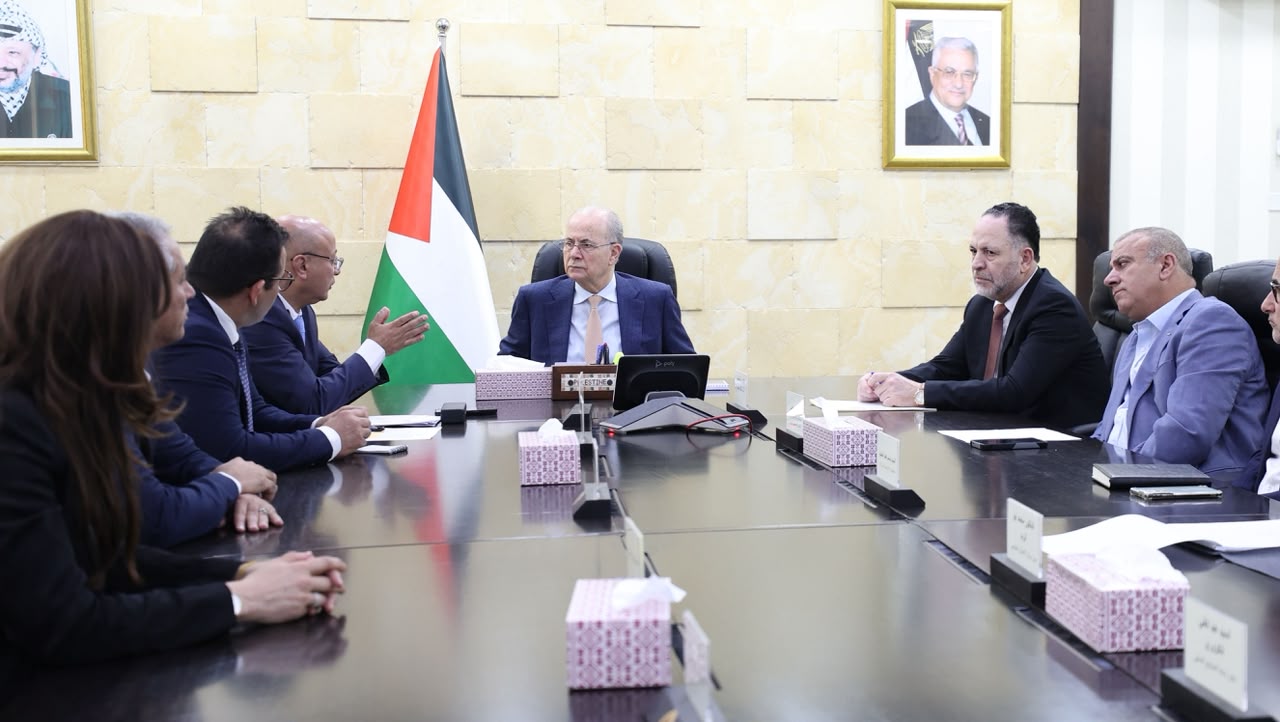
RAMALLAH, November 26, 2026 (WAFA) – Prime Minister Dr. Mohammad Mustafa met on Thursday, at his office in Ramallah with a delegation from the Refugee Affairs Department of the Palestine Liberation Organization (PLO), headed by Executive Committee Member Dr. Ahmad Abu Holi, to discuss the findings of the assessment phase of the project entitled “Development of Strategic Interventions for Improving Water and Wastewater Services in Palestinian Refugee Camps.”
The project is funded by the European Union and implemented in cooperation with several international partners, foremost among them the United Nations Relief and Works Agency for Palestine Refugees in the Near East (UNRWA). The meeting was attended by Head of the Palestinian Water Authority Dr. Ziad Al-Maimi and Prime Minister’s Adviser for Arab and Islamic Funds Dr. Nasser Qatami.
The Refugee Affairs Department presented the study, which aims to assess the current state of services and infrastructure, identify needs and gaps, and lay the groundwork for strategic interventions and priority projects that will help improve service delivery and ensure its sustainability.
The assessment covered 26 Palestinian refugee camps, including 20 in the West Bank and six in Lebanon. It focused on four key areas: water, wastewater, stormwater, and solid waste management. The assessment involved technical and field evaluations of existing services and infrastructure, analysis of challenges and needs, and documentation of available information.
The next phases of the project will involve developing strategic interventions and priority action plans based on the assessment findings. These will include directing projects for which allocations or funding are being secured towards addressing urgent priorities, identifying proposed projects and their financing requirements and implementation phases, and establishing the institutional arrangements necessary to ensure their implementation, operation, maintenance, and sustainability.
The study also identified the refugee camps most in need of intervention during the first phase: Balata, Al-Arroub, Al-Far’a, Aqabat Jabr, Al-Fawwar, Dheisheh, and Al-Jalazone. Available funding will be directed towards these priorities while efforts to mobilise the necessary resources for urgent infrastructure projects are strengthened. In addition, priority interventions were identified for the Nahr al-Bared, Beddawi, Burj al-Barajneh, Mieh Mieh, Shatila, and Ein el-Hilweh refugee camps in Lebanon.
Additionally, the assesment identified several key priorities, including rehabilitating water and sanitation networks by replacing old and deteriorated pipes, addressing leaks, blockages, and flooding, ensuring wastewater treatment, improving stormwater drainage, strengthening solid waste management, and enhancing coordination among UNRWA, municipalities, and refugee camps popular committees.
The Prime Minister reaffirmed UNRWA’s legal mandate across all refugee camps, in accordance with United Nations resolutions, stressing the need to ensure the Agency’s continued operation and enable it to maintain the provision of education, primary healthcare, relief, and social services to refugees, while securing adequate and sustainable funding.
Mustafa underscored the importance of strengthening partnerships with UNRWA, international institutions, and donor agencies to implement priority service projects in Palestinian refugee camps and reinforce the resilience of their residents. He noted that a portion of road transport fees had been allocated to support the implementation of projects in Palestinian refugee camps.
For his part, Abu Holi stressed the importance of the thorough implementation of the Refugee Affairs Department’s strategy, which focuses on protecting refugee rights, defending UNRWA’s mandate, and improving living conditions in the refugee camps. He highlighted the complementary efforts of the Department, UNRWA, government institutions, and international donors in implementing coordinated interventions to improve services for Palestine refugees, both in Palestine and throughout the diaspora.
Abu Holi also noted that work is underway to equip water wells in Palestinian refugee camps in Lebanon with solar energy systems to ensure a sustainable water supply for refugees. The first solar energy project has already been inaugurated in Mar Elias Refugee Camp, with projects in Beddawi and Jalil camps to follow, in full partnership with the Palestine Forum.
Y.S