HEBRON, October 26, 2026 (WAFA) – For the fourth consecutive day, Israeli occupation forces continue their aggression against the Hebron Governorate, marked by an escalation in raids, the deployment of military reinforcements, the imposition of closures, the seizure of Palestinian vehicles, and assaults on citizens. According to the Support and Relief Committee in Hebron, the number of displaced persons in the city has risen to approximately 2,649.
Local sources reported that additional Israeli occupation army forces, accompanied by armored military vehicles, entered the city of Hebron around midnight via the Farsh al-Hawa entrance. Simultaneously, forces raided the southern area near Jabal Karbaj, while further military reinforcements and large trucks arrived in the al-Jalda area.
The sources added that occupation forces confiscated several Palestinian vehicles. Eyewitnesses reported the arrival of new military reinforcements in the Ein Deir Bahha area, where vehicles were also seized. Field footage captured occupation forces mistreating a young man at the al-Jalda roundabout in the city.
In a related development, an eyewitness reported that occupation forces partitioned a street in the Jabal al-Rahma area, designating parts for Palestinians and others for settlers—a measure that severely restricts the movement and transit of local residents.
Furthermore, occupation forces raided the home of the al-Jabari family near the Salah Abu Manshar School in the al-Sha’aba neighborhood, the home of Jamal al-Natsheh near the al-Murabba’a area on al-Salam Street, and the home of Abu Yunus al-Zaru in the southern part of the city. Occupation forces also raided Jabal al-Ja’bari, near the al-Ja’bari Diwan (communal hall) in the Wadi al-Qata’ area of Hebron, and broke into a number of homes.
Hebron Governor Khaled Dudin—who stated he "expects the worst"—reported that the occupation forces have been deliberately destroying the contents of homes, terrorizing residents, establishing field interrogation centers, and arresting over 70 individuals to date. He noted that the occupation is subjecting the governorate’s nearly one million residents to abuse, while eyewitnesses reported that occupation soldiers opened fire on civilian vehicles.
In press statements, Dudin said that 450 families have been forcibly displaced—amounting to more than 2,300 people—from the Deir Bahha and al-Jalda areas. He added that over 500 homes have been searched, and the governorate has been effectively fragmented by 128 closed gates and 120 military checkpoints set up by the occupation army.
Occupation forces continue to keep the al-Jalda and Deir Bahha areas of Hebron under closure, having forcibly compelled families to evacuate large sections of these neighborhoods. This has resulted in mounting damage to the residents, local economic interests, and private property.
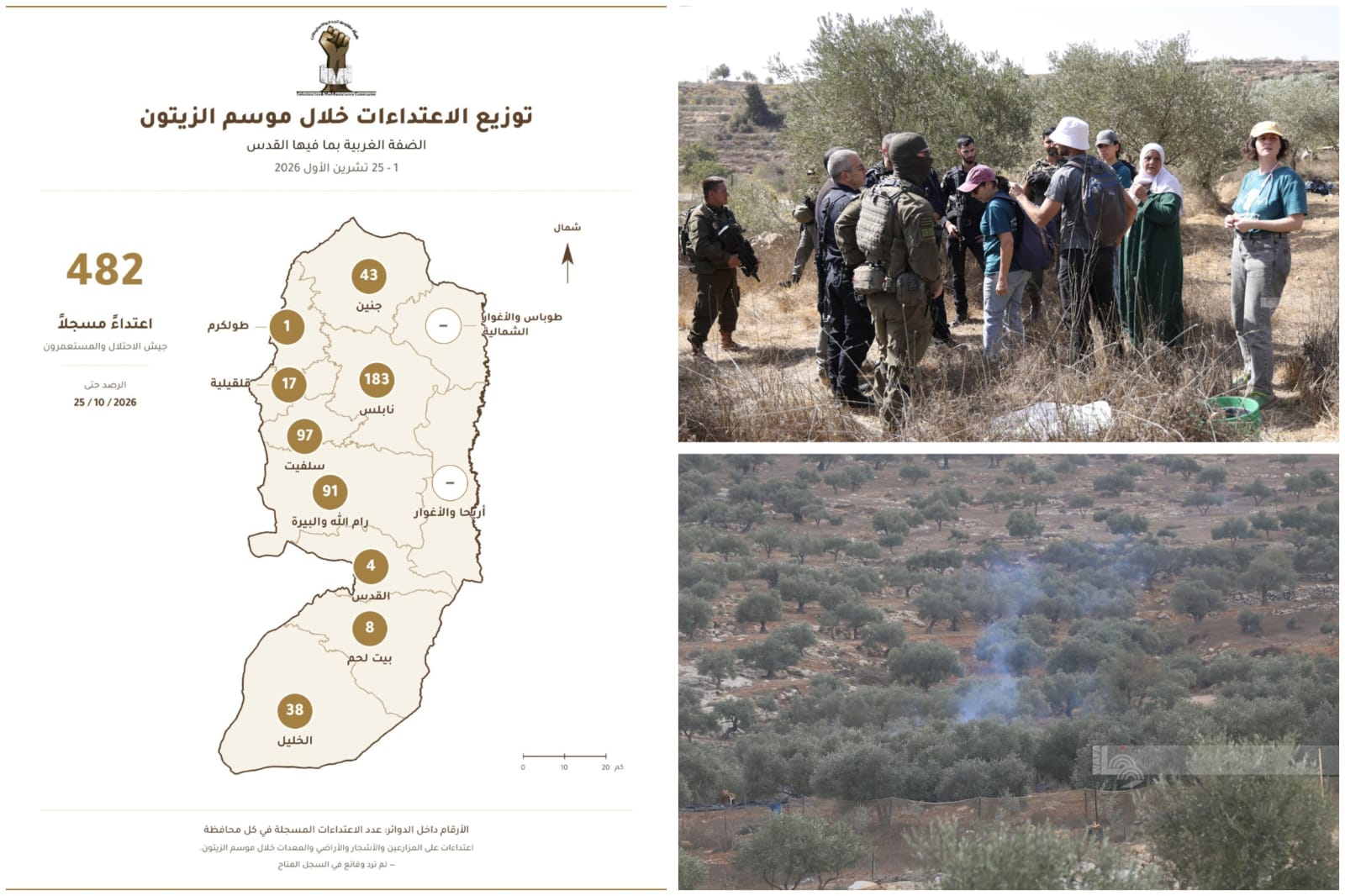
Furthermore, occupation forces are preventing citizens from passing through the closed gates at the entrances to the city, its surrounding towns, and its refugee camps. These closures are concentrated at the entrances to Hebron city, the towns of Idhna, Bani Na’im, and Halhul, as well as the al-Fawwar and al-Arrub refugee camps. According to reports from the governorate, occupation forces have assaulted residents, damaged their vehicles, and commandeered Palestinian vehicles to block roads and intersections. In a related context, the Wall and Settlement Resistance Commission documented—in a statement issued yesterday, Sunday—272 attacks by occupation forces and settlers in the Hebron Governorate during the month of September, 122 of which were carried out by settlers.
The Commission noted that, during the same month, it recorded 19 demolition operations affecting 91 structures in the governorate, making Hebron the West Bank governorate with the highest number of demolished structures during that period.
It explained that the sum of these incidents reflects escalating pressure on Palestinians regarding housing, employment, freedom of movement, and access to property, alongside an expansion of control over sites and roads. The Commission further pointed out that the repercussions of these demolitions, evictions, and closures have extended beyond the targeted buildings, impacting entire neighborhoods and various economic interests.
Amid ongoing military measures and closures, the Hebron Governorate is witnessing a deterioration in humanitarian and living conditions, characterized by restricted movement for residents, the disruption of their livelihoods, and mounting burdens on affected and displaced families.
K.T