By: Mohammad Dahman
GAZA, October 5, 2026 (WAFA) – Between Beersheba in southern Israel and the Gaza Strip, the distance separating Mahmoud Aslih from his wife, 24-year-old Nancy Abu Sweilem, and their son Salah seems relatively short. Yet for the past three years, it has become a road impossible to cross. The father now lives in a tent in the Gaza Strip, while the mother and their child remain in Beersheba. All that connects the family now are old photographs and intermittent internet calls.
Mahmoud, 26, arrived in Beersheba with his father when he was 14 years old and stayed with relatives, living and working there for years. On October 16, 2020, he married Nancy, and the couple began a stable family life, during which they had their son, Salah.
On November 3, 2023, that life came to an abrupt end.
Mahmoud recalls that Israeli police came to his home, detained him in front of his wife and child, and took him to a police station in Beersheba. He remained detained there for about a week before being handed over to the army and deported to the Gaza Strip through the Karem Abu Salem crossing.
He notes that he did not expect to be deported, as he held judicial documents issued by an Israeli court preventing his deportation; however, he explains that he no longer has copies of the documents.
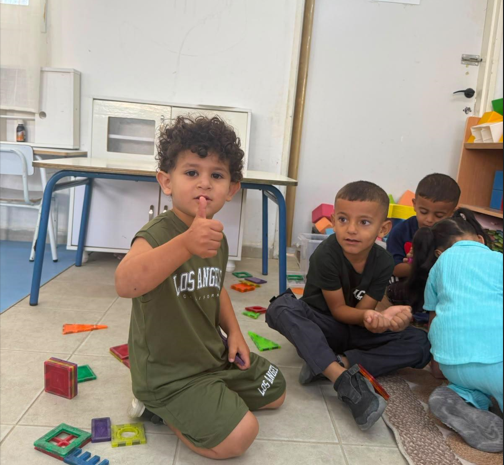
Salah was eight months old at the time, and the hours leading up to his father’s deportation were the last time Mahmoud saw him face-to-face.
“The last thing I remember is holding him in my arms hours before my deportation. I don't feel like I ever got to see him or cuddle him enough,” Mahmoud says.
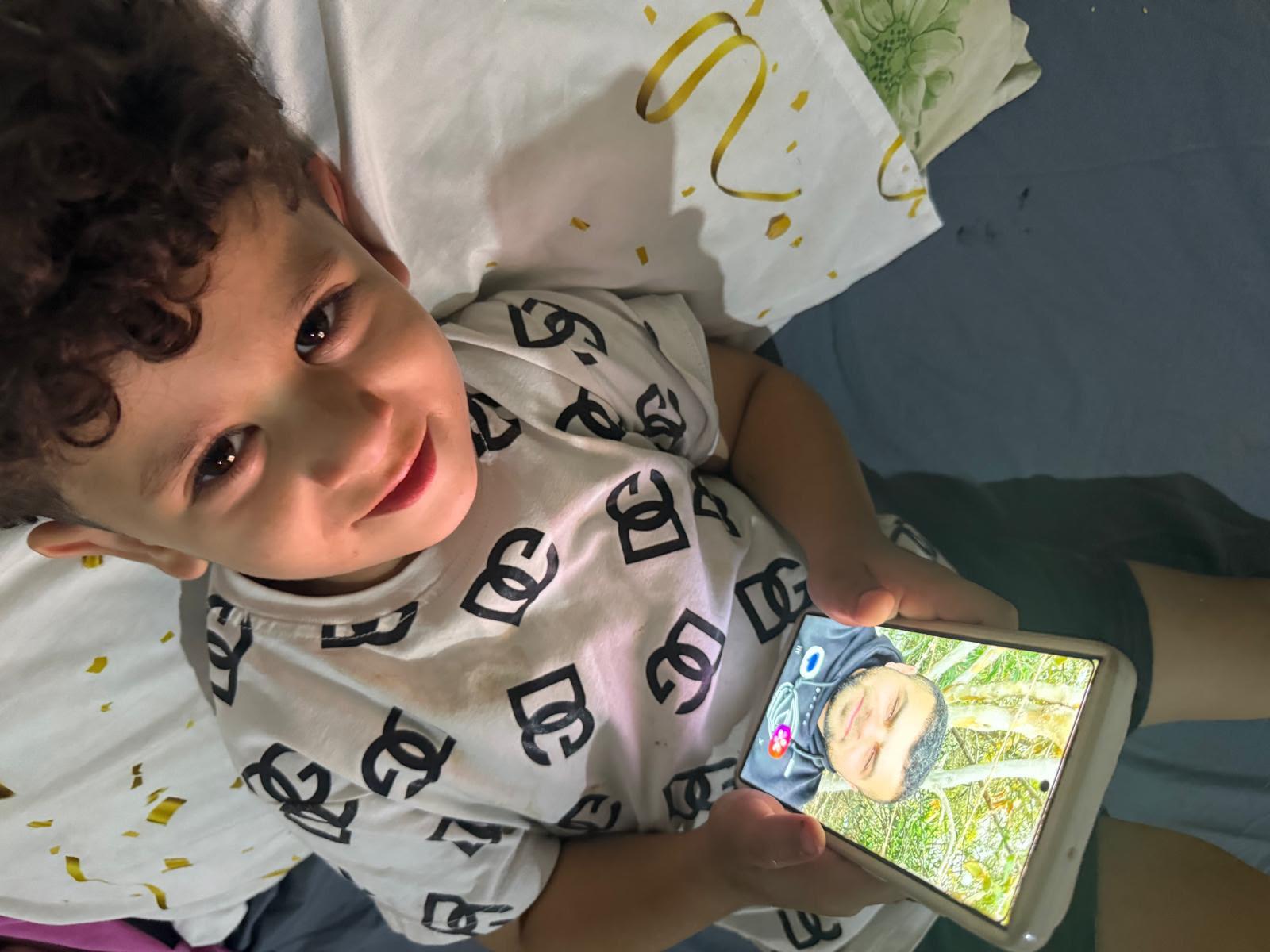
Since then, the phone has become his only window to his child. He speaks to him via voice or video calls whenever the internet connection allows, but notes that this does not make up for his physical presence, especially as the years pass and Salah grows up away from him.
He notes that the child sometimes asks him, “When are you coming home?” Unable to give him a clear answer, Mahmoud tries to change the subject or distract him, all while watching his son grow up through a phone screen.
Nancy notes that Salah was not yet eight months old when his father was deported, so he had no clear memories of him. To keep his father’s image alive, she set Mahmoud’s photograph as her phone's wallpaper. Whenever the child asked about the man in the picture, she would tell him, 'This is your father,' and show him photographs while sharing memories of the first few months they all spent together.
She said that Salah has begun asking, “Where is my dad? Why doesn’t he come to get me?”—especially when he sees other children with their fathers. She tries to reassure him and lets him speak to his father whenever possible.
“I try to play the role of both mother and father at the same time, but it is very difficult. I am still young and do not have enough experience to fulfill both roles, and he is a child who needs his father just as much as he needs me,” she said.
Before the separation, Mahmoud was the family’s main breadwinner, and their life revolved around being together in one home. After his deportation, Nancy assumed sole responsibility for raising their child, stressing that having her family by her side cannot make up for the absence of her husband and her child’s father.
She notes that Mahmoud is only an hour away from her, but because he is in “the hardest place in the world,” reaching him has become “a fantasy.”
Her efforts did not stop at waiting. She contacted social affairs authorities and a social worker, and turned to human rights organizations in Jerusalem, visiting one of them multiple times. However, she notes that nothing changed, and the responses she received mostly urged her to wait until the situation calmed down.
Nancy recalls that the hardest part of the separation in its early stages was the lack of news about him and poor communication. Many times, she feared that he had been killed or that something bad had happened to him before she was finally able to confirm that he was safe.

Today, Salah is approaching his fourth birthday. He has spent most of his life without his father, while the father, Mahmoud, lives in war-ravaged Gaza, far from his family. Mahmoud notes that he sees no normal life or clear hope ahead of him, other than holding on to the possibility of meeting his son.
Attorney Samir Al-Manaameh of the Al Mezan Center for Human Rights states that separating a Palestinian from his wife and child, in legal terms, deprives the family of its right to family reunification and to live together, thereby deepening its humanitarian suffering. He considers this policy contrary to rights relating to family unity and reunification guaranteed under international human rights law.
Al-Manaameh adds that there are dozens of Palestinian families whose members have been forcibly deported to the Gaza Strip, and that such cases are not limited to the Aslih family. He explains that there are currently no accurate statistics on the number of people forcibly deported from inside Israel to the Gaza Strip due to the circumstances of the war, the disruption of institutions, and the irregularity of their work, making updated data on their numbers unavailable.
He adds that children who are deprived of one of their parents for years need to grow up within a family with both parents, unless a court ruling explicitly prevents this. He notes that legal options in such cases include turning to the Israeli judiciary to challenge the deportation or expulsion order, particularly if there are previous documents or court decisions that can be relied upon.
Al-Manaameh notes that the Al Mezan Center has followed cases related to Palestinian family reunification for years and has cooperated with human rights organizations to file petitions before Israeli courts, calling for respect for families’ rights to reunite and live together.
For Mahmoud and Nancy, their demand is no longer limited to restoring the life they once had. They are appealing to international and humanitarian bodies, as well as anyone capable of intervening, to find a safe place where the family can be together—in any country willing to receive them until the war ends—and to open a legal path that would allow Mahmoud to return to his wife and child, reuniting the family once again.
Mahmoud says that the first thing he will do if he manages to return is hold Salah in a long embrace, adding, “He is everything to me in this life.”
As for Nancy, she expressed hope that the family will return to its normal life, allowing Salah to grow up with both parents together, relieving her of having to play two roles and sparing the child the painful feeling of being separated from a father who is still alive.
Between a father waiting to meet his child, a mother striving to preserve her son’s image of his father, and a child growing up without real memories of him, the Aslih family remains suspended between a short distance on the map and a road they have been unable to cross for three years—a family haunted by absence and held together by the hope of “family reunification.”
T.R.