


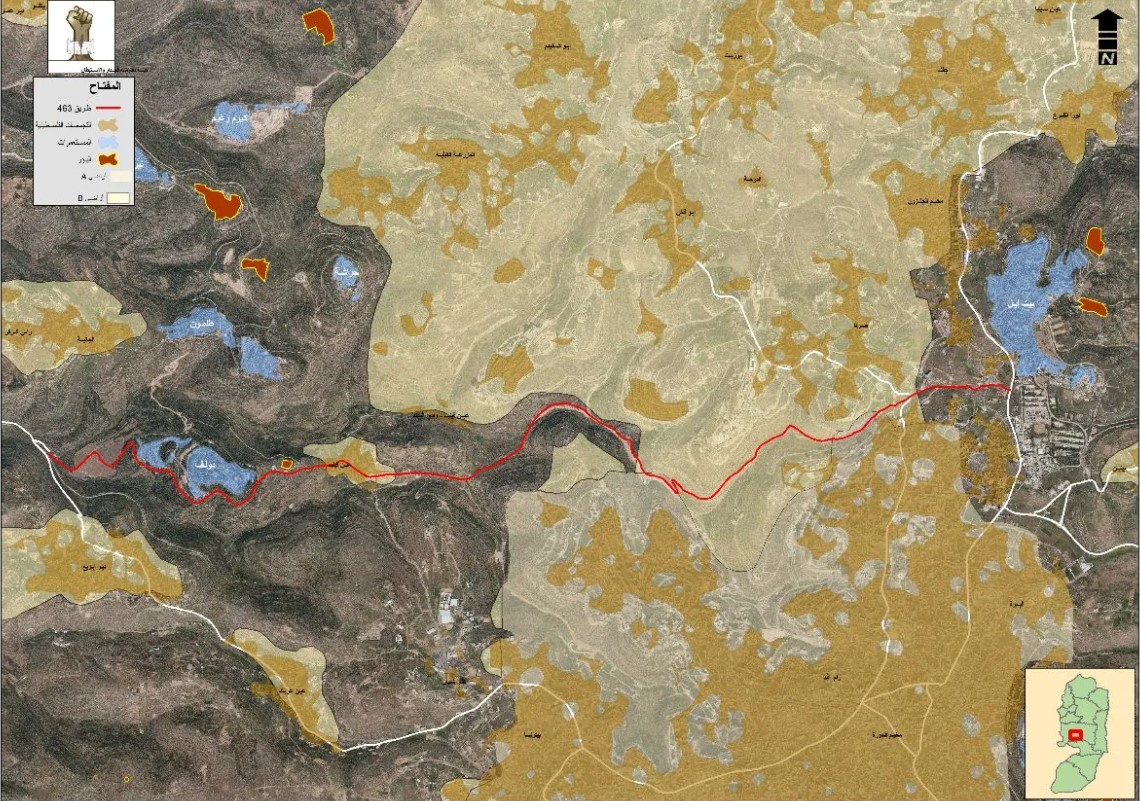
RAMALLAH, September 29, 2026 (WAFA) – Israeli media reports have revealed efforts within the occupation’s military establishment to create the conditions necessary to reopen Route 463 to colonist traffic, a road that cuts through the heart of the Ramallah and al-Bireh urban area and separates its northern and southern parts, according to a statement issued by the Colonization and Wall Resistance Commission.
According to spatial data, reopening the road to colonists would isolate eight villages and two large residential neighborhoods in the northern part of the urban agglomeration from the rest of the area, forcing tens of thousands of Palestinians to use an old alternative route near the Jalazone refugee camp. The road already suffers from severe congestion and would be unable to accommodate the additional traffic.
The reports do not view the plan as an isolated measure, but link it to a broader system of ongoing changes in the Ramallah and al-Bireh Governorate, including the Chinese Roads network originally established by the Municipality of Ramallah to alleviate traffic congestion. The network could effectively be transformed into a tool for reshaping population movement in a manner that serves new colonial arrangements.
In its statement, the Commission said that the plan falls within a systematic policy aimed at dismantling Palestinian geographical and demographic continuity in the Ramallah and al-Bireh Governorate, which is home to around 400,000 Palestinians across nearly 80 communities. The governorate already suffers from extensive fragmentation caused by Area C, colonial settlements, bypass roads, checkpoints, and military gates, amid escalating restrictions on movement since October 7, 2023.
The Commission warned that reopening the road to colonists would constitute an additional step toward de facto annexation and the severing of Area C from its vital Palestinian surroundings, in violation of international humanitarian law and the provisions of the Fourth Geneva Convention, which prohibit altering the legal status of occupied territory and require the occupying power to protect protected persons from measures affecting their geographical and social cohesion.
It explained that Route 463 dates back to 1994, when it was paved to connect the colonial settlements of Beit El and Dolev and was known at the time by an informal local name. Following the outbreak of the Second Intifada, the occupation army banned colonists, as well as Palestinians for a period, from using parts of the road for security reasons.
In recent months, however, there has been a noticeable escalation in efforts to reopen the road fully, manifested in the organization of tours and marches by colonists along parts of it, during which they raised Israeli flags and held activities near Palestinian sites, coordinated by or conducted under the protection of the occupation forces.
The continued classification of parts of the road as Area C, despite their location within the densely populated Palestinian urban agglomeration, provides the administrative basis used to justify this approach, according to the Commission. It said this reflects a recurring pattern of exploiting the classifications established under the Oslo Accords to serve the colonial project rather than protect Palestinian rights.
On the ground, a direct attack by colonists on the same road was documented on September 8, when colonists blocked a roundabout near the Ain Ayoub area on Route 463, close to the village of Ras Karkar, and threw stones at Palestinian vehicles, damaging at least one of them. The Commission said the incident forms part of an escalating pattern of colonist attacks targeting Palestinian road users in the governorate.
T.R.


