


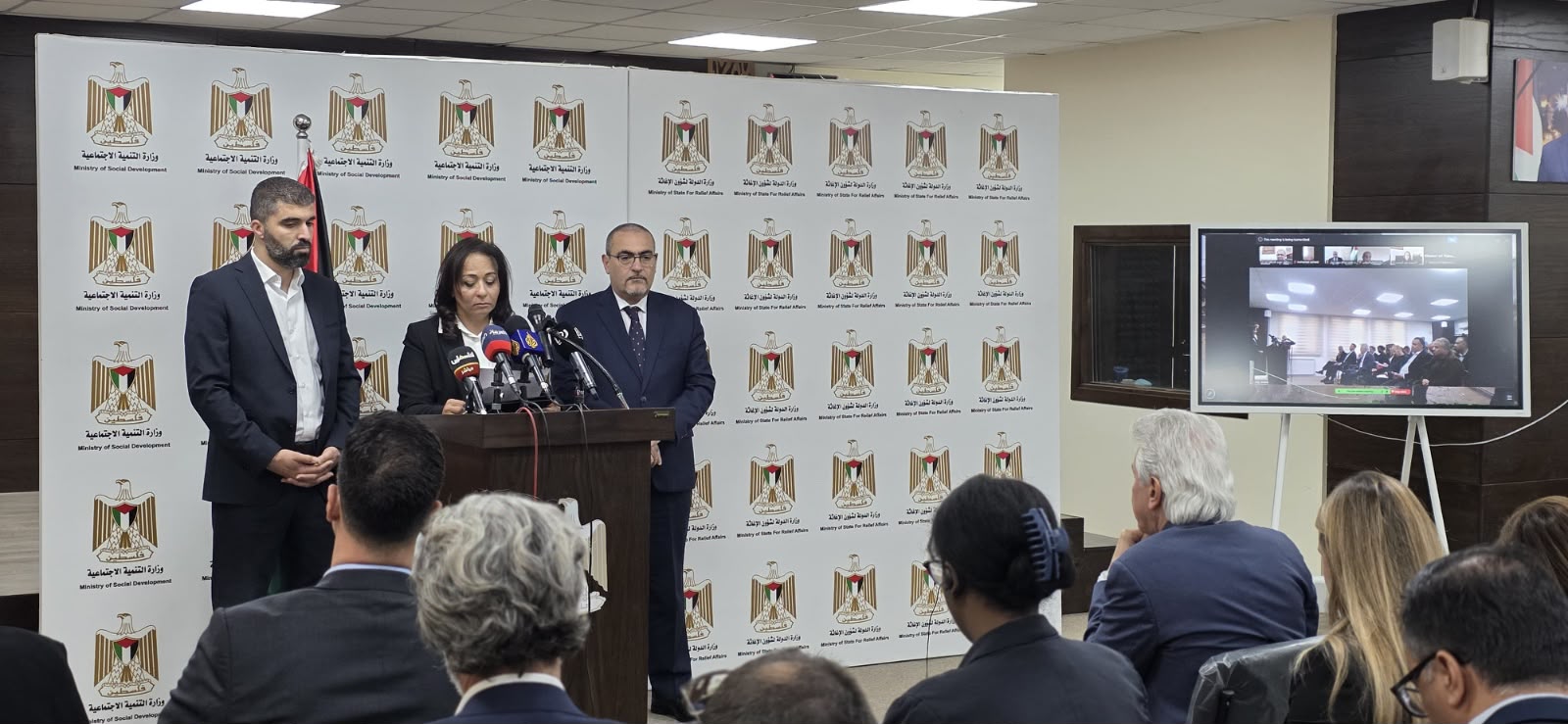
RAMALLAH, November 9, 2026 (WAFA) – Minister of Social Development and Acting Minister of State for Relief Affairs Samah Hamad, alongside UN Humanitarian Coordinator for the Occupied Palestinian Territory and Deputy Special Coordinator for the Middle East Peace Process Ramiz Alakbarov, have warned of grave humanitarian consequences as winter begins in the Gaza Strip, in light of the widespread displacement, rain-damaged tents and shelters, and acute shortages of both shelter materials and relief supplies.
They called for urgent international action to ensure the entry of humanitarian aid and essential equipment needed to protect the lives of Palestinians.
The warning was issued during a joint press conference held in Ramallah on Monday by the Ministry of Social Development and the Government Communication Center to highlight the deteriorating humanitarian situation in Gaza and the urgent needs ahead of winter, following extensive damage caused by a recent low-pressure weather system and heavy rainfall, which triggered a sand cliff collapse in Deir al-Balah, killing five Palestinians, according to the final toll announced by Hamad.
Minister of Social Development: 2.1 million Palestinians need winter protection and assistance
Hamad stated that approximately 2.1 million citizens in the Gaza Strip require protection and assistance during the winter, including more than 1.76 million living in overcrowded displacement sites, while over 65% of families reside in tents and makeshift shelters, leaving them vulnerable to the dangers of cold, rain, and flooding.
She explained that more than 1,600 displacement sites face mounting risks from rainwater accumulation, flooding, and damaged sewage networks, while approximately 80% of the water infrastructure requires repairs. Furthermore, more than 300,000 families lack adequate protection against the cold weather and rain.
She added that winter assistance needs include approximately 200,000 tents and 200,000 tarpaulins, in addition to blankets, winter clothing, mattresses, heating equipment, insulation materials, and supplies for shelter reinforcement and repairs.
Hamad noted that at least 19 people, including children, had died from hypothermia during the previous two winter seasons. She added that displaced families' tents and belongings have also sustained extensive damage following the latest low-pressure system, with approximately 12,000 distress calls and requests for assistance recorded from Palestinians whose shelters were damaged or inundated by floodwater.
She stressed that these risks had been anticipated, as humanitarian assessments and analyses by the UN Office for the Coordination of Humanitarian Affairs (OCHA) and the UN Satellite Centre (UNOSAT) had warned that tens of thousands of tents and shelters were vulnerable to flooding, strong winds, and storms. Specifically, UNOSAT's analysis showed that more than 65,000 shelters and tents were exposed to or affected by flood risks.
Hamad also warned that approximately 4,000 buildings across the Gaza Strip were at risk of collapse, with thousands of families still forced to occupy some of them due to a total lack of safe alternatives.
She pointed out that the shelter crisis is further exacerbated by acute land shortages and a lack of adequate space to establish new displacement centers that meet minimum standards for protection, sanitation, and access to essential services.
She emphasized that the problem extends beyond funding and resource shortages to include the failure to permit available humanitarian supplies to enter in the required quantities and timeframes. She said that approximately 30% of relief and shelter items allocated for the response remain stranded at border crossings, while the volume of materials available for the current winter response stands at only 10% compared to the intervention levels of previous years.
She stressed that the top priority is ensuring the entry of supplies already available, alongside lifting restrictions on shelter and winter supplies, repair materials, and essential equipment. She noted that the government maintains continuous contact with international, UN and regional donors and partners to direct resources toward the shelter, protection, water, sanitation and winter response sectors.
Hamad outlined six urgent demands:
• Allowing the entry of tents, tarpaulins, blankets, mattresses, winter clothing, heating equipment, and insulation or reinforcement materials.
• Allocating safe land for properly equipped displacement shelters.
• Evacuating families from structures at risk of collapse and providing them with immediate alternative accommodation.
• Opening border crossings to ensure the uninterrupted flow of aid, fuel, and equipment.
• Directing international funding according to actual priority sectors.
• Ensuring that relief, protection, and social welfare teams can operate freely while strengthening coordination among them.
Alakbarov: Gaza's vulnerability is a man-made disaster, and time to prepare for winter is running out
For his part, Alakbarov warned of the grave humanitarian consequences stemming from the deteriorating conditions and severe weather in the Gaza Strip. He cited reports of five people killed when a sand cliff collapsed onto their tents, as well as an infant who drowned at a displacement site, adding that approximately 26,000 families had already been affected by the torrential rainfall.
He stated that thousands of families have lost their belongings, shelters, and essential supplies, forcing them to flee once again and spend nights without dry places to sleep, blankets, or warm clothing.
He stressed that the vulnerability of Palestinians in Gaza was not a consequence of weather conditions, but rather the result of the destruction of homes, neighborhoods, infrastructure, water networks, and stormwater drainage systems caused by military operations.
Alakbarov added that floodwater had mixed with sewage and inundated displacement sites and tents where families were seeking shelter. He warned that this winter would be exceptionally harsh, not solely because of climate conditions, but also because the necessary supplies and equipment were not being permitted into Gaza in sufficient quantities.
He called on the Israeli authorities to immediately lift all restrictions on the entry of humanitarian supplies, warning that the window for winter preparations was rapidly closing and that failure to allow these supplies into Gaza during the current week could mean losing the opportunity to prepare for the season.
He explained that the required supplies included water suction trucks, mobile pumps, heavy machinery, engine oil, spare parts, tents, tarpaulins, plastic sheeting, blankets and winter clothing.
Alakbarov also called for halting the advancement of what is known as the "Yellow Line" and reversing its expansion to allow Palestinians to return to elevated areas of the Gaza Strip.
He further called for a full Israeli withdrawal from those areas and an urgent increase in international humanitarian funding amid declining financial support, dwindling stockpiles and mounting needs.
For his part, the Director of the Government Communication Center, Mohammad Abu al-Rub, emphasized the importance of strengthening governmental, local, and international efforts to address the humanitarian situation in the Gaza Strip.
He highlighted the urgent needs arising from the real threats facing our people, which have escalated to unprecedented levels.
These warnings come amid a worsening displacement and shelter crisis in the Gaza Strip, where reports by the UN Office for the Coordination of Humanitarian Affairs (OCHA) indicate that heavy rainfall and strong winds have flooded displacement sites and damaged thousands of tents and shelters.
This crisis is further exacerbated by acute shortages of shelter materials and protection against the cold, coupled with deteriorating water and sewage networks that compound health and humanitarian risks for hundreds of thousands of families.
T.R.


